The National Executive Branch included the amendment of the Glaciers Law in the extraordinary sessions, where environmental, mining, and federalism-related issues will be debated.
By Panorama Minero
Late on Monday, the Government announced that President Javier G. Milei had submitted to the National Congress “a bill to reform the Minimum Environmental Protection Law for Glaciers No. 26,639, with the aim of organizing the current regulatory framework, putting an end to arbitrary interpretations, and consolidating a system of environmental federalism fully compatible with the National Constitution. More than 15 years after its enactment, the so-called Glaciers Law has shown serious interpretative shortcomings that have generated legal uncertainty, paralyzed productive investments, and affected the legitimate exercise of provincial authority over natural resources.”
Expectations now center on how the discussion regarding the concept of the “periglacial environment” will be addressed, a key issue with direct impact on productive development and Argentine mining.
What does the Glaciers Law say?
The text of the law is clear. Its spirit, explicitly stated in Article 1, is to establish “minimum standards for the protection of glaciers and the periglacial environment in order to preserve them as strategic reserves of water resources for human consumption; for agriculture and as water suppliers for the recharge of hydrographic basins; for the protection of biodiversity; as a source of scientific information; and as a tourist attraction.”
With the objective of preserving glaciers, the law created the National Glacier Inventory, assigning this task to the Argentine Institute of Nivology, Glaciology and Environmental Sciences (IANIGLA), an agency under CONICET.
At the center of the debate is the definition of the “periglacial environment.” Specialists argue that the current protection of the “periglacial environment” is “broad and undefined,” allowing mining projects to be blocked even in areas where there would be no genuine water resources.
Federalism and productive development: an ongoing debate
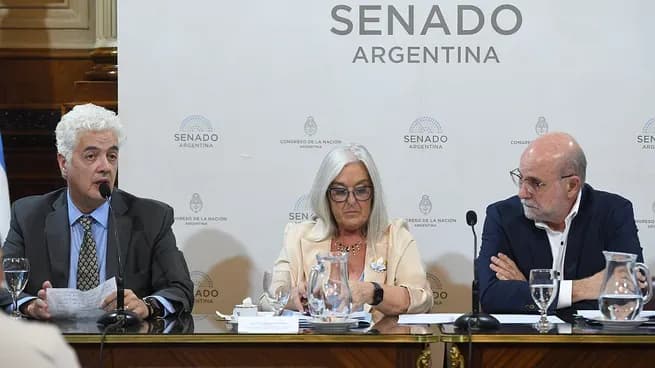
A few days ago, during the opening of the 19th International Edition of the Argentina Gold, Silver and Copper Seminar, organized by PANORAMA MINERO, the Coordinating Secretary of Energy and Mining, Daniel González, and the National Secretary of Mining, Luis Lucero, expressed the Executive Branch’s intention to reformulate the Glaciers Law. Both officials defended the vision of a federal country and the need to return decision-making authority to the provinces.
González described the measure as an act of political courage: “Reformulating the Glaciers Law is something that I don’t know how many statesmen would dare to do; fortunately, our president does. Social acceptance is different, but the likelihood of these investments (under the RIGI framework) is also different. We already have the world’s largest companies saying, ‘this is my project,’ and they will move forward if they have the RIGI.” Lucero, for his part, emphasized the need to reach a consensus that strengthens federalism.
It remains to be seen how the discussion will unfold and progress in Congress, and whether it will be possible to reach an agreement that allows continued promotion of the country’s economic growth, in a context in which technological advances and existing regulations have not only made Argentine mining a dynamic sector, but also one that is increasingly aware and oriented toward sustainable development.