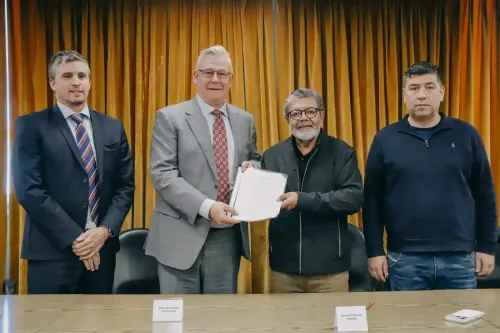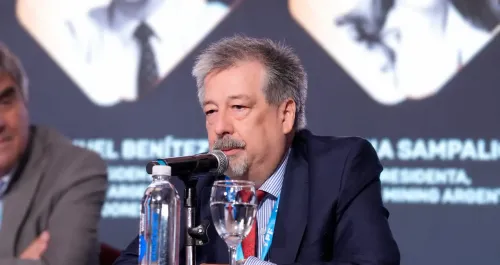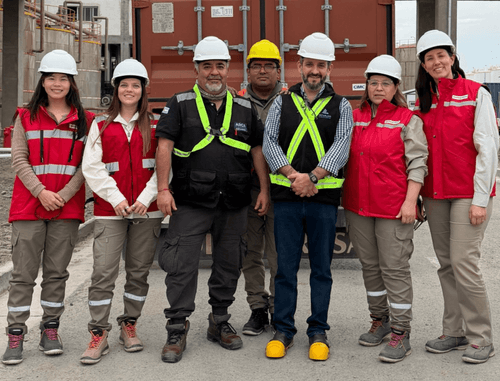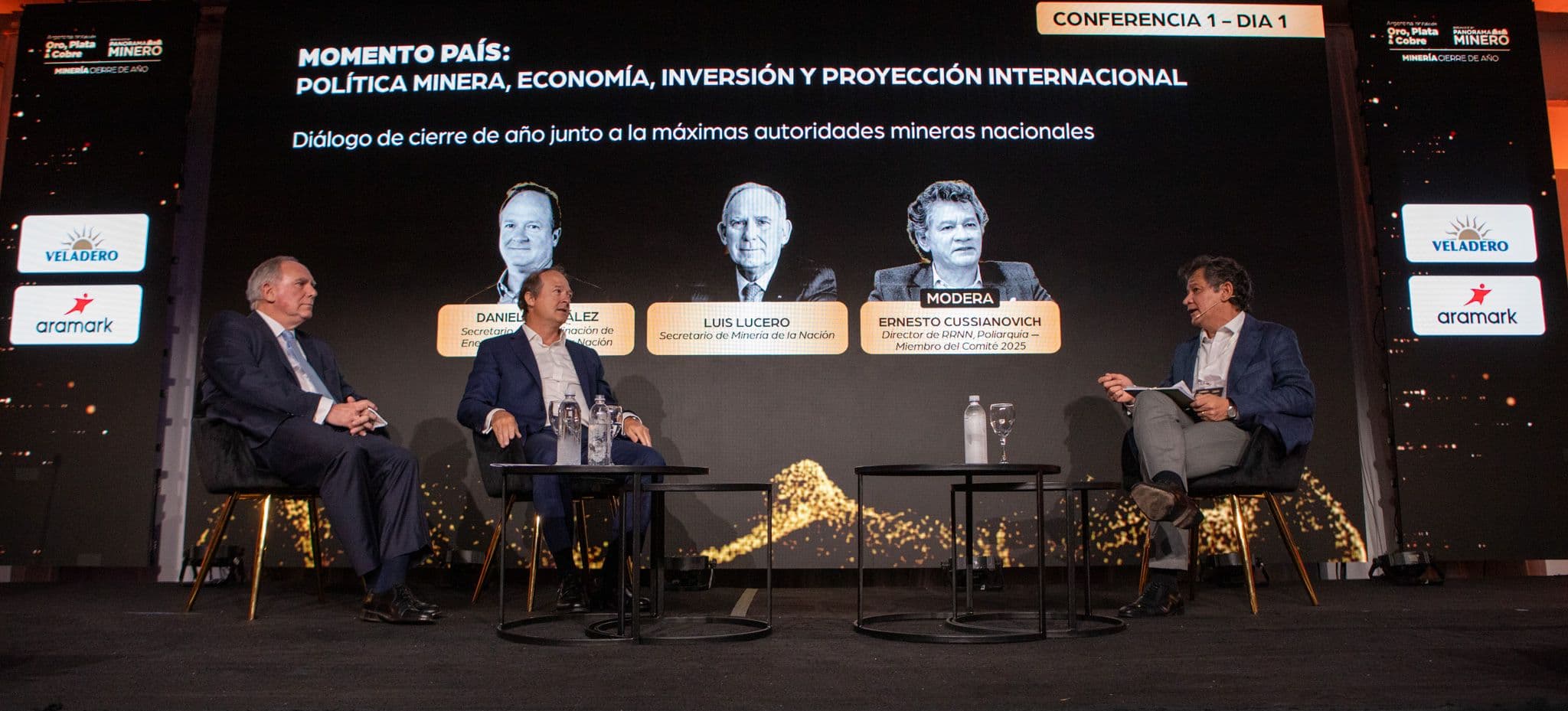
The Secretary for Energy and Mining Coordination, Daniel González, and the National Secretary of Mining, Luis Lucero, announced on Wednesday the decision by Glencore to reopen the Bajo La Alumbrera copper mine in the province of Catamarca. The operation had ceased activities in 2018 after 20 years of production.
This milestone for the sector took place this morning during the opening of the 19th International Edition of the Argentina Gold, Silver and Copper Seminar, organized by PANORAMA MINERO at the Golden Center.
Lucero presented the news before more than 600 attendees at the sector’s year-end event, delivering an announcement with major implications: Glencore will restart operations at the project with the goal of resuming production during the first half of 2028.
The announcement, which marks the return of one of the country’s most emblematic copper and gold deposits after being placed on Care and Maintenance in 2018, was confirmed by the company itself. “The decision is based on a combination of factors: the remaining high-grade ore, the sustained rise in international prices, and a regulatory framework that is considered favorable for investment,” Lucero explained.
Another sensitive and priority issue addressed by both secretaries was the Executive Branch’s intention to reformulate the Glacier Law. Both officials emphasized the vision of a federal country and the need to restore decision-making authority to the provinces.
González described the initiative as an act of political courage:
“The reformulation of the Glacier Law is something very few statesmen would dare to undertake, but fortunately our President does. Social acceptance is different, but so is the likelihood that these investments [under the RIGI] will move forward. We already have the world’s largest companies saying, ‘This is my project,’ and they will carry it out if they have the RIGI.”
Lucero further elaborated on the intended approach to the law, focusing on provincial authority and scientific evidence.
“We are seeking consensus and the best possible solution. The government is convinced that the best solution is a clarifying law. The text has been drafted very thoroughly, over months, and I can only advance that its main direction will be a strategy rooted in federalism.”
He also criticized the centralist approach that shaped the current legislation:
“The law we have today resulted from a view of the country that assumes it must be governed from Buenos Aires, and in the worst possible sense.”
Lucero stressed that the main clarifying aspect of the reform involves decisions on project viability based on scientific studies, addressing the specific characteristics of each region and evaluated by provincial authorities.
“This restores to the provinces the authority granted to them by the Constitution, and obliges us to return that power to them.”
González, meanwhile, underscored that the key factor behind these investment announcements is the improvement of macroeconomic conditions and the Large Investment Incentive Regime (RIGI).
“The most important development in the last two years has been the macroeconomic shift—Argentina has once again become a country worth investing in, with a President who understands that mining has real potential. The first step is passing the RIGI, designed for Mining and Liquefied Natural Gas; other projects joined later, but more than half of them are mining projects.”
The Secretary for Energy and Mining Coordination also highlighted that mining and energy are fundamental pillars for the country’s development.
“This is a path of development that will change the lives of the provinces and all Argentines, alongside other sectors such as energy, agribusiness, and knowledge industries. But mining holds a highly relevant and strategic position.”
Similarly, Lucero emphasized that this revival, together with progress in other projects, demonstrates the strength of a sector that is attracting massive capital, a situation that, as he noted, would have been unthinkable just a few months ago.
“We are beginning to grow accustomed to figures in the billions. We have US$50 billion in committed investment, of which US$31 billion is in mining. If we take a moment to fully grasp that number, just months ago it would have sounded fantastical.”
This scenario is partly explained by the global geopolitical context and the energy transition—which is driving demand for copper and lithium—combined with the macroeconomic policy changes implemented by the current government.
“All of this results in a fundamentally different outlook. The change in mining’s public perception is historic.”
González stressed that the State’s primary role is to create credible conditions so that the private sector can drive growth.
“As long as the State focuses on creating conditions and remains credible, the private sector reacts quickly.”
He noted that mining demonstrates this clearly through the accelerated movement of both large and smaller companies:
“That is the State’s essential role in a country where the private sector is waiting for the State to step aside.”
A central point of his remarks was the role of the State in developing infrastructure. His position was explicit: non-intervention.
“Whenever there is a resource to be developed, such as copper or lithium, and a demand for supplies, the private sector will provide the infrastructure. I do not see the need for the State to insert itself because it will be slower, more expensive, and historically linked to corruption.”
He emphasized that it will be the private sector that drives the necessary infrastructure:
“It is the private sector that will come knocking at our door for the infrastructure required by the mining sector, but we have a great deal of work ahead to create the right conditions.”