The Calcatreu gold project, operated by Patagonia Gold near Ingeniero Jacobacci, province of Río Negro, entered a decisive stage of its development by projecting the start of the first ore irrigation within an estimated period of between 30 and 40 days, a technical milestone that marks the transition from construction to operational start-up and positions the venture as one of the most advanced Argentine metal mining projects toward production.
By Panorama Minero
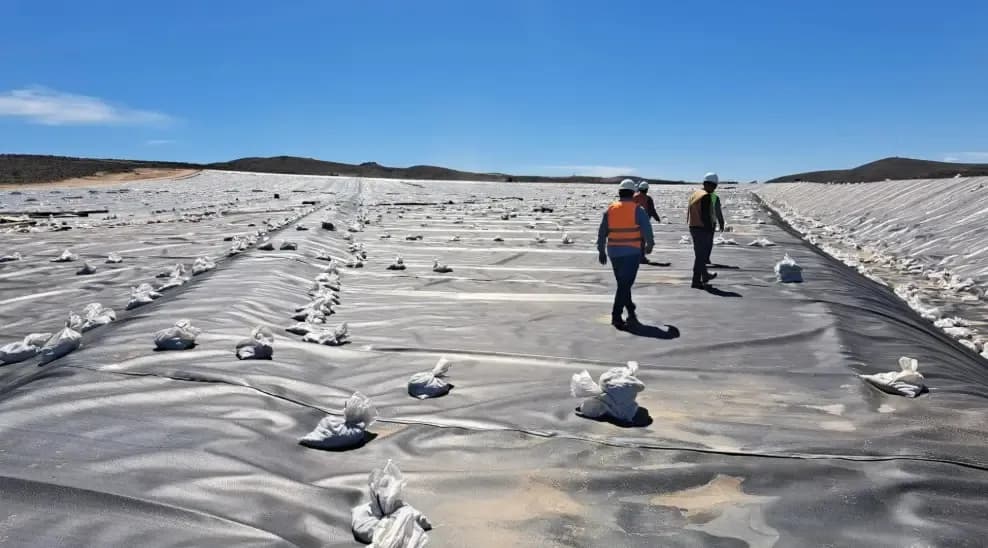
According to statements released in regional media, the project currently shows progress of close to 50%, with sections of the leach pad (PAD) already completed, stockpiled material available in the mine area, and work focused on plant adjustments and infrastructure details. The company’s Head of Community Relations, Ricardo Williams, indicated that the team is working with the objective of initiating the first irrigation in the short term, a stage that represents the first contact of the ore with the leaching solution and constitutes one of the most relevant technical milestones within the start-up of operations for this type of project.
The start of irrigation not only implies operational progress but also a change of stage within the mining cycle. Following approval of the Environmental Impact Study and the provincial authorization obtained in November 2024, the company advanced with access roads and infrastructure assembly, then fully entering the intensive construction phase that is now in its final stretch.
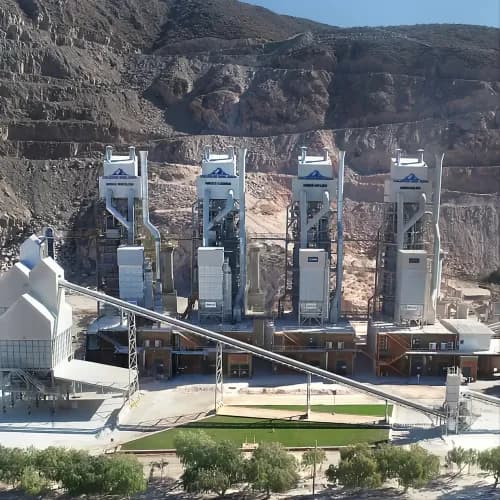
From a technical standpoint, the first irrigation usually marks the inflection point between civil works and operational testing, enabling the gradual start of metallurgical recovery. At Calcatreu, the heap leaching–based design requires prior completion of the PAD construction, ore preparation, and commissioning of the process plant, stages that, according to the company, already show visible progress.
Local Workforce and Construction Logistics on the Eve of Start-Up
The transition process toward initial irrigation occurs in parallel with an intensive phase of employment and economic activity in the region. The project has more than 170 people linked to construction, of which 158 belong to Ingeniero Jacobacci, which represents close to 72% local workforce, according to data released by the company.
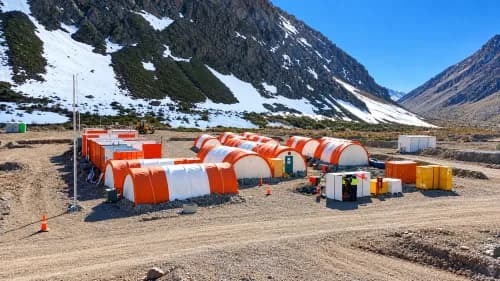
The operation combines personnel housed in camp — between 70 and 80 workers who stay overnight on site — with daily commuting schemes from the town, while progress is made in expanding facilities to accompany the transition toward the productive phase. This operational movement is already beginning to be reflected in the surrounding economy, with greater demand for local services and supplies, in a scenario where the project seeks to consolidate a territorial impact narrative based on employment and direct economic activity.
A Milestone with Regional Significance
Beyond the specific technical progress, the projected start of the first irrigation at Calcatreu acquires relevance within the Patagonian metallic mining map. In a context where several projects remain in early stages or under regulatory debate, the possibility of initiating metallurgical processes positions the Río Negro venture as a benchmark case of how the transition from construction to production materializes.
The company avoided setting rigid dates for the formal start-up, although it emphasized that the immediate horizon depends on operational and climatic factors typical of the region. Even so, the first irrigation serves as a concrete sign of progress within an international market that is experiencing a favorable moment for precious metals, reinforcing interest in smaller-scale projects that manage to advance toward production in the short term.
Technical Data of the Project and Investment Scheme
In technical terms, Calcatreu is developed on a low-sulfidation epithermal system with gold and silver mineralization outcropping at surface, which allows for an open-pit mining scheme with processing through heap leaching to produce doré. The project concentrates measured and indicated mineral resources of approximately 746,000 gold-equivalent ounces, to which nearly 390,000 ounces are added in the inferred category, with average grades close to 2.11 grams per tonne of gold in the main sectors of the deposit.
In parallel, Patagonia Gold advanced with financing agreements of up to US$40 million destined for development and construction, within a total estimated investment scheme of around US$250 million that positions Calcatreu as one of the most relevant gold projects under development in Argentine Patagonia.
With the first ore irrigation increasingly close, Calcatreu enters a stage that redefines its technical schedule and brings it closer to the start of production, consolidating a milestone within the national metallic mining scenario and providing a concrete signal of progress in a context where few projects manage to complete the transition from construction to effective operation.