Within the framework of Argentina Oro, Plata y Cobre 2025, Epiroc presented its roadmap to accelerate the transition toward intelligent mining in the Southern Cone. With a focus on automation, digitalization, electrification, and agnostic solutions, the company outlined how technological integration and people-centered support can transform productivity and competitiveness in copper and lithium operations across the region.
By Panorama Minero
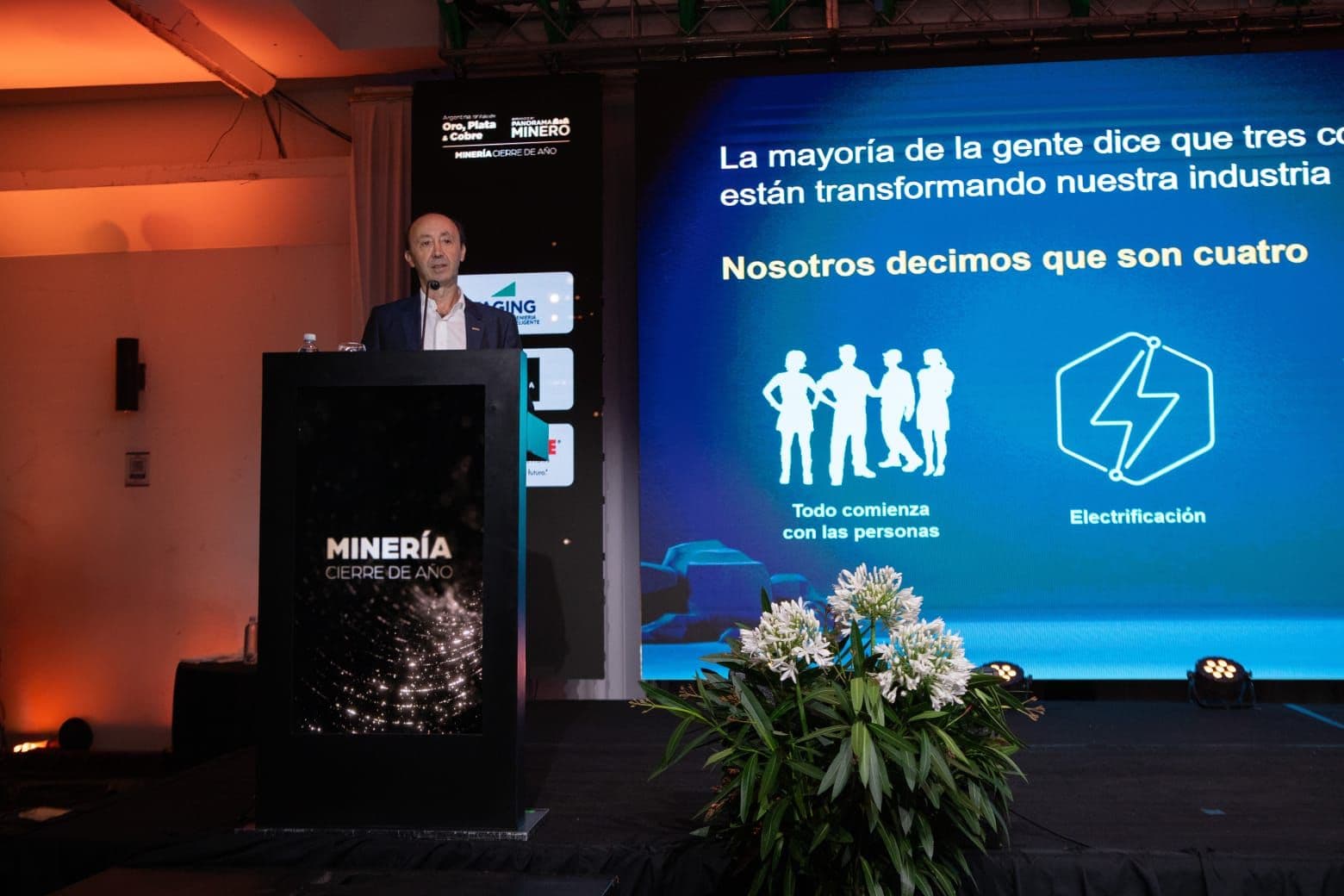
In the panel “Accelerating the Transformation Toward Smart Mining”, Patricio Lagarini Meyer, Interim General Manager of Epiroc Southern Cone, introduced the company’s strategy to support mining operations in Argentina and Chile through a modernization journey anchored in automation, digitalization, electrification and a central pillar: people.
Lagarini emphasized that technological transition cannot be addressed solely through equipment deployment. “It’s not just about implementing systems; it’s about supporting people so that this technology becomes part of everyday work,” he stated, noting that global data shows major operations that invest in automation use only about 35% of its potential during the first year.
He explained that Epiroc’s current pillars — innovation, commitment and collaboration — shape a vision where “simplicity for the customer is the starting point.” The company abandoned the traditional product-centered approach and adopted a model where solutions are designed “from the customer toward the product”, based on actual operational needs.
With a presence in 152 countries, more than 20,000 employees, and a reorganized structure integrating services, equipment and digital solutions, Epiroc promotes a more agile support platform capable of delivering comprehensive responses regardless of business area. “Today, from a single point of contact we can offer the entire portfolio to the customer,” he noted.
While electrification, automation and digitalization are the most visible drivers of mining transformation, Lagarini stressed that the human dimension is decisive. “Support is key in this journey,” he said. For this reason, the company invests in training, technical support, and a collaborative model between internal teams and mining operations.
Aligned with its 2030 global goals, Epiroc committed to:
- Reaching 90% renewable energy in its operations.
- Offering a 100% electric fleet by the same year.
- Reducing logistics emissions through new operational routines.
- Promoting diversity, equity and innovation through its technical labs.
Epiroc Southern Cone operates in Chile with centers in Santiago, Copiapó, Rancagua and Antofagasta, and in Argentina with a base in San Juan and an office in Buenos Aires. The regional organization has 700 employees, four service workshops and a network of 15 partners to cover remote areas.
In automation, the region has become a global benchmark:
37 autonomous units and 7 tele-remote systems are already operating in the Southern Cone, and projections for 2025 estimate reaching 56 autonomous units.
“One of the largest autonomous fleets in the world is right here, in our region,” highlighted Lagarini.
Agnostic solutions: interoperability as a competitive advantage
One of the strongest points of the presentation was the defense of a truly agnostic technological approach. For Epiroc, the future of productivity lies in platforms capable of communicating with any fleet, model or brand.
“The system must be able to integrate existing and new equipment, regardless of the brand,” he stated.
The company already operates real-world cases in Australia, where it controls more than 100 trucks from different brands (Caterpillar and Hitachi) through a single modular platform. According to Lagarini, that model is on its way to being deployed in Brazil, Chile and Peru.
Among the solutions available to accelerate transformation, the company highlighted:
- Remote operation over 200 km from the site
- Collision avoidance systems for surface and underground
- Advanced monitoring for asset protection
- Cloud-based integrated fleet management
- Data-quality assessment to improve performance
Lagarini shared real cases where digitalization and automation enabled:
- A 10% increase in productivity
- Reduced cost per ton
- Lower operational incidents
- Improved sustainability through reduced energy use
- ROI above 15% in some projects
“Smart mining isn’t the future — it’s already happening,” emphasized the executive.
“The key is to move step by step, integrating solutions sequentially and adapting them to each site.”
For Epiroc, the transformation toward more competitive, safe and sustainable mining requires a deep partnership with operations. “Our commitment is to adapt to each customer’s needs and build a collaboration model that works for both sides,” Lagarini said in closing.
He assured that the company will continue “strategically supporting productivity and operations” in a context where the growth of copper and lithium in the Southern Cone presents unprecedented challenges — but also opportunities to lead the new era of intelligent mining.