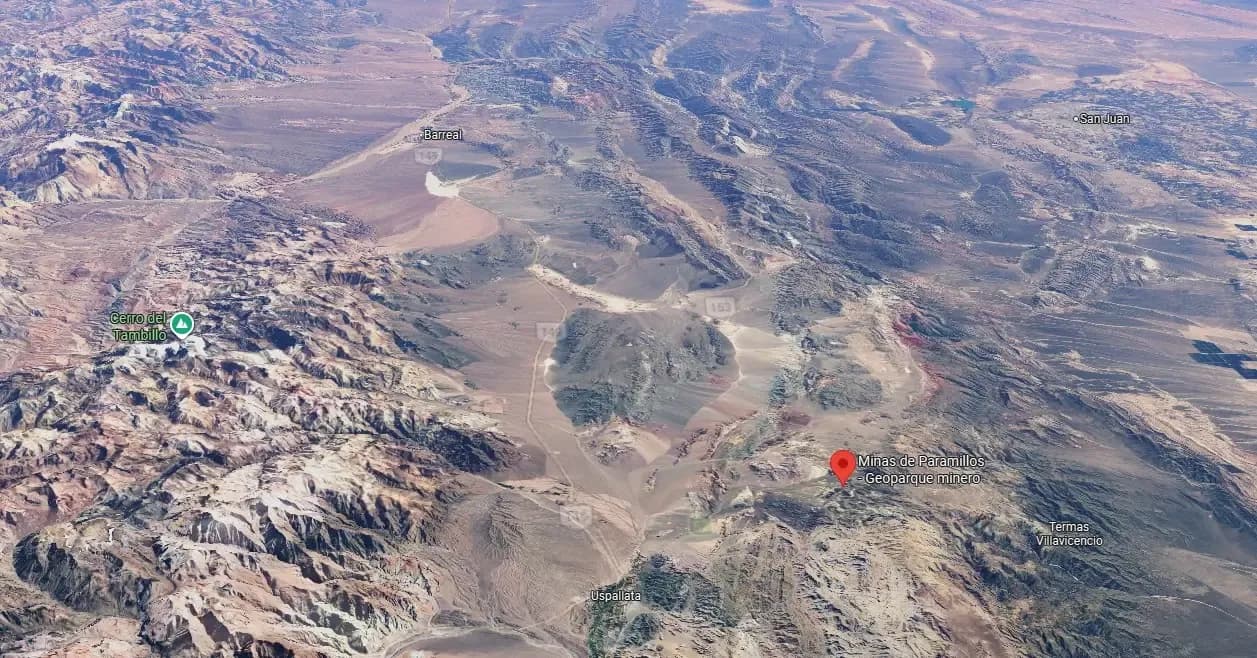
While the administrative focus of mining development in Mendoza continues to be concentrated in Malargüe, the province of Mendoza, through Impulsa Mendoza, has launched the contracting process for the geological baseline study of the Northern Mining District in the Las Heras department, in an area adjacent to the PSJ project. The initiative represents the first formal step toward expanding mining planning beyond the southern part of the province under a district-based framework.
By Panorama Minero
The process will begin with technical studies aimed at determining the geological potential and structural continuity of the area.
The sequence mirrors the model applied in Malargüe Western Mining District: regional geological characterization, development of an environmental baseline, and, based on those results, the potential definition of exploration blocks and projects. In the southern district, this approach helped structure development phases, approve blocks and move forward with 67 approved projects, while 71 are currently under environmental evaluation.
The location of the new district also introduces a relevant geological element. The area extends across the belt surrounding the PSJ project, one of the most studied copper systems in northern Mendoza and a project that holds a valid Environmental Impact Statement for exploitation. Its proximity raises questions about the potential continuity of porphyry-type systems and the extension of the Andean mineralized belt in the area.
The initiative forms part of a broader strategy presented by the province at PDAC 2026, where it also introduced financial instruments designed to channel capital toward projects with lower levels of risk, including the Closed-End Public Offering Fund currently under review by Argentina’s National Securities Commission (CNV). Within that framework, the Northern Mining District emerges as the next territorial step in the province’s mining planning.
The Paramillos factor and the dispute with Danone
In northern Mendoza, mining planning is influenced not only by geological factors. A pending legal dimension also conditions any district-scale framework: the conflict surrounding Paramillos and the position of Danone in Las Heras.
Paramillos Sur received its Environmental Impact Statement in 2000. However, the project has remained stalled for more than two decades due to litigation linked to the refusal of the surface landowner — Aguas Danone de Argentina S.A., associated with the Villavicencio brand — to grant mining easements, along with an extensive legal strategy.
In 2001, Danone acquired 23 mining rights in the Las Heras area through assignment, including exploration permits, mines and vacant claims both within Estancia Canota and Paramillos Norte. Mendoza’s Mining Directorate certified the presence of copper and gold within those concessions. Since then, the company has faced administrative notices for failing to submit investment declarations and allegations of abandonment, while maintaining administrative and judicial appeals that keep the cases open.
The dispute deepened when Minera del Oeste, holder of Paramillos Sur I, II and III and Paramillos Norte I and II, attempted to move forward with exploration work through contracts with companies linked at the time to the emerging Lundin group. Court injunctions and the application of the precautionary principle halted those activities.
Territorial planning and institutional factors
Structuring a mining district in Las Heras requires organizing claims, easements, pre-existing rights and ongoing legal disputes. The experience in Malargüe showed that prior territorial planning can reduce overlapping concessions and future litigation. In northern Mendoza, the legal dimension already exists and influences the district’s design.
The Northern Mining District has now begun its geological baseline stage. Its future viability will depend not only on the mineral potential of the area but also on the institutional resolution of disputes that have remained open for more than twenty years, reflecting tensions between mining rights, surface land ownership and corporate strategies.
With the launch of geological studies in Las Heras, Mendoza expands the territorial scope of its mining planning toward the northern part of the province. The expansion of the district framework has begun, while the legal outcome surrounding Paramillos will be a determining factor for its consolidation.