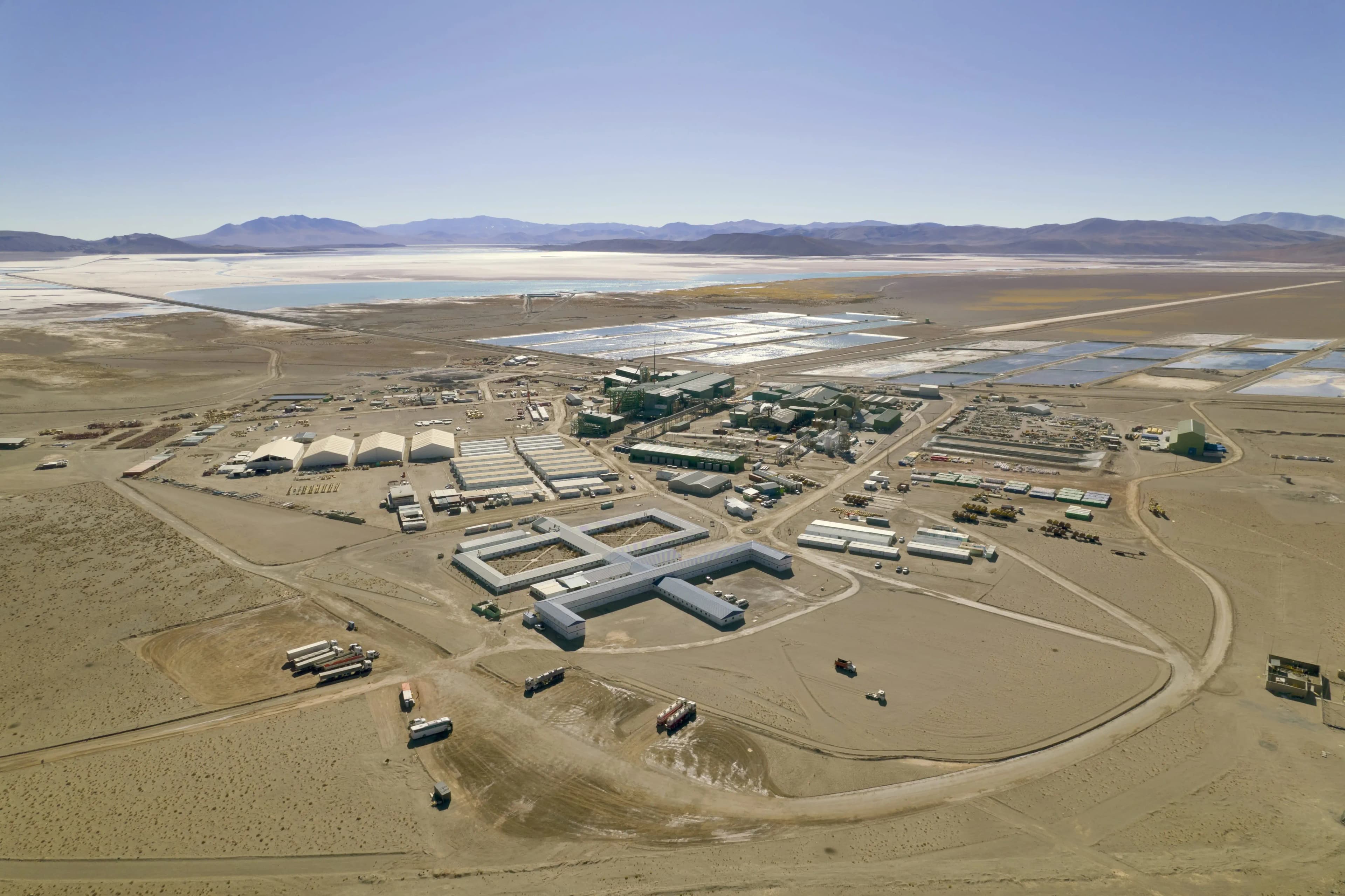
Argentina’s lithium market is experiencing a phase of production and export expansion, within an international environment characterized by price volatility and shifting demand expectations. The trend is outlined in the February monthly report published by Aleph, the consulting firm led by economist Daniel Dreizzen, which compiles indicators on production, exports and global pricing dynamics with a focus on lithium carbonate.
By Panorama Minero
Production: expansion driven by new projects
The report indicates that lithium carbonate production increased significantly during the past year, reaching historical volume levels toward the end of the period.
In November, output totaled 11,244 tons, representing a 66% year-on-year increase. In December, production rose to 12,393 tons, with a 44% year-on-year increase and an 80% rise in the rolling annual variation.
The increase reflects the start-up and expansion of key projects, including Cauchari-Olaroz, expansions at Fénix and Olaroz, and the initial production phases of new operations such as Sal de Oro, Mariana, Centenario-Ratones and Tres Quebradas (3Q).
According to the report, several of these operations remain in ramp-up stages, meaning their nominal capacity is not yet fully reflected in production data.
At present, seven projects account for Argentina’s entire lithium carbonate output, reflecting the country’s transition toward larger-scale industrial activity in the lithium value chain.
Exports: record levels and rising share
From a commercial perspective, lithium continues to gain weight within Argentina’s mining export basket.
In December, exports reached approximately US$104 million, representing close to 40% year-on-year growth, driven by a 38% increase in export volumes and improvements in international prices.
On an annual basis, lithium exports totaled US$905 million, representing 40.3% year-on-year growth and the highest annual figure on record.
During the period, lithium accounted for around 15% of total mining exports, making it the second most exported mineral product in the sector.
Prices: from recent peak to stabilization phase
Price dynamics show a more complex pattern.
The report indicates that spot lithium carbonate averaged US$11,817 per ton LCE in December, with a 15.3% monthly increase and a 12.5% year-on-year rise.
However, annual measurements still show a negative cumulative variation, reflecting the correction that followed the previous price cycle.
In the futures market, contracts traded around 160,000 yuan per ton, equivalent to approximately US$23,000, after surpassing 180,000 yuan (around US$25,900), a two-year high reached at the end of January.
This trajectory suggests a transition toward a more balanced price range, with expectations pointing to stabilization near US$20,000 per ton in the medium term.
The price rebound observed toward the end of the year was associated with global supply disruptions, inventory reductions and demand linked to electric vehicle batteries and energy storage systems.
Global context: structural demand and cyclical volatility
Globally, lithium consumption remains strongly concentrated in the battery segment, which accounts for approximately 87% of end uses.
The expansion of the electric vehicle fleet, energy storage and broader electrification trends continue to drive demand.
In 2024, global production reached approximately 240,000 tons, representing an 18% increase from the previous year, while consumption was estimated at 220,000 tons, with 29% growth.
The expansion of production capacity in countries such as Argentina, Chile and China has coincided with periods of short-term oversupply, helping explain part of the recent price volatility.
Global reserves exceed 30 million tons of lithium, with total resources estimated at around 115 million tons, indicating a strong geological base for the industry’s long-term expansion.
A market entering a normalization phase
The report indicates that Argentina’s lithium sector remains one of the most dynamic segments of the country’s mining industry, with simultaneous growth in production and exports.
Future market evolution will depend largely on the pace of new project start-ups, the trajectory of global battery demand, and the capacity of the market to absorb new supply without generating downward pressure on prices.
Within this context, lithium carbonate prices stabilizing after the recent peak suggests a phase of greater balance between supply and demand in a market that continues to expand its global production scale.