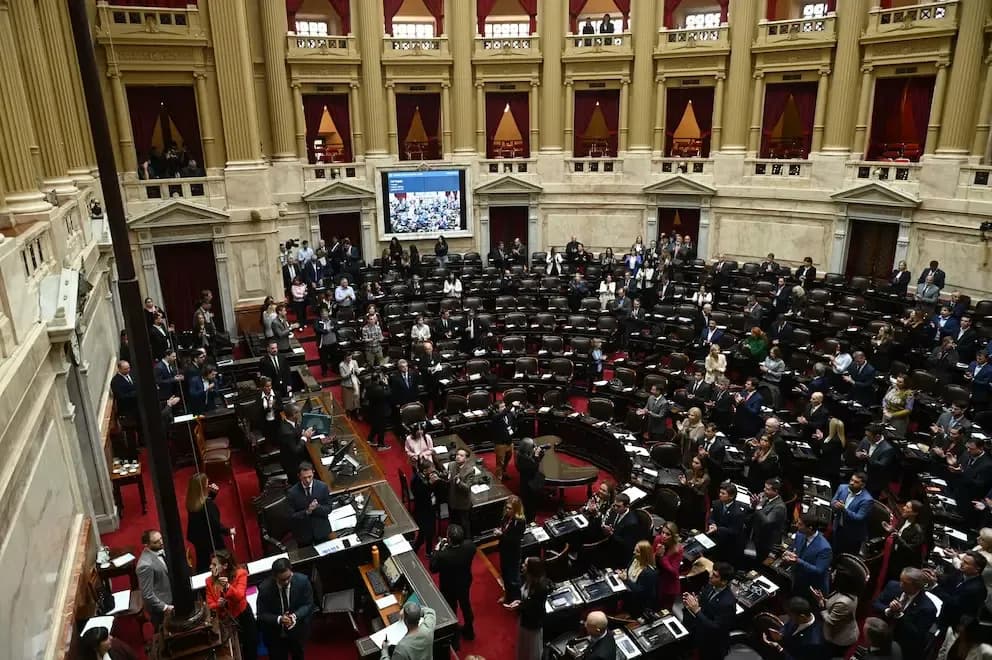
The recent approval of amendments to Argentina’s Glacier Law by 137 votes in the Chamber of Deputies has not only reshaped the country’s environmental and productive regulatory framework, but also opened a significant legal dispute. With diverging positions among environmental organizations, the government, provinces and the mining sector, the conflict is expected to escalate to the Supreme Court of Justice, where the constitutionality of the reform will ultimately be determined.
By Panorama Minero
In the short term, injunctions from NGOs and environmental foundations are expected, alongside legal action already initiated by the province of La Pampa, aimed at suspending the implementation of the reform. At the same time, the federal government and allied provinces are assessing their legal strategy to defend the law.
At the core of the dispute lies the balance between productive development and environmental protection, with water as a strategic resource at the center of the debate.
The legal front: injunctions and government strategy
Organizations opposing the reform have announced plans to file injunctions across federal courts nationwide in an effort to halt its enforcement. The strategy includes a nationwide collective injunction, which, according to proponents, has already gathered hundreds of thousands of endorsements.
In parallel, the government is evaluating procedural mechanisms to bring the case before the Supreme Court. Among the options under consideration is the per saltum appeal, although its use would depend on meeting the threshold of institutional gravity required for such an exceptional measure.
Arguments against the reform: constitutionality and water protection
Criticism of the reform is primarily based on two legal principles: environmental non-regression and the precautionary principle.
Organizations such as Greenpeace and FARN argue that the amendment could reduce environmental protection standards, potentially conflicting with Article 41 of the National Constitution and the Escazú Agreement. In this context, they have warned about possible impacts on water sources.
Another key concern relates to the reinterpretation of the precautionary principle. Critics argue that the new framework introduces criteria requiring technical verification of the hydrological function of certain landforms.
There are also concerns regarding the role of provinces in the enforcement of the law. According to Andrés Nápoli of FARN, this could lead to a form of “environmental dumping,” with varying standards across jurisdictions.
Additional criticism has been directed at the public participation process, as more than 105,000 individuals registered for the public hearing, yet less than 0.2% were able to present.
La Pampa: downstream concerns
The government of La Pampa has filed a collective injunction before federal courts seeking to suspend the application of the law until its constitutionality is resolved. The case was filed in the federal court of Santa Rosa, alongside the National University of La Pampa and local organizations.
Governor Sergio Ziliotto noted that, although the province does not have glaciers, it depends on glacier-fed river basins, raising concerns about potential impacts on water availability.
In this regard, State Attorney Romina Schmidt warned about possible effects on the flow of the Colorado River, while constitutional lawyer Andrés Gil Domínguez argued that the law could affect water-related rights.
The claim is framed within long-standing interprovincial water disputes, particularly involving the Atuel River.
Government position: federalism and development
From the government’s perspective, the legal defense of the reform is based on the compatibility between the right to a healthy environment (Article 41) and the provincial ownership of natural resources (Article 124).
Secretary of Mining Luis Lucero stated that “this reform is not unconstitutional as has been misleadingly claimed, because it respects Articles 41 and 124 of the National Constitution.”
The government argues that the reform does not eliminate glacier protection, but rather introduces more precise technical criteria and strengthens the role of provinces in its implementation.
It also highlights the potential impact in terms of investment and employment, particularly in projects currently on hold.
Expert perspectives: timing and precautionary measures
Lawyer Diego Calonje, senior mining counsel at Martínez de Hoz & Rueda, pointed to a key factor that may delay judicial action, stating that “judicialization should not occur immediately, as the requirement of an actual case or controversy—necessary for judicial intervention under Argentina’s constitutional system—is not yet present.”
Calonje referenced the Supreme Court’s 2019 “Barrick” precedent, noting that “the Court rejected the claim due to lack of standing, indicating that the mere enactment of the law did not constitute a concrete harm sufficient to challenge its constitutionality.”
He added that “it would be necessary to wait until, under the new law, a province approves an environmental impact assessment. Only then could a legitimate party challenge that decision in court.”
He also emphasized that jurisdiction would likely be provincial, stating that “any challenge should be addressed within provincial courts, as project approvals fall under local authorities.”
Geologist and lawyer Favio Casarín agreed that legal action is likely, but focused on precautionary measures, stating that “requests to suspend the law are expected, but such measures should not prevail, as this is an extraordinary situation that does not appear to be present.”
He further explained that “the legal requirements for an injunction—likelihood of success and risk of irreparable harm—are not clearly met, given that no projects have yet been approved in glacier-related areas.”
He added that “from a strictly legal standpoint, such measures should not succeed, although political factors could influence the outcome.”
Support from the mining and business sector
From the business side, support for the reform was immediate. The Argentine Chamber of Mining Companies (CAEM) described it as “a decision of major institutional, productive and environmental relevance.”
According to the chamber, the reform introduces predictability and clear rules, both key conditions for investment. In this context, it stated that “responsible mining requires clear rules and effective oversight.”
Similarly, the San Juan Mining Chamber highlighted the reduction of regulatory ambiguities and the strengthening of federalism, noting that “consolidating clear rules is essential to promote responsible development that combines environmental protection with the creation of opportunities.”
Meanwhile, CAPMIN emphasized that the new framework helps reduce longstanding regulatory uncertainties and aligns development with environmental standards. Its president, Manuel Benítez, stated that “in mining, one of the first things learned is how to take care of water.”
An open debate: development and environmental protection
Beyond technical and legal arguments, the broader debate remains centered on how to reconcile economic development with the protection of strategic resources.
While environmental organizations warn about potential risks to water resources, the government and productive sectors argue that the reform represents an update aimed at improving implementation without weakening glacier protection.
The judicial process ahead will determine how the law is applied in practice, although its resolution may take time. In the meantime, the reform marks a new phase in one of Argentina’s most sensitive structural debates: the management of its natural resources.