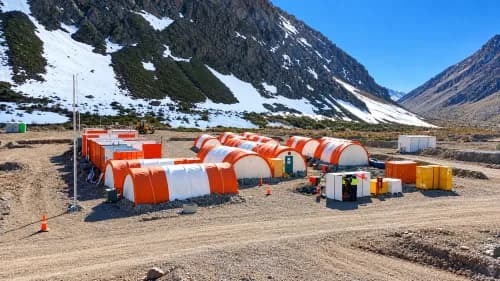
The growth of energy and mining activity in Río Negro is beginning to be reflected more clearly in the provincial labor market, with projects advancing simultaneously and showing a growing impact on the demand for direct and indirect labor. Within this scenario, mining appears as one of the initial drivers of the process, particularly following the development of the Calcatreu gold project, operated by Patagonia Gold, which currently accounts for 185 direct jobs and projects the incorporation of around 700 workers in its first operational stage.
By Panorama Minero
The data arise from official information released by the Secretariat of Labor of Río Negro in its latest survey on employment linked to productive projects. The progress of the mining project not only implies the generation of direct on-site employment, but also a multiplier effect on local suppliers and associated services, with estimates of indirect positions close to double the current jobs.
This phenomenon is part of a broader trend that combines exploration, infrastructure, and coordination with provincial policies aimed at prioritizing local hiring, in a context where mining is beginning to consolidate itself as a relevant component within Río Negro’s productive framework.
Energy and infrastructure expand labor demand
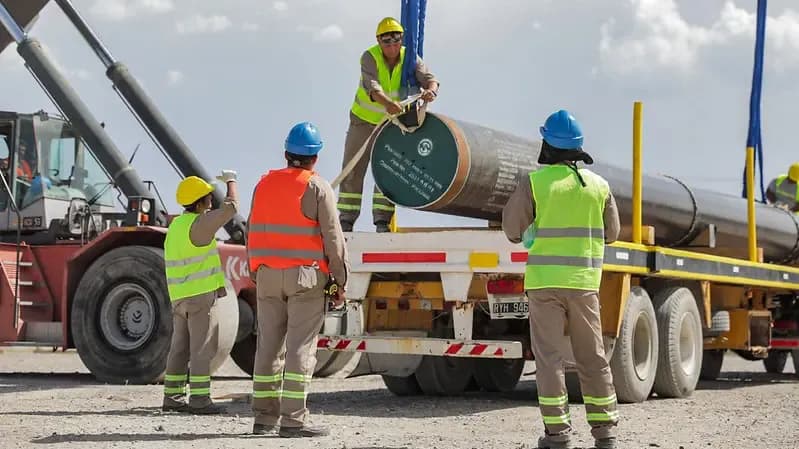
At the same time, the energy sector is deepening its prominence through works linked to hydrocarbon development and the expansion of transport infrastructure. The Duplicar Norte project — a pipeline of approximately 200 kilometers that will expand evacuation capacity from Vaca Muerta to Allen — is expected to generate around 300 jobs in its first stage, consolidating the synergy between energy and industrial employment in the province.
At a general level, initiatives currently underway already register 2,980 direct jobs and 4,200 indirect ones, figures that reflect the combined impact of mining, hydrocarbons, and specialized construction within the provincial territory.
Labor regulation and local hiring
From a regulatory standpoint, the application of Law 80/20 — which requires the hiring of labor from Río Negro — appears as one of the axes explaining the orientation of employment growth toward local profiles, with selection processes coordinated between the provincial Employment Office and the UOCRA union. This framework seeks to consolidate technical capacities within the territory while the arrival of investments linked to larger-scale projects accelerates.
An energy hub with long-term impact
The scenario is also framed within a provincial strategy aimed at positioning Río Negro as an energy hub of national and international scope. Initiatives such as Vaca Muerta Oil Sur (VMOS), Argentina LNG, and SESA contemplate investments exceeding US$36 billion, with projections that go beyond the short term and anticipate new demands for specialized employment in mining, energy, and infrastructure.
In this context, mining development emerges as one of the first indicators of the productive transformation underway, while the energy component amplifies the scale of the labor impact and consolidates a dynamic that is beginning to redefine the industrial and economic profile of Río Negro.