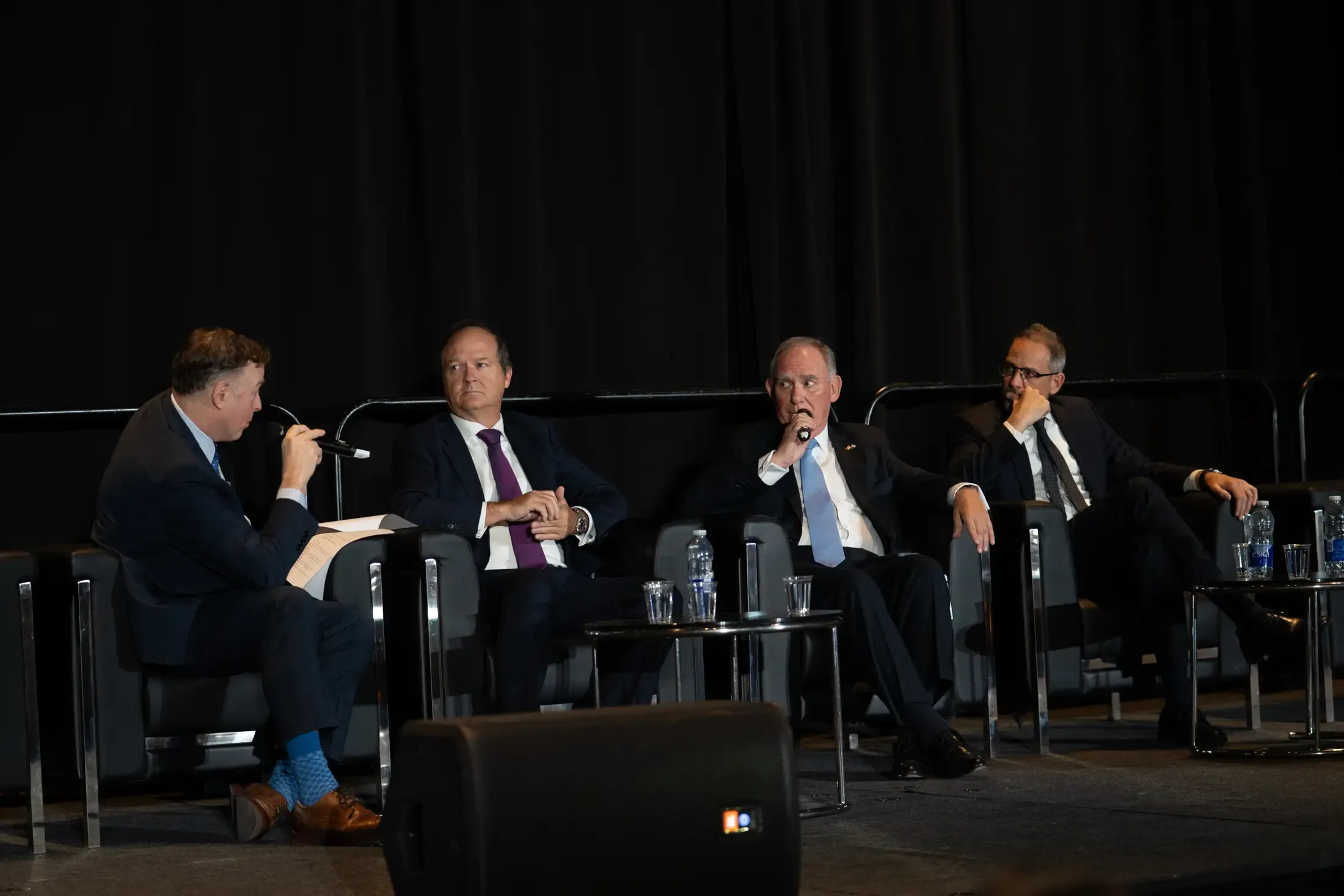
On March 2, Argentina Day included a panel made up of officials who analyzed the role Argentina can adopt in light of the growing demand for minerals for the energy transition.
By Panorama Minero
Moderated by Colin McClelland, General Director of The Northern Miner, Daniel González (Coordinating Secretary of Energy and Mining of Argentina), Luis Lucero (Secretary of Mining of Argentina), and Diego Sucalesca (President of the Argentine Agency for Investment and International Trade) presented the great opportunity that Argentina’s mining represents to the investment community gathered in the city of Toronto.
First, Daniel González reported on the macroeconomic measures carried out by the government of President Javier Milei, highlighting the support that the ruling party had in the midterm elections: “The president is fighting what are called cultural battles. An example of this is what happened last week in Congress with the Glacier Law,” referring to the approval of this bill in the Senate of the Nation, while also highlighting the RIGI, an instrument that offers stability and legal and fiscal guarantees to large investments, reducing the Corporate Income Tax rate from 35% to 25%, while eliminating export duties, which represents the great opportunity for mining exports, and also energy exports, for the next five years.
Subsequently, Luis Lucero, Secretary of Mining of the Nation, expanded on the RIGI, indicating that it has consisted of the evolution of a scheme that remains in place and, in effect, the development framework for mining investments in the 1990s, which allowed the materialization of projects such as Bajo la Alumbrera, Cerro Vanguardia, San José, Veladero, among others. “After this first wave, learning from that lesson, the RIGI was brought forward in a way that, I could say, would perfect the laws of the ’90s.”
From the Argentine Agency for Investment and International Trade, its head Diego Sucalesca praised PDAC, informing about the functions of the agency he leads, while highlighting the moment when it moved under the orbit of the Presidency of the Nation, placing this agency in a strategic position in terms of promoting the investments’ attraction in international trade. “This decision was not only an organizational chart change, but a political decision to put promotion at the center of management. Basically, what we do is actively promote Argentina’s international business around the world. We not only have the institutional pavilion here at PDAC, but also companies accompanying the internationalization of their services.”
In the field of the Glacier Law, Luis Lucero highlighted the care that the mining industry takes regarding water protection, referring to a 2018 report indicating the presence of 16,000 glaciers. “The issue is that those 16,000 glaciers that have been identified, certainly through satellite images, were supposed to be sources, strategic reserves of water, without any evidence on the ground from the study of those glaciers or other forms of precipitation. What we intend to do now is to allow science, through an environmental impact report, assessed by the authorities, to truly demonstrate what the actual contribution is to the aquifers of the region and to the population from that glacier or permafrost.” Lucero made clear the need to move forward in this field, because otherwise the development of mining projects with great potential and improvements in the quality of life of the communities in the project areas would not be allowed.
“In summary, we are doing two things. First, allowing science to come and demonstrate what the current contribution of those aquifers is, and second, giving back the power to decide what to do with the resources to the provincial authorities, who are the ones that truly know their territories. I think it was perceived that the nation was able to determine what to do with the resources,” Lucero concluded.
Subsequently, Diego Sucalesca concluded by stating: “Argentina needs to build a mining culture. And we have to help do it. We have to talk about serious information.”
“Fifteen years ago we went through this. At the beginning of fracking, the development of unconventional resources, and we were able to obtain a social license for this by dedicating ourselves to people, but also by having responsible operators to show that we can have both. We can have resource development and at the same time protect the environment. I do not see why it cannot be different,” Daniel González compared. “I am very optimistic, because with Vicuña we will have one of the top five global copper producers. In addition, we also have Pachón, Taca Taca, Los Azules, Altar, and Agua Rica. We have 6 or 7 projects that will add production, which will contribute to the demand that we know keeps growing and growing.”