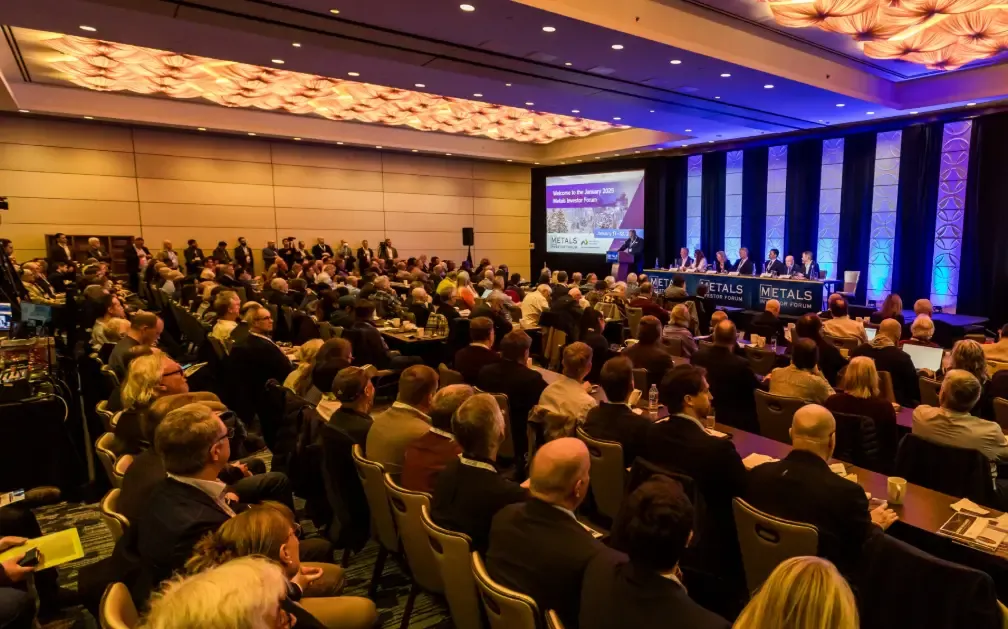
The final week of January in Vancouver, one of the world’s primary hubs for mining finance, delivered a clear market signal: investor appetite for metals has returned, both in their safe-haven and industrial dimensions, amid monetary realignments, geopolitical tension and a renewed search for regulatory stability.
By Panorama Minero
The assessment follows a dense agenda that included the Metals Investor Forum, the Vancouver Resource Investment Conference (VRIC), the Association for Mineral Exploration Roundup (AME Roundup), and Argentina Night, a country-focused event organized by Argenta Silver with the support of the Argentine Consulate in Vancouver. Companies active in Argentine exploration, including Kobrea, Mirasol, Latin Metals, Aldebaran, Astra and Argenta, participated in the gathering.
Julio César Ortiz, a Mendoza-based lawyer with international mining practice at Ortiz & Macaluzzo, attended the events and summarized the prevailing market narrative emerging from investor and technical sessions.
One of the most notable features of the current cycle, he observed, is the simultaneous strength of precious metals and industrial metals, an alignment not commonly seen at early stages of capital rotation.

Multi-Factor Rally Across Precious and Industrial Metals
According to discussions gathered during the Vancouver events, gold, silver and copper are being supported by multiple converging drivers: global political and regulatory instability, trade friction, tariff tensions and an ongoing de-dollarization trend reflected in sustained central bank gold purchases.
Retail participation has not yet fully entered the current cycle, suggesting additional upside pressure if broader capital flows follow institutional positioning.
Silver, in particular, was identified as structurally tight in terms of physical availability. A significant portion of market exposure is built on forward expectations rather than readily available supply, increasing sensitivity to disruptions and reinforcing the strategic position of producing jurisdictions such as Argentina.
Copper, meanwhile, remains central to the energy transition, electrification and infrastructure build-out, while simultaneously being affected by geopolitical and trade considerations. This dual dynamic is reinforcing its classification as a critical mineral within global supply chains.
Although technical consensus anticipates a potential short-term correction toward late February or early March, market participants framed it as a likely temporary adjustment before establishing new structural price floors.
Capital Allocation and the Supercycle Thesis
A recurring theme among investors was the possibility that the sector is entering a new multi-year commodity upswing, potentially spanning three to five years. In that context, jurisdictional stability, regulatory predictability and fiscal clarity become decisive factors for capital allocation.
Argentina has begun to regain visibility as an investment destination, supported by national instruments such as the Large Investment Incentive Regime and renewed provincial exploration agendas. The presence of multiple companies with Argentine assets during Vancouver’s financing week and the dedicated Argentina-focused event reflected a perceptible shift in investor sentiment compared to previous years.
Mendoza and the Expanding Exploration Frontier
Within Argentina, Mendoza is gradually re-entering the exploration map, particularly through campaigns underway in the Malargüe Western Mining District. The combination of geological potential and evolving regulatory frameworks is drawing renewed attention from early-stage capital.
For market observers in Vancouver, the current phase reflects a broader rebalancing: sustained metal prices, capital reallocation toward resource assets and renewed focus on jurisdictions capable of offering both resource potential and institutional predictability.