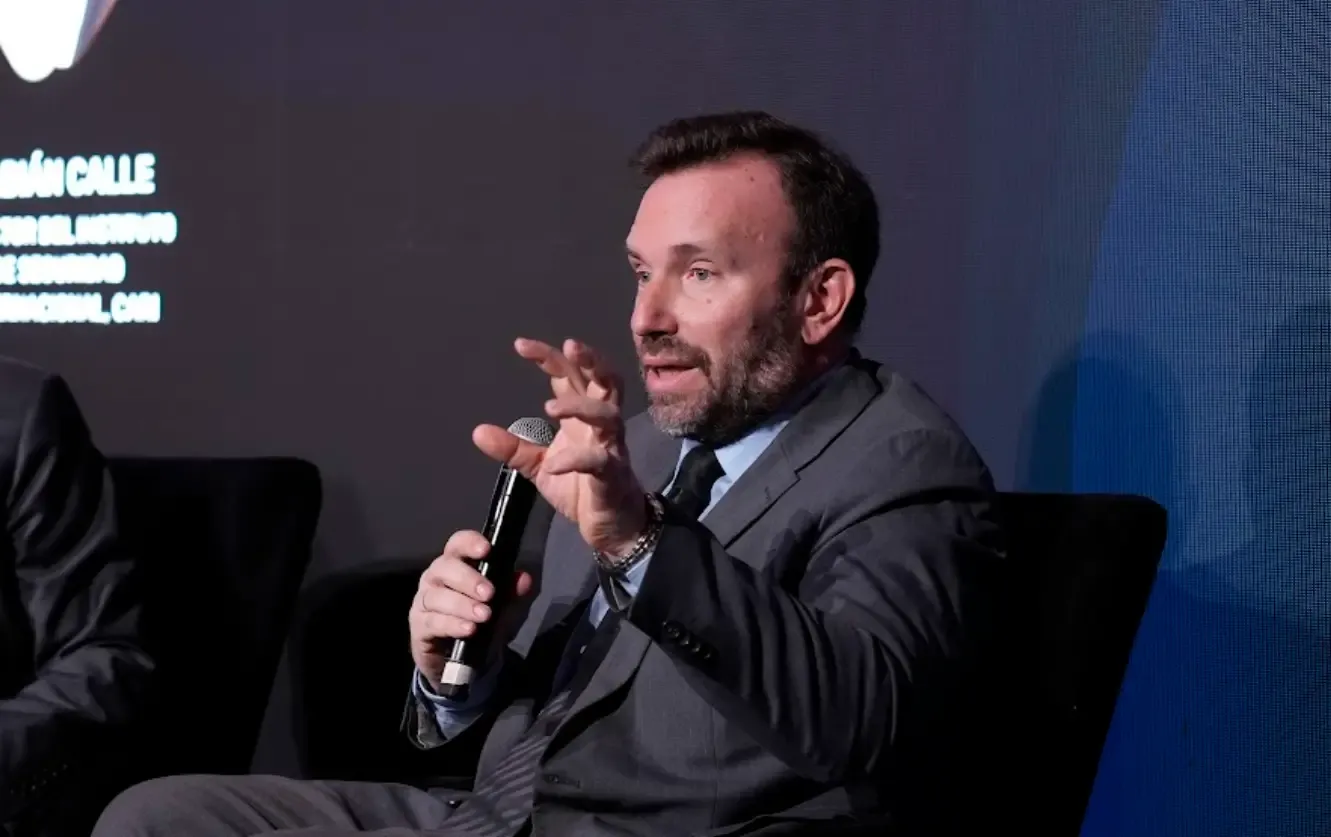
Venezuela’s crisis has entered a decisive phase. Far from a sudden collapse, the process now underway points to a prolonged transition, shaped by negotiations, external pressure, and an increasingly visible framework of international supervision. In a conversation with Panorama Minero, geopolitical analyst Fabián Calle, Senior Fellow at Florida International University and Director of the Institute of International Security at CARI, lays out the key elements of the new regional chessboard and explains the role the United States has chosen to assume, now in a more explicit manner.
By Panorama Minero
According to Calle, what is unfolding in Venezuela does not follow the classic pattern of a dictatorship’s downfall. Rather, it marks the beginning of a transitional process that will not be immediate and could extend over one, two, or even more years. In this sense, he warns that what is collapsing is not a traditional strongman, but a delegated power structure. Nicolás Maduro, he explains, does not embody an autonomous figure of authority comparable to other historical authoritarian leaders, but instead operated as a delegate within a broader system of control, one that has been heavily shaped, he notes, by Cuba.
The weight of Havana within Venezuela’s power architecture, Calle argues, consolidated after the failed coup attempt in 2002. From that moment on, Hugo Chávez would have decided to hand over control of internal security to the Cuban intelligence apparatus, triggering a progressive penetration of the G2 into the Venezuelan Armed Forces. From then on, Calle maintains, every relevant military promotion was filtered through Cuba, a dynamic that deepened following Chávez’s death. At that stage, a decisive internal struggle emerged within the regime, between a faction more closely linked to the Armed Forces and another aligned with Havana, of which Maduro was a part. The victory of the latter entrenched Cuban influence as a structural pillar of power.
Within this context, the United States’ strategy sought to dismantle the symbolic core of Venezuela’s senior leadership. For Calle, the Trump administration chose to cut off the visible head of the system by sidelining Maduro as the central figure, but without pursuing a chaotic collapse. The objective was to open a conditional negotiation process, with clear incentives and carefully calibrated margins of maneuver. Within that framework, he explains, Washington’s real interest lay in creating relative autonomy within the Venezuelan military sector vis-à-vis the Cuban apparatus, thereby weakening the heart of the control system.
The selective nature of sanctions fits squarely within this logic. Calle emphasizes that not all key actors were included on the sanctions lists, deliberately leaving certain doors open for the construction of internal interlocutors. The U.S. message combined concrete political demands — the release of political prisoners, an end to the persecution of the opposition, and the return of U.S. companies — with broader strategic objectives, such as reducing the influence of extra-hemispheric actors, particularly Iran and, to a lesser extent, China.
The pressure, the analyst warns, is not merely rhetorical. The United States is acting as a direct supervisor of the process, and it has explicitly signaled the possibility of a far more severe military escalation in the event of non-compliance. In this scenario, the Venezuelan Armed Forces occupy a central role, but one with extremely limited room for maneuver. Calle describes a military establishment operating under forced caution, constrained by technological inferiority, intelligence penetration, and international judicial risk. More than a traditional army, he argues, it functions as a structure deeply integrated into legal and illegal businesses, ranging from oil to smuggling, which in turn shapes its incentives and behavior.
From this perspective, Calle states that the “regime as an all-powerful dictatorship” has come to an end, although he is careful to clarify that this does not imply immediate normalization. “Economic hardship, restrictions on freedoms, and the absence of press freedom will persist for some time,” he notes. From a geopolitical standpoint, however, the shift is unequivocal: “Venezuela has ceased to be a refuge for U.S. strategic rivals such as China, Russia, Iran, or the FARC,” he stresses.
Broadening the lens, Calle argues that the United States’ main structural advantage remains military, and within that sphere, control of the seas is decisive. The global U.S. military deployment, with hundreds of strategically distributed installations, not only serves a defensive purpose but also constitutes the backbone of the international commercial and diplomatic order. In naval terms, while China is advancing rapidly, it remains far from matching the United States in operational, technological, and logistical capacity, particularly given Washington’s network of solid military allies across Asia, Europe, and the Americas.
To this hard-power supremacy is added a less visible yet equally decisive dimension: soft power. Calle highlights the profound educational asymmetry between the United States and China, reflected in the vast number of Chinese students studying at U.S. universities, compared with an almost nonexistent flow in the opposite direction. This imbalance, he underscores, speaks to cultural attraction, talent absorption, and the shaping of future elites.
Within this framework, the analyst dismantles a recurring assumption: great powers always make unilateral decisions. The institutional architecture built after 1945 — the United Nations, the IMF, the World Bank, NATO — serves U.S. interests and has never operated against them. The current difference, he explains, lies not in the exercise of power itself, but in its presentation. “Unlike previous administrations, Trump dispenses with the effort to disguise or soften decisions, leaving the exercise of power fully exposed.”
For Argentina, this scenario opens a concrete window of opportunity. Calle points to the existence of a significant core within the Republican Party with deep knowledge of Latin America, particularly in Florida, which does not rely on simplified regional diagnoses. At the same time, in a context of global strategic rivalry, the United States is seeking to consolidate its natural sphere of influence — the Western Hemisphere — a logic that is structural rather than ideological. Added to this is the growing importance of the Arctic and Antarctica, Atlantic–Pacific corridors, and the strategic value of natural resources.
In this context, Argentina is increasingly being viewed from abroad through a far more strategic lens, not only for its agri-industrial output, but also for its potential in lithium, copper, gold, oil, gas, and energy, as well as its cold climates, which are relevant for electricity-intensive industries such as those linked to artificial intelligence. “External assessments are increasingly structured around hard, geopolitical, and productive variables, very different from the country’s traditional self-image.”
Therein, Calle concludes, lies an opportunity — provided that Argentina can read the context with realism and move intelligently within an international arena where power is no longer concealed and rules are written through force.