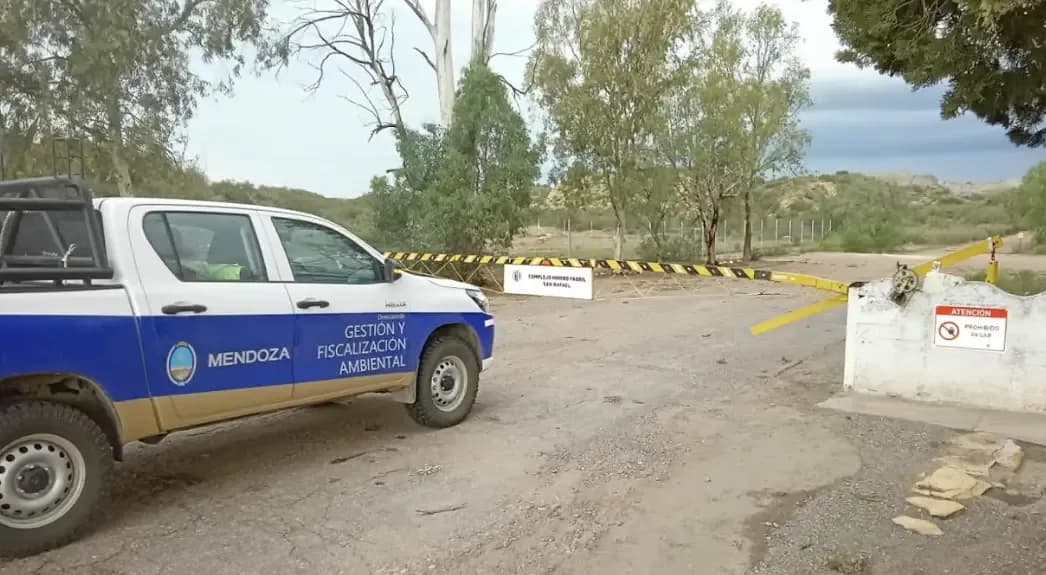
Following the intense rainfall recorded in San Rafael over recent hours, the Government of Mendoza and the General Department of Irrigation (DGI) moved to deny reports of a potential incident at the Sierra Pintada complex, confirming that no overflows or impacts occurred affecting the containment systems of the site, which is currently undergoing remediation.
By Panorama Minero
According to information provided by the Irrigation Authority, no overflows were recorded in any of the reservoirs at the San Rafael Mining–Industrial Complex operated by the National Atomic Energy Commission (CNEA), nor were there any alterations in the water quality of the Diamante River, even after concentrated rainfall events in the El Tigre stream area.
The water authority further explained that two days prior to the storms, technical staff conducted a routine inspection at the site, confirming that reservoir levels were well below their maximum capacity, providing ample safety margins in the event of extraordinary precipitation. After the rainfall episodes, all structures—including quarries and evaporation and containment dams—remained intact, fully operational, and with complete retention capacity, with no liquid releases or loss of control in their operation.
At the same time, and in line with standard protocols activated during rises in the El Tigre stream, the Irrigation Authority carried out preventive water sampling. According to the official statement, these controls are part of the area’s long-standing monitoring framework and, in all recorded precedents to date, analyses have never shown abnormal values or results of concern. In this context, DGI reassured the population, confirming that the Diamante River’s water was not affected by the recent rainfall and that control systems continue to operate normally.
Meanwhile, Mendoza’s Ministry of Energy and Environment reported that on-site inspections were carried out at the complex, verifying low water levels in the reservoirs and the proper performance of containment works. As an additional preventive measure, maneuvers were executed to reduce water levels at the so-called Reservoir II, an internal infrastructure designed to contain surface runoff from within the site, in anticipation of possible new storms. A contingency watch was also established to reinforce inspections during extraordinary hydrometeorological events, with continuous monitoring of the situation.
A Site Under Active Remediation
The official clarifications come within a particular context: Sierra Pintada is one of Argentina’s most significant environmental mining liabilities. The complex was the country’s last major uranium mine in operation, producing approximately 1,600 tonnes between 1975 and 1997 for the national nuclear program.
Today, the site is undergoing a large-scale industrial remediation process led by CNEA. The core of the program involves the individualized treatment of approximately 5,200 drums of 200 liters each containing solid uranium residues, under a “drum-by-drum” approach that prioritizes radiological safety, chemical stability, and the permanent confinement of materials. Residual uranium is recovered using ion exchange resins, while remaining solids are neutralized with lime, without the use of acid leaching or sulfuric acid, aiming to ensure long-term geochemical stability.
In parallel, another central front of the project is the treatment of quarry water accumulated in former excavations. This water flow is processed through multiple stages to recover uranium and manage associated elements such as radium and arsenic, after which the water is reused within the site under controlled conditions, with no external discharges. All resulting materials converge in a final disposal dam designed with multiple protective barriers, geomembranes, and drainage systems, conceived as a cornerstone of the remediation engineering.
In terms of progress, remediation is currently at an early-to-intermediate operational stage. The project has already completed the administrative and environmental phase — with the Environmental Impact Declaration granted and audit frameworks defined — and is advancing with priority works, commissioning of plants and systems, and the effective start of liability treatment. However, it has not yet reached a full and sustained mass-processing regime. Progress is gradual, validated stage by stage with continuous monitoring, a dynamic typical of nuclear remediation projects of this complexity.
From an institutional standpoint, the process marks a turning point: Sierra Pintada has shifted from being an unresolved liability to an active remediation system operating under current technical standards. At the same time, it establishes a regulatory and environmental baseline for any future discussion regarding uranium in Mendoza, at a time when nuclear energy is regaining prominence and the province concentrates a substantial share of Argentina’s identified uranium resources.