In 2025, San Juan moved forward with the recovery of the right to operate the Jáchal Free Trade Zone, following more than three decades without implementation. The decision involved a comprehensive redefinition of the project’s profile, centered on metal mining, a formal relocation process, and a development scheme combining a customs enclave, a solar park and a provincial industrial park, with the possibility of establishing subzones in different areas of the territory to strengthen the mining productive network.
By Panorama Minero
According to statements by Alfredo Aciar, Secretary for Coordination of Economic Development of the Government of San Juan, the province managed to avoid the expiration of the regime, which is renewed every 15 years, while simultaneously submitting to the federal government a comprehensive reformulation aimed at demonstrating economic viability and strategic relevance in the current context of mining expansion, particularly in the northern and western parts of the province.
Based on the assessment carried out by the economic area, San Juan was facing a critical scenario, with the second 15-year period nearing expiration without concrete progress, resulting in 30 years of inactivity. During that time, successive administrations failed to materialize the project. The current provincial administration reversed this situation through a political decision, supported by Governor Marcelo Orrego and endorsed by Minister of Production, Labor and Innovation Gustavo Fernández.
One of the key elements in securing federal approval was the change in the Free Trade Zone’s profile. The province advanced a strategic redefinition primarily oriented toward mining, without excluding other productive activities. This shift made it possible to address federal concerns regarding the lack of historical progress and to demonstrate that, at this stage, there is a concrete economic foundation, linked to logistics, supply of inputs and the potential installation of industrial activities associated with large-scale mining projects.
Within this framework, the Jáchal Free Trade Zone has gained renewed relevance due to its proximity to projects such as Vicuña, Veladero, Gualcamayo and Hualilán, as well as other developments at different stages. This is reinforced by the national context, in which metal mining projects may access the Large Investment Incentive Regime, with the Ministry of Economy of Argentina acting as the enforcement authority for both the regime and mining activity, a convergence of institutional frameworks that strengthens the project’s consistency.
After recovering the right to the Free Trade Zone, the provincial government moved forward with the creation of an Evaluation and Selection Committee, composed of five officials. It is chaired by Minister Gustavo Fernández and includes Secretary of Industry and Trade Alejandro Martín, Secretary of Sustainable Mining Development Guillermo Olguín, Secretary Alfredo Aciar, and Federico Contegrand, strategic advisor to the governor. Over the past year, the committee focused on two priorities, the relocation of the project and the identification of a suitable provincial-owned site that meets regulatory requirements.
The original location at the former Belgrano railway station was ruled out for technical, legal and urban planning reasons. The land belongs to the federal government rather than the province, is located within the urban area, has informal occupations and presents severe limitations for heavy truck traffic, making it incompatible with a large-scale logistics and industrial hub.
After evaluating nine alternatives, the site known as Virgen del Luján was selected, located in the Los Blanquitos area, west of the city of San José de Jáchal, with frontage on National Route 150. This corridor connects westward to Iglesia and Rodeo and eastward to National Route 40 and central Argentina. From a technical standpoint, the site offers significant advantages, including the availability of a 132 kV power line, a nearby transformer station, and close access to water and sewage services, substantially reducing initial investment costs.
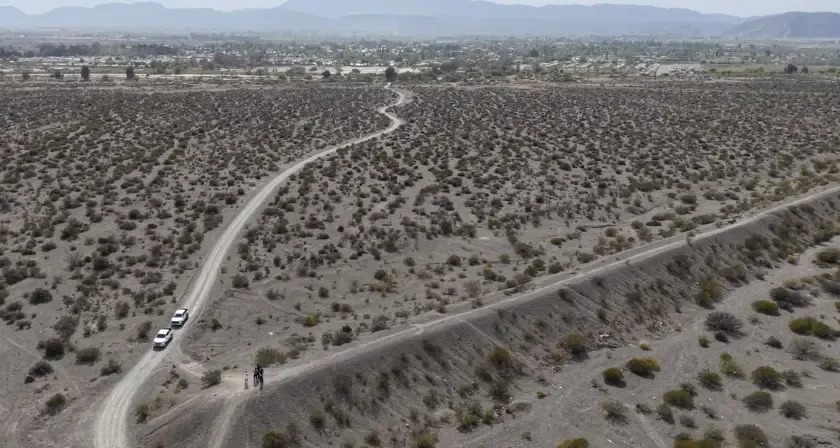
To meet federal deadlines, the province advanced with the expropriation of the land through the Expropriation Law passed during extraordinary legislative sessions. The process covers 110 hectares of a property of approximately 3,400 hectares. Federal authorities have already been formally notified that the relocation process is underway within the administrative framework.
The development plan for the site includes three complementary projects. The Free Trade Zone will occupy between 30 and 40 hectares, with room for future expansion. Between 10 and 20 hectares will be allocated to a solar park, aimed at supplying energy to the complex. The remaining land will be reserved for a Provincial Industrial Park, with characteristics similar to the Chimbas park, enabling the integration of industrial, logistics and service activities.
From an operational standpoint, the Free Trade Zone will function as a special customs enclave, fully fenced and with its own customs control. Goods entering the zone will do so without paying taxes, which will only be applied upon nationalization. This scheme seeks to significantly reduce the financial burden on mining and industrial projects, facilitating the entry of spare parts, machinery and equipment, as well as the installation of activities focused on value-added processing for export. The expected employment impact includes roles related to customs control, security, logistics and specialized industrial operations, a productive dynamic not seen in Jáchal for decades.
In parallel with the expropriation process, federal authorities are reviewing two submissions presented by the province, the formal approval of the relocation and a new operational regulation, updated after 30 years. This framework incorporates technological and productive advances, including the integration of solar parks and information and communication technologies. One of the most relevant aspects is the request to authorize annexes or subzones in the departments of Iglesia, Calingasta and Sarmiento, with the aim of establishing a strategic territorial scheme to support mining activity.
Once final approval is granted by the Ministry of Economy of Argentina, the timeline foresees rapid progress in execution. The Government of San Juan has set the goal of having the tender documents to select the operator of the Jáchal Free Trade Zone ready by April, with the call to be launched during the second half of 2026. The selected operator will be responsible for executing the infrastructure works, with expectations that the project will begin to take physical shape in 2027.