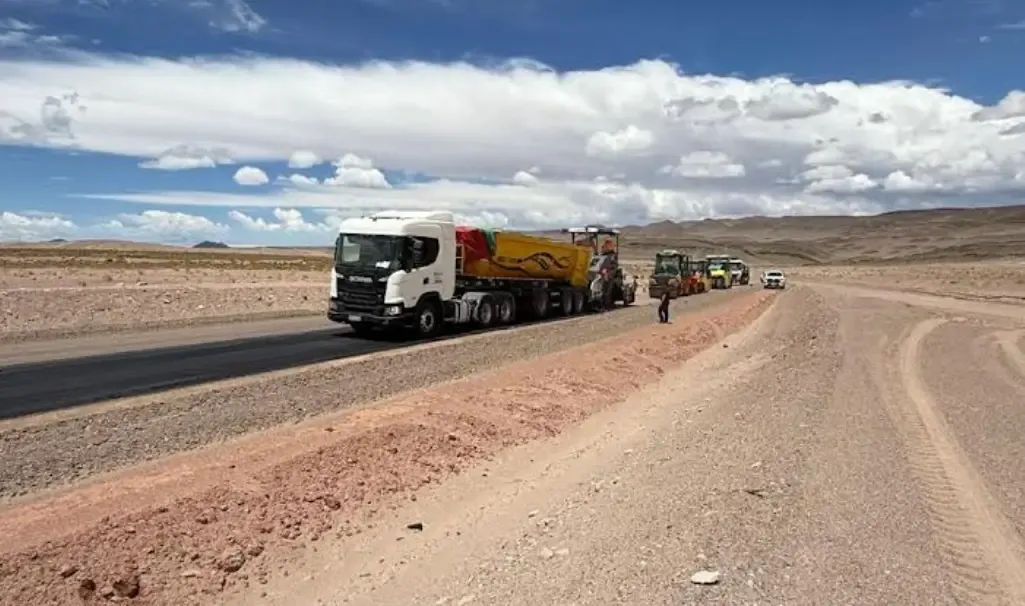
Catamarca province continues construction and paving works on Provincial Route 43 in the Antofagasta de la Sierra department, a strategic corridor for lithium logistics in Argentina’s Puna region. The full project covers 112 kilometers to the Salta border and has reached 15% physical progress in its first section.
By Panorama Minero
According to provincial authorities, current works correspond to Section I, extending from kilometer 0 in Antofagasta de la Sierra to kilometer 60.3. Favorable weather conditions in recent weeks have supported steady execution.
The provincial government emphasized that the project is key to improving regional connectivity, enhancing road safety and strengthening productive development in western Catamarca, particularly in an area where lithium mining plays a central economic role.
Construction Scope and Strategic Impact
Ongoing works include embankment construction, crushed stone base formation, road paving and shoulder development, essential components to ensure durability and performance under high-altitude conditions.
While the route is critical for transporting inputs and output from lithium operations in the Salar del Hombre Muerto area, it will also support high-altitude tourism and local agricultural activities.
Governor Raúl Jalil stated that “connecting the Puna is a strategic decision for Catamarca’s present and future,” highlighting that Route 43 improves road safety, reduces travel times and strengthens regional development. The first stage comprises 60 kilometers.
This project complements the previously completed paving works linking the provincial capital with Antofagasta de la Sierra. Once the full 112 kilometers are completed, paved connectivity will extend across Catamarca’s Puna to the Salta border.
Public-Private Financing Structure
The project is financed through provincial resources under the Mining Royalties Fund, with additional contributions from mining companies operating in the region.
South Korea’s POSCO committed an extraordinary contribution of US$1 million to help fund part of the first section. Rio Tinto, Pan American Energy and Galán Lithium have also provided financial support. All maintain projects in development or production in the Salar del Hombre Muerto basin.
A formal financing agreement was signed late last year between the provincial government, the Ministry of Finance and Public Works, the Provincial Road Authority, the Mining Royalties Trust Fund and POSCO Argentina, consolidating the mixed public-private funding structure behind the infrastructure upgrade.