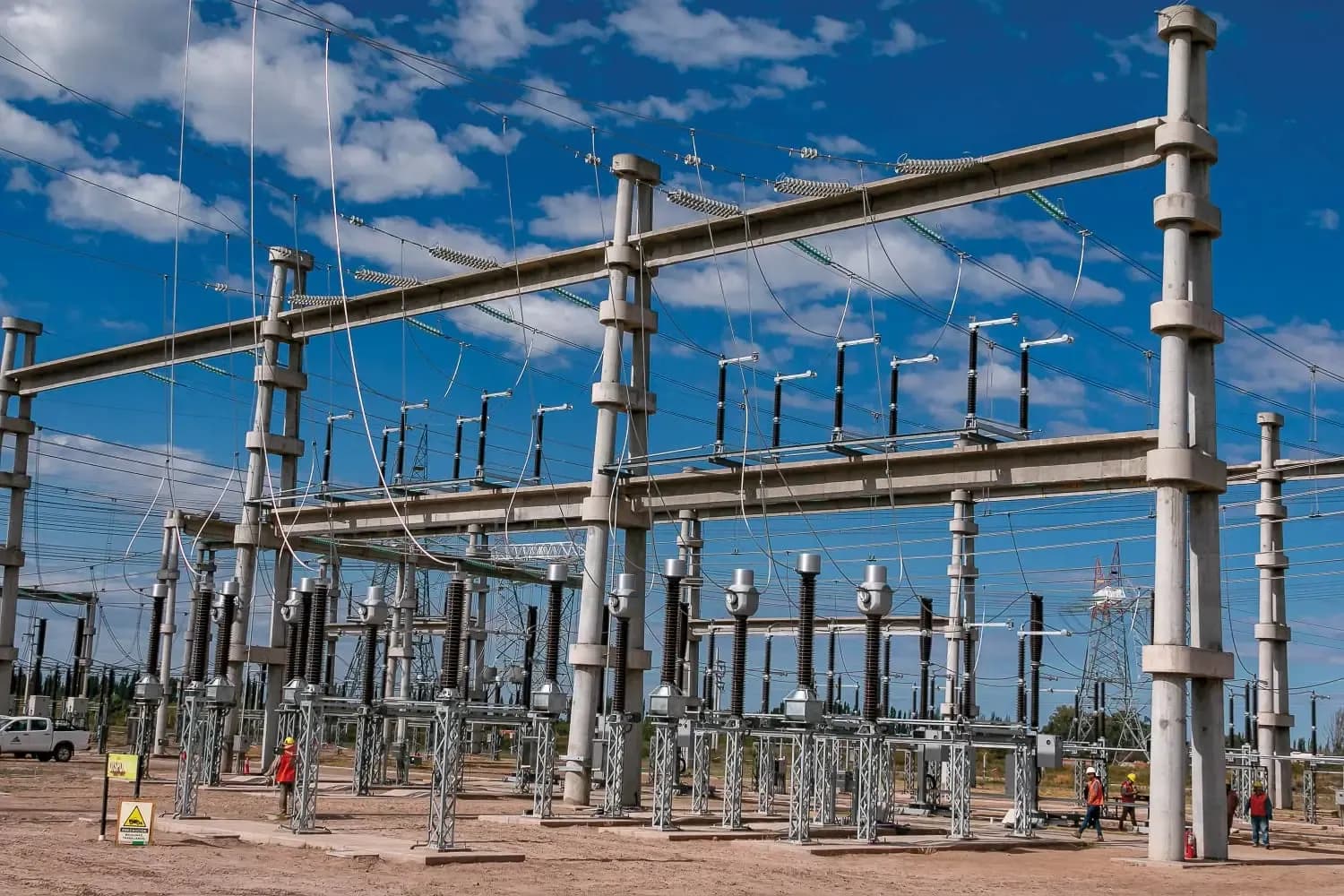
The Mendoza North 220/132 kV substation has formally entered the bidding stage and is positioning itself as a structural node within Mendoza’s power system and a critical component of the province’s mining energy framework. The project concentrates two strategic functions in a single infrastructure point: expanding transformation capacity for Greater Mendoza and providing the future high-voltage link required by PSJ to secure firm power supply in Uspallata.
By Panorama Minero
The technical scope includes the opening of the 220 kV Cruz de Piedra–San Juan transmission line, construction of the Mendoza North substation at 220/132/13.2 kV levels, upgrades to the Las Heras transformer station, installation of a new double-circuit 132 kV overhead transmission line between both nodes, and an approximately 850-meter underground high-voltage segment to connect new bays at Las Heras with the planned substation.
Operationally, Mendoza North will function as a transfer node, receiving energy at 220 kV, stepping it down to 132 kV and 13.2 kV, and redistributing it to the existing grid. This will add both transport and transformation capacity for continuous industrial demand.
PSJ And Access to Firm Power
This role has direct implications for the PSJ copper project. Following approval of its Environmental Impact Declaration, the company signed a technical agreement with Distrocuyo S.A. to define its energy access scheme. The plan includes construction of the San Jorge transformer station at 220/33 kV as a medium-voltage delivery point to supply local demand and the future processing plant, along with a dedicated 220 kV high-voltage transmission line linking that infrastructure directly to the Mendoza North substation, integrating the project into the core provincial power ring.
The agreement covers electrical studies, evaluation of technical alternatives, route definition, permitting procedures, and access arrangements to the transmission system. Current work focuses on conceptual engineering, including demand characterization, identification of interconnection points, voltage levels, and preliminary infrastructure siting. The objective is to ensure sufficient quality, stability, and capacity for an open-pit operation with a concentrator plant requiring continuous power supply for crushing, grinding, and flotation circuits.
From an operational perspective, the PSJ–Mendoza North connection reflects the core energy model: a copper project connected at 220 kV to a high-capacity provincial node, with subsequent transformation to 33 kV for internal distribution. This configuration enables a shift from temporary solutions such as on-site generation or hybrid systems to stable grid supply, a necessary condition for permanent installations and accurate long-term energy cost projections.
FOPIATZAD and Financing of Strategic Infrastructure
The Mendoza North tender process is being carried out through FOPIATZAD, the Provincial Trust Fund for High-Voltage Electrical Infrastructure, Isolated Areas, and Areas to Be Developed. This provincial instrument was created to finance and contract strategic electrical works aimed at strengthening the high-voltage network, addressing system vulnerabilities, and enabling connections in areas with productive potential. The trust acts as a platform for tendering and executing transformer stations and associated transmission lines that exceed the usual operational scope of distribution companies due to their scale or systemic impact.
In parallel, another structural component of the national infrastructure agenda is the bi-oceanic corridor. Authorities recently announced the upcoming tender of a section of National Route 7 toward the Cristo Redentor International Pass. Although a road project, its articulation with the power network responds to the same enabling infrastructure logic: high-voltage energy to support production and large-scale connectivity to move that output efficiently.
Taken together, the Mendoza North substation and its associated 220 kV and 132 kV network, the 220/33 kV station and dedicated 220 kV transmission line defined for PSJ, and the structural requirements of Potasio Río Colorado form part of the same technical axis. Without expansion of the electrical system, large-scale projects remain limited to early stages. The substation now entering tender therefore stands as a foundational energy asset for Mendoza’s productive future and, in the near term, as the node upon which PSJ will secure firm power access.