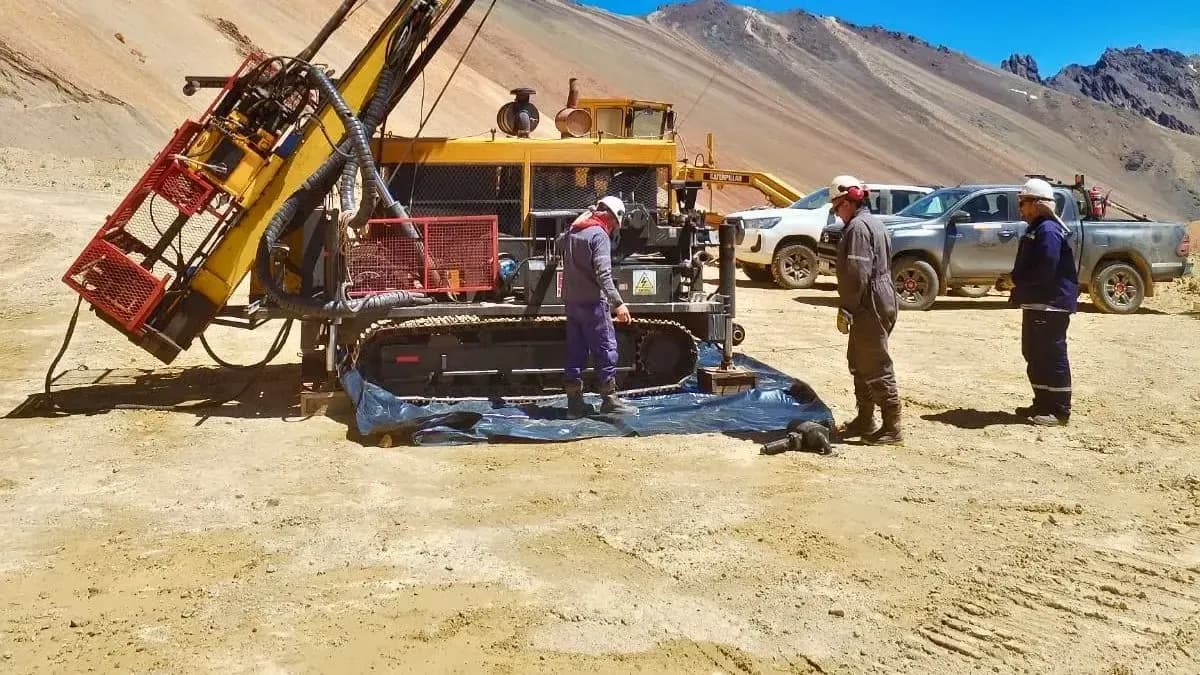
Kobrea Exploration has commenced the first deep diamond drilling program at El Perdido, within the Malargüe Western Mining District, marking the beginning of subsurface testing across the district. The milestone goes beyond simply initiating drilling activities: the company is executing a hole specifically designed to interpret the internal architecture of the Cu–Au–Mo porphyry system and identify its mineralized core.
By Panorama Minero
Phase 1 consists of three drillholes of 500 meters each, totaling approximately 1,500 meters. The first hole, DD26ELP001, is being drilled from the central pad at a –55° inclination to the east. Kobrea selected this collar location after integrating geological mapping, quartz stockwork veinlet mapping, rock geochemical sampling, and ASTER spectral analysis. This multi-layered technical approach defined a target where early porphyry, potassic alteration, a central hydrothermal breccia, and surface copper anomalies converge.
At this early stage, Kobrea is not yet focused on tonnage or resource definition. Instead, the campaign has been structured as vector drilling aimed at understanding the system, defining its three-dimensional geometry, and locating the sweet spot, the portion of the porphyry where higher grades and thicknesses typically concentrate. With this information, the company will refine the placement of future drillholes before scaling up exploration.
Targeting the Thermal Engine of the Porphyry
Technical maps indicate a classic zonation pattern. A potassic core dominates the center of the prospect, surrounded by a broader phyllic halo. The hydrothermal breccia is vertically emplaced near the heart of the system and acts as a conduit for mineralizing fluids. Surface rock sampling has returned copper values of up to 761 ppm around the initial drill pad, consistent with a leached cap overlying primary mineralization at depth. At the regional scale, ASTER data outline a sericite–clay alteration envelope extending several hundred meters, signaling a large hydrothermal system.
The drill design prioritizes geological interpretation over mere meterage. The –55° inclination allows the hole to intersect multiple vein families and maximize true stockwork intersections, a critical decision for reconstructing geometry, continuity, and structural controls of the porphyry system. Kobrea expects the first three holes to pass through the leached cap, enter early quartz diorite porphyries, and intersect the hydrothermal breccia, enabling vectoring of subsequent pads toward zones of higher temperature and stronger veining intensity.
This approach is particularly relevant in Mendoza. In Andean porphyry systems, the oxidized zone can extend from tens of meters to roughly 200–300 meters before transitioning into primary sulfides. Given that provincial legislation does not authorize the processing of oxidized ore, any development scenario requires direct interception of primary mineralization. With 500-meter holes, Kobrea ensures full penetration of the leached cap and direct evaluation of the system’s core.
El Perdido as a Benchmark for the District
The implications of these initial drillholes extend beyond El Perdido itself. If drilling confirms robust primary sulfides beneath the oxidized cover, the results will calibrate the geological model for the broader district.
El Perdido serves as a reference point for nearby targets. Confirming an active porphyry system at depth here would reshape the interpretation of regional anomalies exhibiting similar structural, alteration, and geochemical signatures within the Malargüe Western Mining District.
With the first hole underway, the district enters its most technical phase, transitioning from surface geology to direct subsurface system interpretation aimed at understanding its geometry and potential.