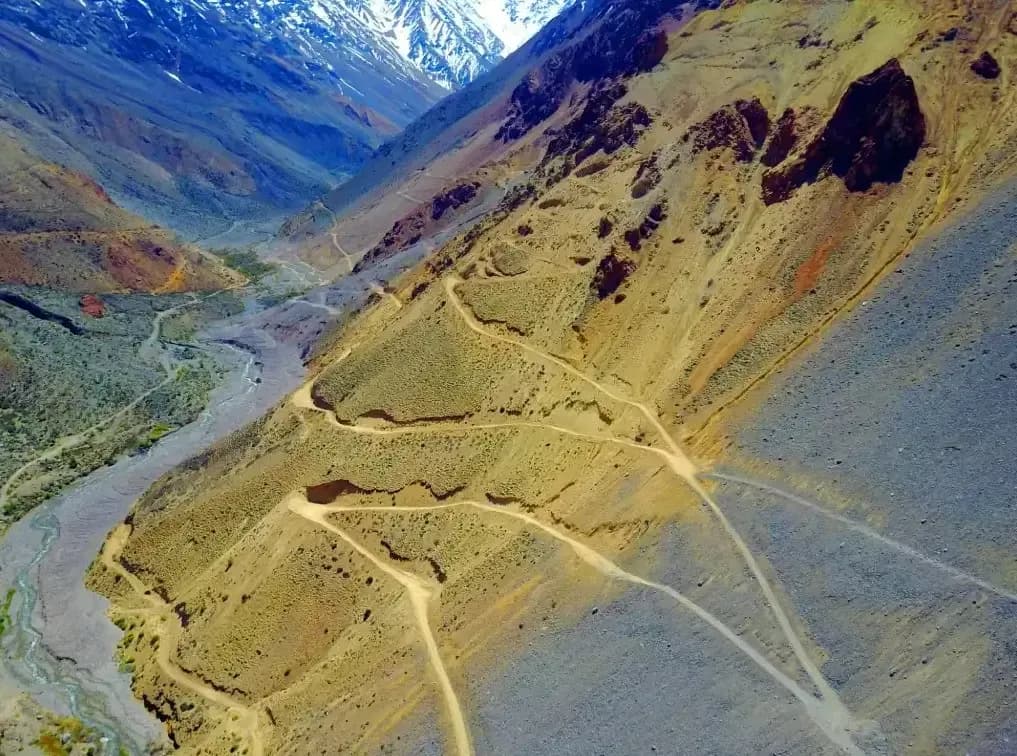
In the same week that the market is once again pricing in “transition copper” – with deficit projections emerging as early as 2026 and signals of a structural supply gap toward the next decade – a greenfield project in the Valparaíso cordillera serves as both a geological and political reminder of an idea well understood in Mendoza: copper does not follow borders, it follows belts.
By Panorama Minero
The project in question is Vizcachitas, owned by Los Andes Copper, a copper–molybdenum porphyry system with silver as a by-product, located in San Felipe Province, Putaendo district, roughly 150 kilometers north of Santiago. From a Mendoza perspective, the key point is not only the scale of the deposit but its position within the Andean copper belt.
Viewed on a map, the project footprint aligns almost directly with the copper corridor that, on the Argentine side, includes names such as PSJ, El Pachón and Los Azules, while on the Chilean side it connects with operations and systems such as Los Pelambres and the historic El Soldado.
A Large-Scale Industrial Porphyry
The most cited technical snapshot of Vizcachitas comes from its prefeasibility study and corporate presentations: a 26-year open-pit operation with a plant designed to process 136,000 tonnes per day. During the first eight years, the company projects average annual production of approximately 183,000 tonnes of copper, with a reported C1 cash cost of US$0.93/lb net of by-products and initial CAPEX of US$2.4 billion.
In terms of reserves, the PFS reports 1.2199 billion tonnes of proven and probable reserves at 0.36 percent Cu, or 0.40 percent CuEq, with molybdenum and silver supporting the model. On the resource side, the corporate base indicates 1,541 million tonnes in the measured and indicated category at 0.383 percent Cu, plus 1,823 million tonnes inferred at 0.342 percent Cu. It is a large-scale system seeking to demonstrate continuity and convert volume into a financeable development plan.
In its conceptual design, the company highlights three elements that weigh heavily in today’s investment decisions: filtered tailings with dry-stack deposition, HPGR technology for comminution, and a water supply strategy that includes a letter of intent for desalinated water, according to public company materials.
cPermits, Drilling and Surface-Level Tensions
Vizcachitas has not progressed in a straight line socially or regulatorily. In October 2025, Chile’s Second Environmental Court rejected six claims and upheld the environmental approval of the “Las Tejas” prefeasibility drilling program, noting that the assessment process had been properly conducted and that community observations were considered. The program contemplates up to 350 drill holes, both diamond and reverse circulation, over a 48-month period, distributed across new and existing platforms.
Local debate remains centered on recurring Andean themes: water, territorial footprint, biodiversity and social license.
The Political Turn That Put the Project in the Headlines
The latest episode of uncertainty came through a less conventional channel: politics. On January 20, 2026, the company announced that its CEO, Santiago Montt, would step down after being appointed Minister of Mining by president-elect José Antonio Kast, with an interim leadership structure already defined. The following day, the appointment was withdrawn amid public controversy over the premature announcement, and the incoming administration opted for a different ministerial formula.
From an Argentine perspective, the episode adds another layer at a time when global discussion revolves around constrained supply, longer permitting timelines and demand that continues to rise due to electrification, grid expansion and data centers, with short-term deficits already appearing in market projections.
A Binational Corridor Taking Shape
Seen from Argentina, Vizcachitas offers a broader territorial confirmation: the distribution of projects under development is beginning to clearly outline a major binational copper corridor, where much of the region’s mining future appears concentrated in the polygon formed by Chile’s Coquimbo and Valparaíso regions and Argentina’s San Juan and Mendoza provinces.
These developments reinforce the view that this stretch of the Andes will become one of the main engines of the next generation of South American copper.
In a context of projected deficits and structurally rising demand, Vizcachitas serves as both mirror and benchmark. For Mendoza, the reading goes beyond the Chilean case: it confirms that transition copper is organized along geological belts rather than administrative boundaries, and that the axis linking Valparaíso with San Juan and Mendoza is consolidating as one of the strategic territories of the region’s next copper cycle.