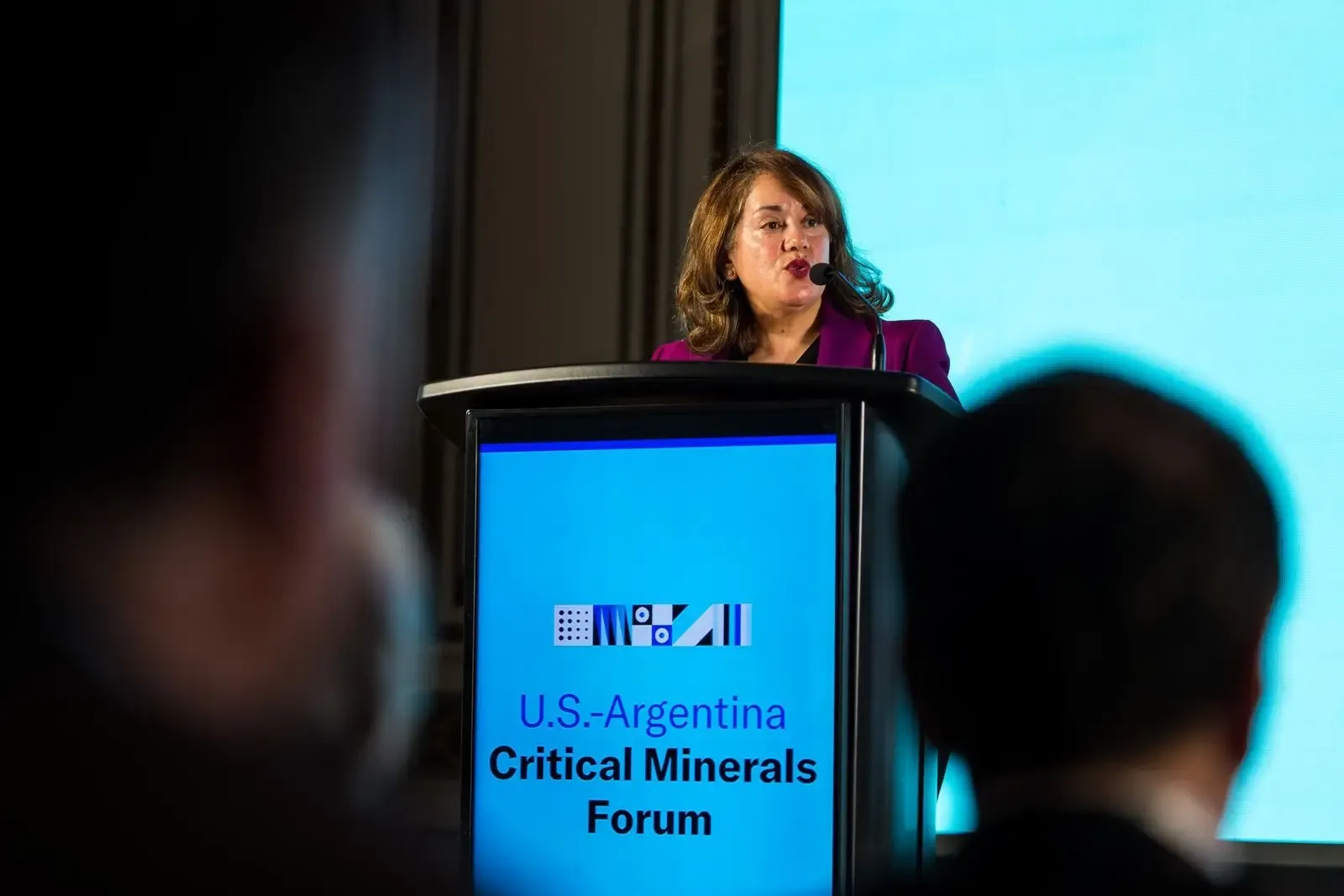
DFC, EXIM Bank and USTDA are part of a strategy aimed at mobilizing capital for mining, processing and infrastructure. ARTI and the specific critical minerals framework broaden a bilateral agenda in which copper and lithium hold a strategic position.
By Panorama Minero
The United States is seeking to expand its participation in the development of Argentina’s critical minerals through a combination of financing, guarantees, project preparation and trade cooperation. This comes at a time when Argentina needs capital to turn its lithium and copper project pipeline into new production, while Washington is seeking to strengthen the security of its supply chains and deepen integration across the Americas, as part of a broader strategy to reduce dependence on and the influence of extra-regional actors in strategic sectors.
The availability of capital and the conditions required to mobilize it into Argentina were among the main topics discussed this week at the US-Argentina Forum on Critical Minerals in Buenos Aires. But the debate also revealed a broader dimension: for the United States, financing new projects is part of a strategy that encompasses supply security, infrastructure and deeper integration with countries regarded as trusted partners.
Against this backdrop, Heidi Gómez Rápalo, Chargé d’Affaires at the U.S. Embassy in Argentina, again raised one of the key pending issues in the bilateral economic relationship. “Our hope is that Argentina will be able to ratify ARTI,” she said, referring to the Agreement on Reciprocal Trade and Investment signed by the two countries in Washington on February 5.
ARTI and a specific chapter on critical minerals
Although its scope extends well beyond mining, ARTI contains specific provisions covering critical minerals and U.S. investment in the sector.
The agreement establishes that Argentina will work with provincial governments to facilitate investment by U.S. companies in critical mineral projects and provides for expedited consideration of eligible initiatives under Argentina’s Large Investment Incentive Regime (RIGI).
It also addresses infrastructure needed to facilitate those investments and states Argentina’s intention to prioritize the United States as a trade and investment partner for copper, lithium and other critical minerals, including raw, processed and finished products.
This last point adds another dimension to the bilateral discussion. The issue is not necessarily limited to who provides the capital to extract a resource. It is also beginning to encompass downstream stages and the role Argentine production could play within international supply chains.
ARTI also includes commitments related to economic security, technology and certain practices by economies or companies that intervene in markets.
The agreement was signed by Argentine Foreign Minister Pablo Quirno and U.S. Trade Representative Jamieson Greer and must still complete Argentina’s domestic procedures before entering into force.
An agenda that already includes a mining-specific framework
ARTI does not stand alone. One day before it was signed, Argentina and the United States entered into the Framework Instrument for Strengthening Supply in Critical Minerals Mining and Processing, specifically focused on the sector.
The framework is intended to develop “secure, resilient and competitive” supply chains and includes cooperation on public and private financing, streamlined permitting, geological information, recycling and materials management.
The explicit inclusion of processing is significant in a market where extraction and subsequent transformation do not necessarily take place in the same country or region.
In copper, for example, many mines produce concentrate, which must subsequently undergo smelting and refining before becoming the metal used by industry. Global capacity for those stages is heavily concentrated in Asia, particularly in China.
For Argentina, which has yet to define much of the commercial and logistics structure surrounding its future large-scale copper projects, new production also raises questions about processing, traceability and the ultimate destination of its minerals.
These issues remain secondary to the immediate challenge of financing and building the projects, but they are beginning to enter the conversation, as became apparent during the US-Argentina Forum on Critical Minerals.
DFC, EXIM and USTDA: different tools for different stages
Within this strategy, DFC, EXIM Bank and USTDA offer different capabilities to support investment.
The U.S. International Development Finance Corporation (DFC) can participate through financing and risk-mitigation mechanisms for private-sector projects. Its assessment of mining opportunities considers factors including project maturity, permitting, developer capabilities, committed capital, and environmental and social standards.
Consistent with this approach, RIGI emerged during the discussions as one of the measures that has favorably changed the risk assessment surrounding large-scale investments in Argentina by providing a specific framework for long-term projects.
EXIM Bank, meanwhile, has financing instruments designed to support U.S. participation in projects and strategic supply chains.
ARTI itself provides for the United States to work through DFC and EXIM to consider support for eligible investments in critical sectors in Argentina, in collaboration with the U.S. private sector.
USTDA plays a different role within this architecture, primarily supporting project preparation, before many initiatives are ready to secure construction financing.
During the forum, Brenda Quiroz Maday, USTDA Country Manager for Latin America, explained that the agency can provide non-reimbursable grants for feasibility studies, technical assistance and pilot projects, helping reduce technical and commercial risks.
In mining, that work can cover drilling campaigns, metallurgy, process testing and feasibility studies, as well as energy, transportation and other infrastructure required to bring a project to market.
According to the agency, USTDA is currently seeking new opportunities related to advanced exploration, extraction, processing and associated infrastructure.
Quiroz Maday also issued a direct invitation to expand USTDA’s presence in Argentina, with the goal of bringing its level of activity closer to that seen in Brazil: “On my scoreboard, we have Brazil six, Argentina one. So I want to invite you to change that score and work together.”
Project Vault and a strategy increasingly focused on supply
One recent U.S. initiative illustrates how financing is becoming connected with broader supply objectives.
Project Vault is an approximately US$12 billion public-private initiative launched by the U.S. government in February to establish a strategic civilian reserve of critical minerals. The structure includes up to US$10 billion in EXIM Bank financing and close to US$2 billion in private capital, with the aim of protecting U.S. industry against supply disruptions and reducing its exposure to highly concentrated overseas supply chains.
The initiative is designed to stockpile essential materials in the United States and ensure their availability to manufacturers in the event of disruptions.
For Argentina, Project Vault is significant less as a standalone initiative than for the direction it signals: the United States is seeking to use financial tools to develop new sources of supply while strengthening its industry’s access to those minerals.
That helps explain why financing, traceability, processing and supply security are increasingly appearing within the same agenda.
China and the push for more diversified supply chains
The strategy is unfolding against a reality that will be difficult to change in the short term: China operates at a scale that is difficult to replicate across several stages of critical mineral processing.
In copper, China accounts for approximately half of global smelting capacity. Its share is even greater in the processing of several other minerals considered strategic.
This does not mean that every tonne of mineral processed in China reflects a geopolitical decision. For a mining company, the destination of its production depends on available capacity, buyers, contracts, costs and logistics.
But the growing strategic importance of these materials adds another variable to that decision.
For the United States, developing new mines in allied countries without creating alternatives elsewhere in the value chain could preserve some of the same dependencies that its critical minerals policy is seeking to reduce.
Argentina represents a particular opportunity in this regard because much of its future copper industry has yet to be built. Infrastructure, export corridors, commercial agreements and potentially new processing capacity will be defined as projects move forward.
This does not mean the country necessarily needs to refine everything it produces domestically. It does mean that decisions about how and where those minerals reach the market are beginning to carry implications beyond logistics alone.
From instruments to capital
Argentina and the United States now have a signed trade agreement, a framework specifically dedicated to critical minerals, and several public-sector tools capable of supporting project preparation, financing and risk reduction.
The relationship did not begin with the current U.S. administration. In 2024, the two countries had already signed a memorandum of understanding covering critical mineral exploration, extraction, processing, refining, recycling and recovery.
The instruments agreed in 2026 deepened that agenda and added new commercial and financial components.
For Argentina, the timing coincides with a concrete need. Large copper projects require billions of dollars before producing their first tonne, while the expansion of lithium production is creating new infrastructure and capital requirements.
For the United States, Argentina’s project pipeline represents an opportunity to incorporate new supply from a country with which Washington is seeking to deepen its commercial and strategic ties.
Financing is emerging as the entry point. Behind it, discussions are also beginning to encompass infrastructure, processing, traceability and the destination of the minerals Argentina could produce over the coming decades.