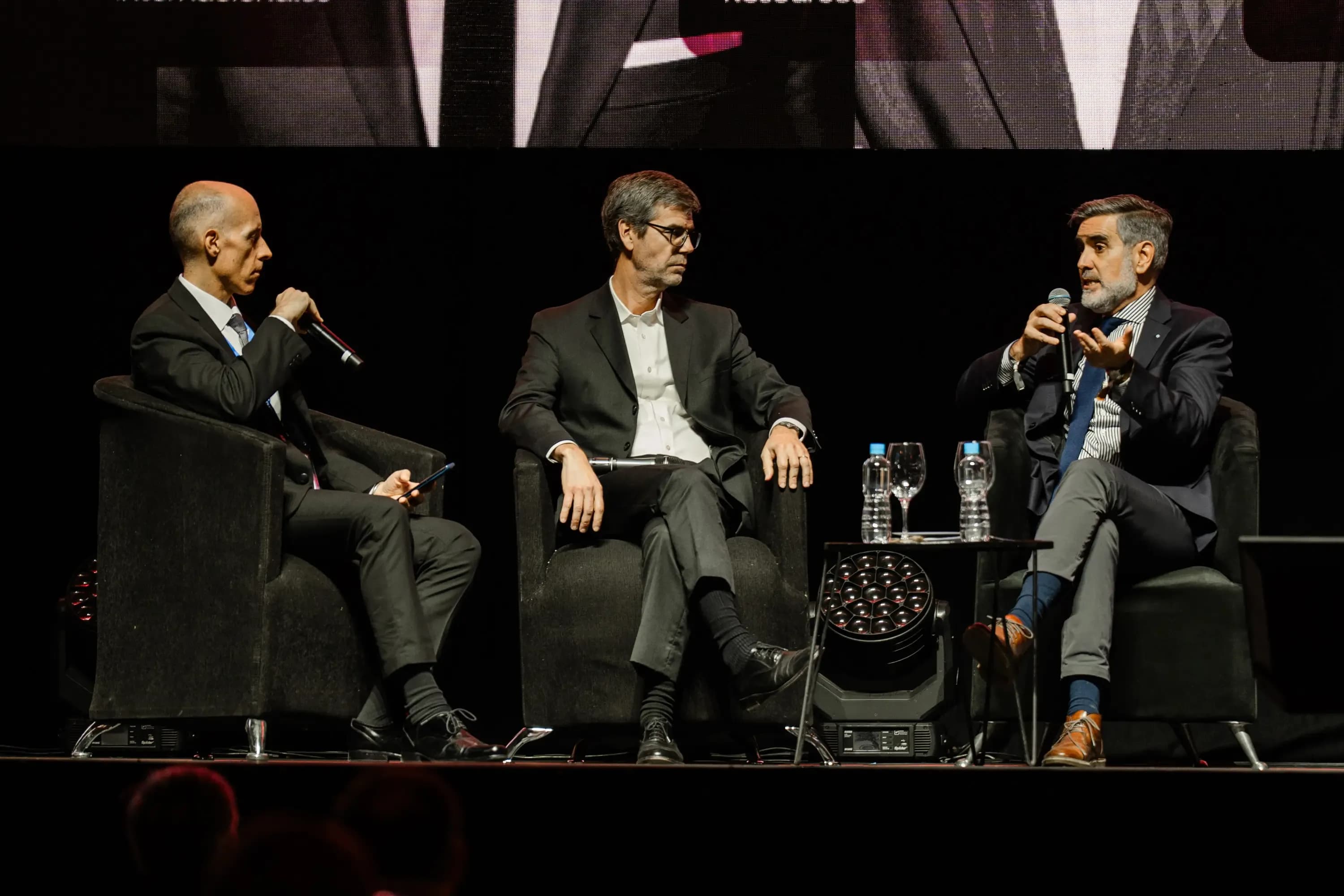
An increasingly favorable geopolitical context and the progressive normalization of the domestic market have enhanced the attractiveness of Argentine mining in the eyes of the world. Looking ahead, Fernando Brun, Secretary of International Economic Relations, and Federico Elewaut, President of Citibank, outlined the strengths to leverage and the risks to minimize in order to continue expanding sector development.
By Panorama Minero
Until recently, Argentina’s mining development was discussed almost exclusively in terms of potential. According to the Secretary of International Economic Relations, Fernando Brun, this was extremely frustrating because that potential never materialized into concrete results. “Then we started talking about opportunities, accompanying governors to markets increasingly demanding critical minerals linked to the energy transition. These days, fortunately, we are seeing that the world’s attention is genuinely focused on Argentina, its resources, and the execution capacity of each of its initiatives,” emphasized the official during his participation at Expo San Juan Minera 2026.
Many projects that today attract the interest of international investors, he noted, had remained dormant and hidden for decades under the label of “advanced exploration projects.” “Today, however, we have realities thanks to macroeconomic stability and legal certainty, which are essential elements for developing business and creating a ‘new normal,’ without overlooking the importance of tools such as the Large Investment Incentive Regime (RIGI),” he pointed out.
Specifically regarding this regulation, he detailed proposals totaling US$86 billion have already been submitted, a value comparable to Argentina’s annual exports. “At the same time, we are working on improving Argentina’s credit rating to reduce the cost of capital,” he announced.
Key Variables for Attracting Investment
From the perspective of Federico Elewaut, President of Citibank, a tool such as the RIGI represents a necessary—but not sufficient—solution. “To attract investors, a set of factors is required, such as macroeconomic stability, growth prospects, the existence of political consensus around the development of an activity such as mining, the presence of a suitable industrial network, and the implementation of environmental protection standards, among others,” the executive listed.
Since its founding as a nation, he recalled, Argentina has possessed the mineral wealth of the Andes Mountains. “However, we only began to truly value those mining resources about 15 years ago. And only now are we accelerating the pace of activity,” he stated.
Another factor to consider, he added, is respect for rules and legal certainty. “It is essential to continue evolving in that aspect. On the other hand, there is no doubt that country risk influences investments in Argentina. In fact, when a local company has to finance a project—whether in the international market or through shareholder-required returns—we are currently paying 400 basis points more than other countries,” he quantified.
Despite this, he emphasized, the scale of Argentina’s mineral wealth makes many projects profitable even under current rates. “That can be seen in the number of projects being submitted to join the RIGI,” he celebrated.
Argentina’s Second Mining Revolution
The geopolitical context, Brun indicated, is also creating favorable conditions for sector development. “We can already speak of a strategic international instrument such as the framework agreement with the European Union (EU) regarding critical minerals, which enabled the signing of long-term off-take contracts related to lithium and copper,” he highlighted.
In this context, he added, European countries have provided sovereign guarantees to support projects such as the expansion of Rio Tinto’s operations. “It is no coincidence that the major names in international mining are currently present in the country,” stressed Brun, who highlighted the leading role of capital from Canada, Australia, Switzerland, and China.
The major challenge, he acknowledged, is to begin integrating value chains ranging from extractive mining to energy transmission. “That is what is guiding an economic diplomacy that begins within provincial governments. The attraction of investments and the country’s positioning on the mining and energy map depend on coordinated work between the provinces, the national government, and each entrepreneur involved,” he stated.
What Argentina is currently experiencing, he defined, is a second mining revolution based on cooperation to advance through geological mapping, technology transfer, and talent development. “The goal is to position the country in the global market by strengthening the supply chain and increasing value addition,” he affirmed.
From his perspective, the Reciprocal Trade and Investment Agreement (ARTI) signed with the United States in February of this year deepen cooperation between both countries, with emphasis on Argentina’s mining potential and development possibilities. “It is the same agreement signed, for example, by a country such as the United Arab Emirates, where significant work is being carried out in the energy sector. With a very clear geopolitical vision regarding the global market reality, we agreed on the need to diversify value chains, develop infrastructure for mineral processing, and design effective financing mechanisms for the entire sector,” he explained.
Main Criteria for Financing Mining Projects
According to Elewaut, several criteria are taken into account when evaluating the possibility of financing a mining project in the country. “The first is environmental. If the project does not meet minimum requirements, it is ruled out,” he stated.
The second criterion, he continued, relates to the sponsors. “When costs are excessive relative to the budget, there must be sufficient financial backing to support the works,” he clarified.
The banking executive also emphasized the importance of off-takers. “A solid financial structure is needed to support exports and make project repayment viable,” he explained.
Mining initiatives, in general, require billions of dollars, are not easy to finance, and demand successful management involving shareholders, multilateral institutions, and banking organizations. “These projects are so large that having a single source of financing is not enough,” he concluded.