The British Geological Survey (BGS) has released a new edition of World Mineral Production 2020–2024, one of the most comprehensive and widely used databases for tracking global mineral commodity production.
By Panorama Minero
The publication compiles data covering the 2020–2024 period for more than 70 minerals and metals produced worldwide, continuing a statistical series developed by the institution since 1913.
This edition also incorporates a visual tool that allows users to quickly interpret the relative scale of different mineral resources.
A Snapshot of Global Mining
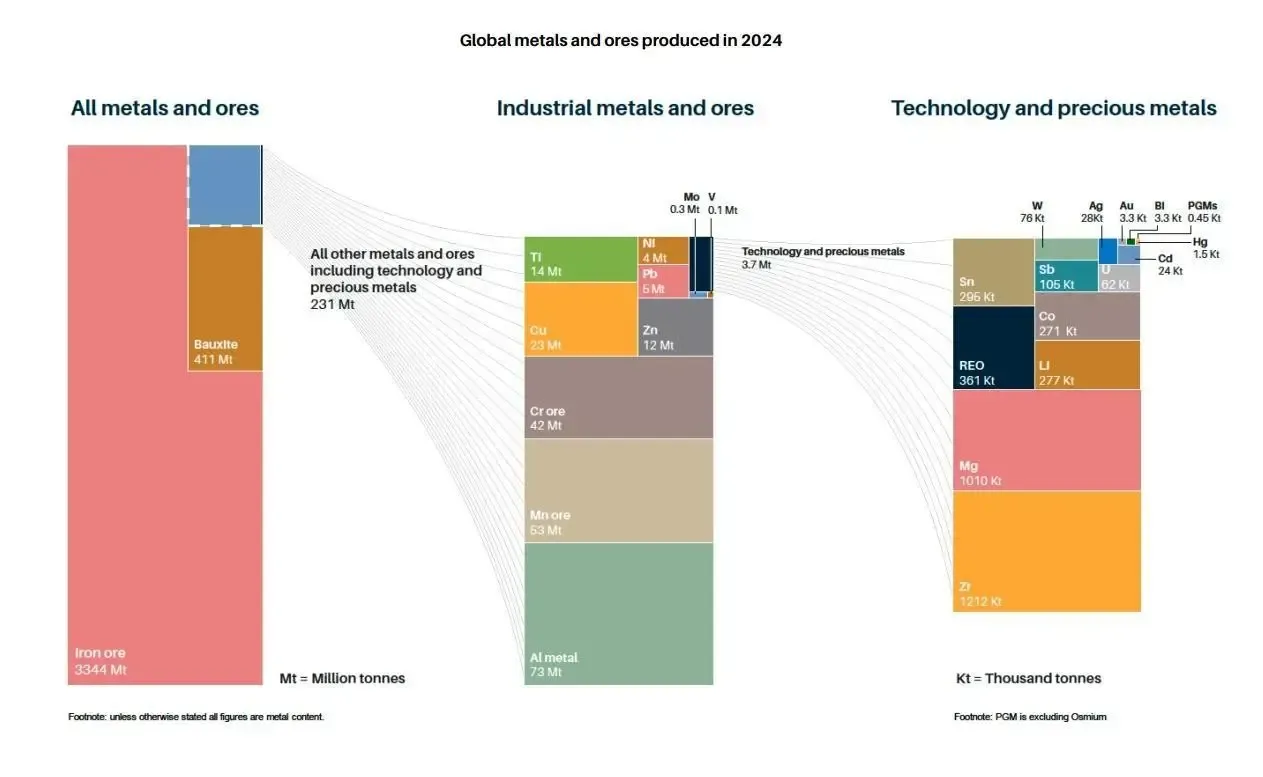
The visualization summarizes global metals and minerals production in 2024 and highlights the resources that currently dominate mining activity worldwide.
The chart illustrates the overwhelming scale of iron ore production, which reached approximately 3.344 billion tonnes, far exceeding all other commodities included in the survey. Bauxite, the primary raw material used in aluminum production, ranked second with 411 million tonnes.
A broad range of industrial minerals follows, including aluminum, manganese, chromium, copper, titanium, zinc and lead, all of which remain essential for sectors such as construction, manufacturing, infrastructure and heavy industry.
The chart also highlights the contrast between minerals that lead global production volumes and those considered strategic for future technologies.
Critical Minerals: Small in Volume, Strategic in Value
One of the most interesting aspects of the visualization is its ability to illustrate the difference between production volume and strategic importance. So-called critical minerals occupy a relatively small area within the chart but play a central role in supply chains linked to the energy transition and digital transformation.
These include lithium, cobalt, rare earth elements, nickel, tin, zirconium and magnesium, all essential for the production of batteries, electric vehicles, wind turbines, solar panels, semiconductors and advanced electronic equipment.
The graphic also reflects a reality increasingly recognized by governments, companies and international organizations: a mineral's economic importance is not always proportional to the volume produced.
While traditional commodities such as iron ore continue to dominate global mining by tonnage, minerals produced in significantly smaller quantities have become strategic components for industrial competitiveness and supply security.
Argentina's Mineral Production Profile
According to the BGS report, Argentina displayed varied performance across different mineral commodities.
The most significant growth occurred in lithium. Lithium carbonate production increased from 26,846 tonnes in 2020 to approximately 81,000 tonnes in 2024, while contained lithium rose from 5,047 tonnes to 15,228 tonnes over the same period.
Among precious metals, notable changes were also recorded. Argentina's gold production declined from 63 tonnes in 2020 to 54 tonnes in 2024, continuing a downward trend observed in recent years.
Silver production reached 1,100 tonnes in 2020, peaked at 1,400 tonnes in 2022 and later declined to 1,200 tonnes in 2024.
Primary aluminum production remained relatively stable, with 318,000 tonnes in 2020, 336,000 tonnes in 2021, 332,000 tonnes in 2022, 330,000 tonnes in 2023 and 324,000 tonnes in 2024, reflecting a mature industry without major capacity expansions in recent years.
Among industrial minerals, borates production remained relatively stable, totaling 134,604 tonnes in 2020 and approximately 130,000 tonnes annually between 2021 and 2024.
Bentonite production showed virtually no variation at around 46,000 tonnes per year, while perlite production expanded significantly, increasing from 13,176 tonnes in 2020 to approximately 32,000 tonnes in 2024.
Fluorspar production also remained stable at around 4,800 tonnes annually, while strontium minerals averaged approximately 700 tonnes per year.
By contrast, some commodities recorded declines. Refined cadmium production fell from 46 tonnes in 2020 and 50 tonnes in 2021 to no reported production from 2022 onward.
Bituminous coal production showed strong volatility, with 12,875 tonnes in 2020, 13,113 tonnes in 2021, 13,110 tonnes in 2022, a jump to 65,560 tonnes in 2023 and a decline to just 1,300 tonnes in 2024.
A Tool for Understanding the Energy Transition
In this context, the latest edition of World Mineral Production provides an updated reference on global mining output and a visual tool that facilitates comparisons among different mineral resources.
The publication offers a comprehensive view of both traditional commodities and the minerals gaining relevance within supply chains associated with the energy transition and emerging technologies.