With 56 projects spanning production, construction and exploration, Argentina has established one of the world's largest lithium project pipelines. Reports by the Mining Secretariat, the Argentine Industrial Union (UIA) and the Argentine Chamber of Mining Companies (CAEM) project US$15 billion in investment, installed capacity exceeding 517,000 tonnes per year of lithium carbonate equivalent (LCE) and production growth of 254% over the next decade, driven by new developments and the expansion of the main deposits across northwestern Argentina.
By Panorama Minero
Argentina's lithium industry is experiencing one of the most dynamic periods in its history. As global demand for critical minerals continues to be driven by the energy transition, energy storage and electric vehicle manufacturing, the country is accelerating the development of a pipeline that now includes 56 projects at different stages of advancement.
From producing operations that currently sustain exports to projects moving through construction, feasibility and exploration, the sector is preparing for unprecedented growth.
Projections prepared by the Argentine Industrial Union (UIA) and the Argentine Chamber of Mining Companies (CAEM), together with data from Argentina's Mining Secretariat, indicate that lithium is on track to become one of the country's main drivers of investment, foreign exchange earnings and industrial development over the coming decade.
According to the National Directorate for Mining Promotion and Economics, Argentina currently has 56 lithium projects, distributed across the following development stages:
-
7 in operation
-
5 under construction
-
2 at the feasibility stage
-
3 at the pre-feasibility stage
-
4 at the Preliminary Economic Assessment (PEA) stage
-
27 in advanced exploration
-
8 in early-stage exploration
Together, this portfolio contains 216.32 million tonnes of LCE resources, 23 million tonnes of reserves, and an estimated production potential of 602,000 tonnes per year, a figure that exceeds projected production for 2035 and suggests that the sector's growth trajectory could extend well beyond the next decade.
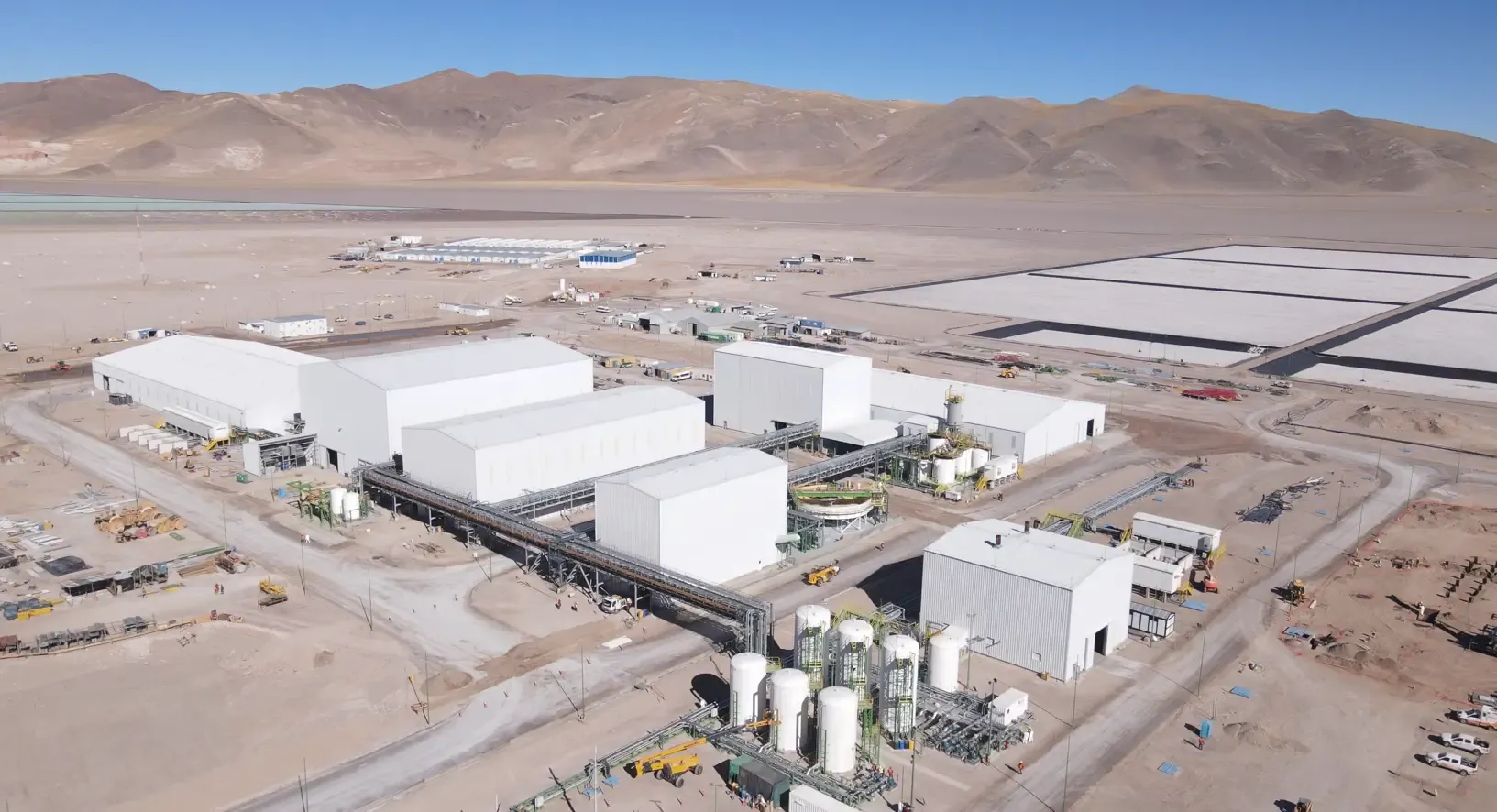
The seven projects currently in commercial production are Cauchari-Olaroz, Centenario-Ratones, Fénix, Mariana, Olaroz, Sal de Oro and Tres Quebradas, which together form the backbone of Argentina's lithium output.
They are followed by five projects under construction—Hombre Muerto Oeste, Rincón, Sal de los Ángeles, Sal de Vida and Salar del Rincón—that represent the next major increase in production capacity and are expected to come online progressively over the coming years.
The pipeline also includes two projects at the feasibility stage—Kachi and Pozuelos-Pastos Grandes (PPG)—which rank among the largest planned developments for the next decade; three projects at the pre-feasibility stage—Arizaro, Cauchari and Cauchari JV—that continue advancing technical and engineering studies; and four projects with completed Preliminary Economic Assessments (PEA): Candelas, Hombre Muerto Norte, Río Grande and Salar Tolillar, all of which continue to expand their resource base and evaluate economic viability.
Argentina's long-term potential is further supported by 27 advanced exploration projects, including Arizaro Sur, Cangrejillos, Centenario, Doncellas, Gallego and Incahuasi, along with numerous other developments located primarily in the provinces of Salta, Catamarca and Jujuy.
An additional eight early-stage exploration projects—including Antofalla Norte, Candela II, Cazadero Grande, Formentera-Cilón, Incahuasi, Leoncito, Los Sapitos and San Jorge—represent the next generation of developments that could support the industry's expansion over the coming decades.
The Road Ahead: Investment and Production Growth
Projections prepared by Francisco Abramovich, Head of the Mining Department at the Argentine Industrial Union (UIA), and Nadav Rajzman, Chief Economist at the Argentine Chamber of Mining Companies (CAEM), outline a strong expansion scenario through 2035 that, if achieved, would position Argentina among the world's leading producers of lithium carbonate equivalent (LCE).
The study forecasts nearly US$15 billion in investment, directed both toward new operations and the expansion of existing projects. That capital would increase theoretical installed capacity from 201,000 tonnes of LCE per year in 2025 to 517,000 tonnes by 2035, while actual production would rise from 115,000 tonnes to approximately 407,000 tonnes annually. Over just ten years, national output would increase by 292,000 tonnes, representing cumulative growth of 254%, or 3.54 times current production.
The growth projected by the Argentine Industrial Union (UIA) and the Argentine Chamber of Mining Companies (CAEM) is not driven by a single large-scale investment, but rather by a sequence of expansions and new developments scheduled to come online progressively between 2026 and 2033.
The first major milestone will arrive in 2026, when several projects enter different stages of production: Fénix Phase 1B, operated by Rio Tinto Lithium; Hombre Muerto Oeste, developed by Galan Lithium; Sal de Oro Phase 2, led by POSCO Argentina; and Sal de Vida, also under Rio Tinto following its acquisition of Arcadium Lithium. The simultaneous advancement of these projects explains the first significant increase in installed capacity and marks the beginning of a new phase for Argentina's lithium industry.
Two years later, the outlook will shift again with the second stage of Hombre Muerto Oeste and the expansion of the Rincón project, both regarded as strategic assets within Rio Tinto's global portfolio.
In 2029, the Pozuelos-Pastos Grandes (PPG) project, jointly developed by Lithium Argentina and Ganfeng Lithium, is expected to begin production. In 2030, attention will turn to Minera Exar's Phase 2 expansion at the Cauchari-Olaroz salar, one of the largest individual capacity increases projected for the decade.
The timeline continues with the second expansion of Pastos Grandes in 2031, the commissioning of Lake Resources' Kachi project in 2032, and a third phase at Pastos Grandes in 2033, when Argentina's installed lithium production capacity is expected to approach its projected ceiling of 517,000 tonnes per year of LCE.
The acceleration of these investments is already being reflected in recent corporate announcements. Under Argentina's Large Investment Incentive Regime (RIGI), the national government has approved the expansions of Cauchari-Olaroz, Sal de Oro, Rincón and Fénix, recently joined by LIEX S.A.'s Tres Quebradas (3Q) project in Fiambalá, Catamarca.
The new project involves an investment of US$709 million to develop a plant with an annual production capacity of 40,000 tonnes of lithium carbonate, together with the infrastructure required for brine extraction and processing. According to the national government, the project will create 4,406 direct and indirect jobs during construction and operation, has an estimated productive life of more than 19 years, and is expected to generate approximately US$400 million in annual exports. With this addition, the RIGI program now comprises 21 approved projects, representing US$46.7 billion in committed investment.
In the case of Minera Exar, the expansion will require US$1.241 billion, increase production capacity to 85,000 tonnes per year, generate approximately 1,800 direct and indirect jobs, and is expected to begin operations by the end of 2028.
POSCO, meanwhile, will invest US$547 million in the second phase of Sal de Oro, increasing production capacity to 23,000 tonnes per year of lithium carbonate and potentially generating more than US$300 million in annual exports.
Activity is also accelerating in Catamarca, driven by the 3Q and Hombre Muerto Oeste (HMW) projects. With a RIGI approval granted in August 2025, Galan Lithium recently announced the first production of lithium chloride at Hombre Muerto Oeste after completing the wet commissioning of its nanofiltration plant. The brine processing and lithium carbonate plant began operating on April 1, 2026, with a total capacity of 12,000 tonnes per year. The project represents an investment of US$217 million.
The Australian company expects to begin commercial sales this year, supported by a long-term supply agreement with U.S.-based Authium, while advancing an expansion that will increase initial capacity from 4,000 to 5,200 tonnes per year during the first half of 2027.
At the same time, Galan has already secured permits for a second phase with a capacity of 21,000 tonnes per year of LCE, consistent with the expansion scenario projected by the UIA and CAEM.
Another project expected to reshape the scale of Argentina's lithium industry is Pozuelos-Pastos Grandes (PPG) in Salta, being developed by Ganfeng Lithium LATAM, through its subsidiary Lithea Inc., together with Lithium Argentina. The partners are seeking to incorporate a third strategic investor to support financing for a development that will require more than US$3 billion and is designed to produce 150,000 tonnes of LCE per year across three phases.
To that end, PPG applied to join the RIGI in February. The project has already reached a key milestone in its initial phase, having secured its Environmental Impact Declaration (DIA), allowing development to proceed under the applicable regulatory framework.
Meanwhile, also in Salta, NOA Lithium continues expanding its future project portfolio through progress at Río Grande, where it estimates resources of nearly five million tonnes of LCE and a potential production capacity of 40,000 tonnes per year, while also advancing the Arizaro project, where it is testing Direct Lithium Extraction (DLE) technologies in partnership with Summit Explore Corporation.
At the same time, Rio Tinto confirmed that lithium will be the fastest-growing division within its global portfolio, supported by new investments in its Rincón, Sal de Vida and Olaroz assets. The Rincón project, located in the Salar de Rincón in Salta Province, consists of a lithium carbonate plant expansion with a capacity of 60,000 tonnes per year of battery-grade lithium carbonate, enough to supply approximately one million electric vehicles annually. The development includes the existing 3,000-tonne plant and a 57,000-tonne expansion. According to the company, total investment amounts to US$3 billion, with operations expected to begin in January 2028. The project has already secured RIGI approval for US$2.7 billion.
The second Rio Tinto project approved under the RIGI is the Fénix 1B expansion, located in the Salar del Hombre Muerto, Catamarca. The initiative, developed by Minera del Altiplano S.A., involves an investment of US$530 million to increase lithium carbonate production capacity by 9,500 tonnes per year.
Fénix Phase 1B includes the construction of a new selective adsorption plant and a new lithium carbonate plant, together with additional brine wells, supporting infrastructure and a gas compressor station in Olacapato to expand gas transportation capacity and supply the increased lithium production. The project will generate 1,143 jobs during construction and 504 permanent positions once operations begin, while contributing approximately US$165 million per year in exports.
Rio Tinto's strategy reflects a broader industry trend: the expectation that the continued expansion of electric mobility, energy storage and renewable energy will sustain global demand for critical minerals for decades to come, reinforcing Argentina's position as one of the world's leading hubs for lithium development.