Lithium is entering a transformative phase that could reshape the profile of Argentina's mining exports over the next decade. Projections by the Argentine Industrial Union (UIA) and the Argentine Chamber of Mining Companies (CAEM) point to strong production growth, while new reports indicate that the sector is on track to become one of the country's leading sources of foreign currency, supported by the start-up of new projects, plant expansions and a recovery in international lithium prices.
By Panorama Minero
For years, lithium's potential was associated almost exclusively with the vast geological resources contained within the so-called Lithium Triangle. However, recent studies by industry organizations and private institutions show that the discussion is no longer centered solely on resource availability, but rather on how quickly Argentina can convert that potential into production, exports and investment.
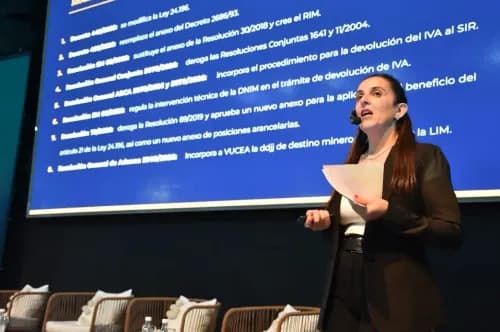
Projections prepared by Francisco Abramovich, Head of the Mining Department at the Argentine Industrial Union (UIA), and Nadav Rajzman, Chief Economist at the Argentine Chamber of Mining Companies (CAEM), presented during the seminar "Opportunities and Challenges for Industry in the Mining Value Chain", outline a strong growth scenario through 2035 that, if realized, would position Argentina among the world's leading producers of lithium carbonate equivalent (LCE).
The study forecasts nearly US$15 billion in investment directed toward both new operations and the expansion of existing projects. This capital inflow would increase theoretical installed capacity from 201,000 tonnes of LCE per year in 2025 to 517,000 tonnes by 2035, while actual production would rise from 115,000 tonnes to approximately 407,000 tonnes annually.
Within just ten years, lithium supply would increase by 292,000 tonnes, representing cumulative growth of 254%, or 3.54 times current production.
Beyond the scale of these figures, the report offers insight into how the industry is expected to evolve. Growth will not be linear nor driven by a single mega-project, but rather by the gradual commissioning of new operations alongside successive expansions of existing mines.
Between 2025 and 2030, production is projected to nearly double, increasing from 115,000 to 233,000 tonnes. Between 2030 and 2035, output would expand further to 407,000 tonnes. Although percentage growth during the second five-year period would be lower, the additional production volume would be even greater, reflecting the maturation of projects currently under construction or at various stages of development.
Installed capacity projections also underscore the sector's expected dynamism. According to the UIA and CAEM, Argentina will add 316,000 tonnes of annual production capacity, equivalent to a 157% increase over current levels. However, the study notes that installed capacity will not automatically translate into actual production.
In 2025, production represents just 57.2% of installed capacity. By 2030, that figure is expected to decline slightly to 55.9%, reflecting the simultaneous commissioning of numerous plants still progressing through their ramp-up phases. Only toward the end of the decade is capacity utilization expected to reach approximately 78.7%, a level considered typical for an industry where ramp-up processes often take several years before facilities reach design capacity.
The gap between installed capacity and actual production is one of the report's most noteworthy findings. While the difference stands at roughly 86,000 tonnes in 2025, it exceeds 184,000 tonnes by 2030, illustrating the substantial amount of infrastructure that will still be operating below full capacity.
From that point onward, the gap gradually narrows, falling to approximately 110,000 tonnes by 2035, indicating that most new operations will have reached a more stable stage of production.
Production projections are reinforced by another indicator that is beginning to reshape mining's role within Argentina's economy: exports. Another report prepared by Nadav Rajzman and Guido D'Angelo, of the Rosario Board of Trade, estimates that mining exports reached US$6.075 billion in 2025, a 31% increase over 2024, representing 6.9% of Argentina's total exports and marking the sector's fifth consecutive year of growth. The most significant figures, however, emerge in the outlook for 2026.
If current expectations materialize, mining exports would exceed US$9 billion, an increase of more than 50%, raising the sector's share to over 10% of Argentina's total exports.
In other words, one out of every ten export dollars generated by Argentina would come from mining, establishing the industry alongside agribusiness and energy as one of the country's principal net generators of foreign currency.
Remaining Challenges
Despite its extraordinary geological potential, Argentina still faces structural challenges that constrain the sector's development. A study by Fundación Libertad, sponsored by the Center for International Private Enterprise (CIPE), notes that Argentina holds approximately 21% of the world's lithium resources, yet accounts for only 5.2% of global production.
The report also points out that, although more than 50 lithium projects are distributed across the provinces of Catamarca, Salta and Jujuy, only seven are currently producing and five are under construction. This gap illustrates why, according to the study's authors, the industry often advances "in a hurry": international price cycles accelerate or delay investment decisions, while commissioning new plants frequently takes longer than initially expected.
Meanwhile, investment momentum continues to be reflected in approvals granted under Argentina's Large Investment Incentive Regime (RIGI). In addition to the approved expansions of Cauchari-Olaroz, Sal de Oro, Rincón and Fénix, the government recently approved the Tres Quebradas (3Q) project, developed by LIEX S.A. in Fiambalá, Catamarca. The project involves an investment of US$709 million to build a plant with an annual production capacity of 40,000 tonnes of lithium carbonate. It is expected to generate 4,406 direct and indirect jobs and contribute approximately US$400 million in annual exports. With this addition, the RIGI now includes 21 approved projects, representing US$46.7 billion in committed investment.
Industry experts agree that the key challenge is no longer discovering new salt flats, but rather consolidating an institutional framework capable of attracting long-term investment.
According to Dana Barringer, of CIPE, "constructive capital is essential for strategic sectors such as lithium because it supports more sustained and competitive long-term growth." Meanwhile, Javier Bongiovanni, economist at Fundación Libertad, argues that "having one of the region's largest lithium reserves is not enough; success depends on Argentina's ability to become a reliable partner for the global market."
Along those same lines, the study recommends strengthening coordination between the national and provincial governments through the Lithium Board (Mesa del Litio), modernizing transfer pricing regulations, improving logistics infrastructure across northwest Argentina (NOA), enhancing transparency standards, and promoting the development of local suppliers and specialized human capital.
Taken together, the various reports lead to the same conclusion. Argentina possesses one of the mining sector's greatest opportunities for the coming decades, supported by world-class resources, projected investments of US$15 billion, and a project pipeline capable of increasing annual LCE production from 115,000 to 407,000 tonnes by 2035.
Yet transforming that potential into global leadership will require more than geological wealth. Regulatory stability, institutional coordination, infrastructure development, technological innovation and the ability to attract sustained investment will ultimately determine whether Argentina can convert its projected growth into a lasting leap in competitiveness and economic development.