In Jujuy, national and provincial authorities and business leaders agreed that the new scale of the lithium industry requires infrastructure, suppliers, talent and stable rules to transform investment into regional development.
By Panorama Minero
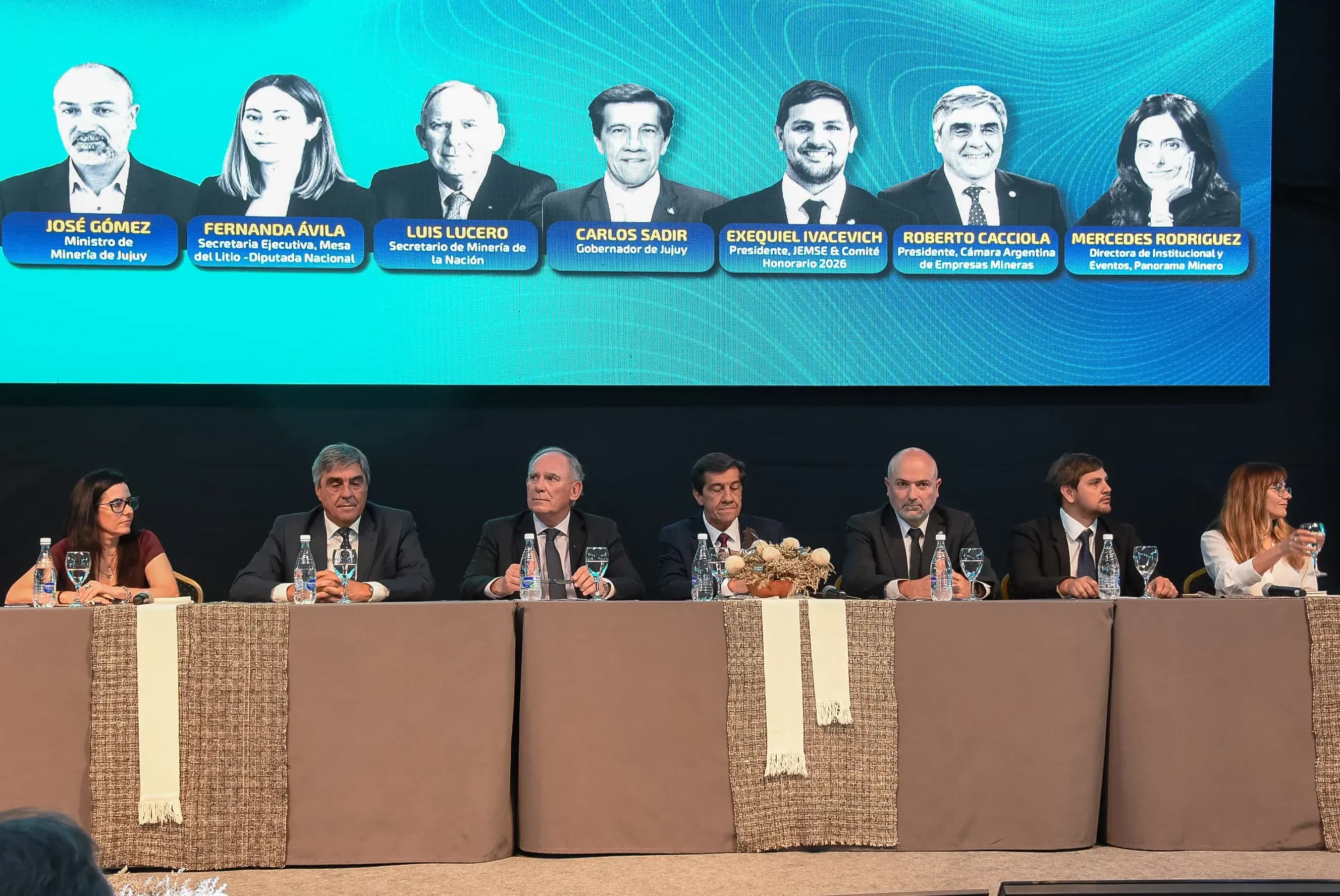
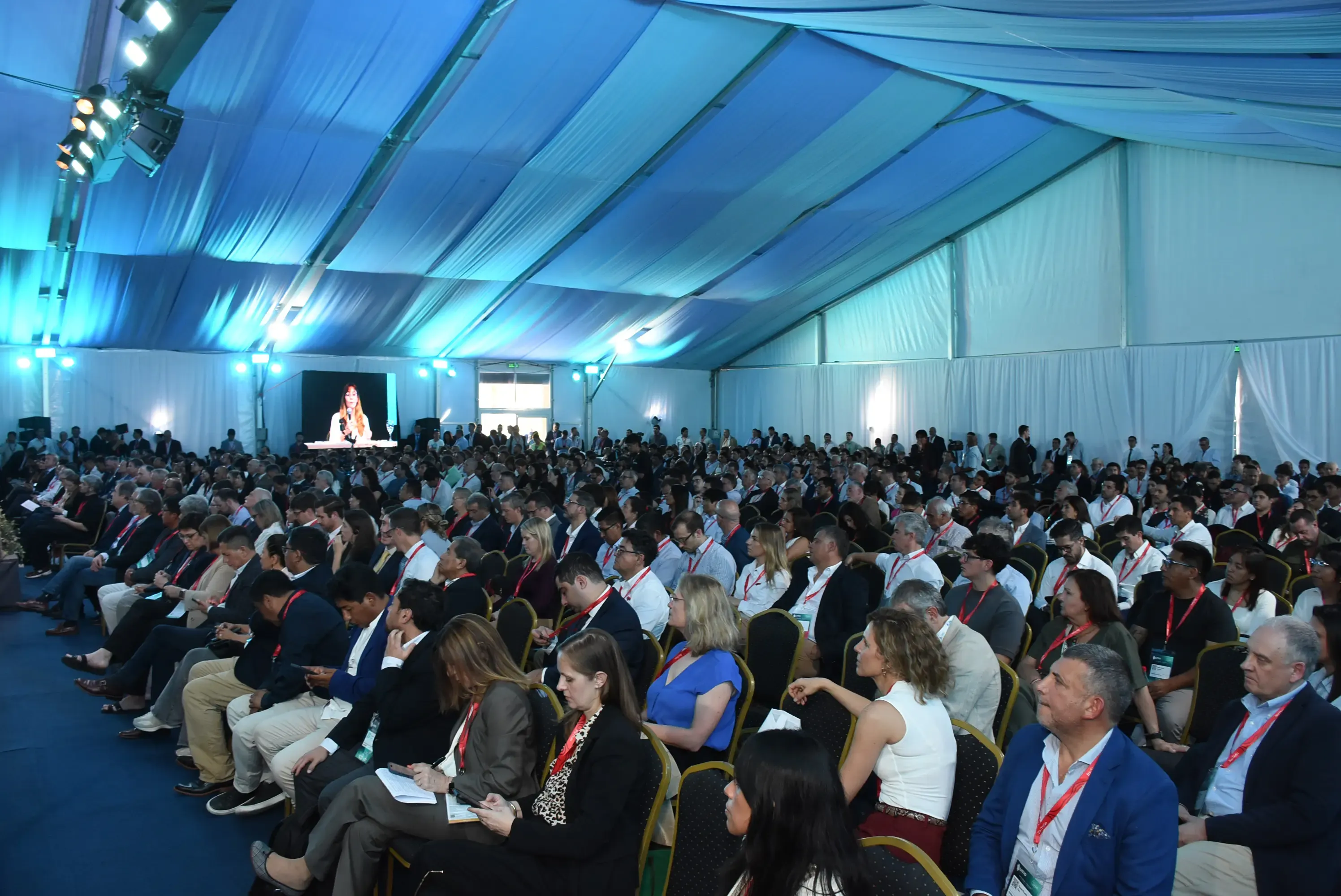
Panorama Minero’s 15th Lithium in South America Seminar opened its doors in San Salvador de Jujuy with a clear indication of the change in scale taking place in the industry: more than 2,000 attendees, representatives from more than 10 countries and an opening panel comprising national and provincial authorities and business representatives, gathered in the enormous main marquee set up at the Altos de la Viña Hotel.
The formal opening featured Mercedes Rodríguez, Executive Director of Panorama Minero; Exequiel Lello Ivacevich, President of JEMSE and of the event’s 2026 Honorary Committee; Roberto Cacciola, President of the Argentine Chamber of Mining Companies (CAEM); Fernanda Ávila, Executive Secretary of the Lithium Roundtable and National Deputy; José Gómez, Minister of Mining of Jujuy; Luis Lucero, National Secretary of Mining; and Carlos Sadir, Governor of Jujuy.
Rodríguez opened the event with a comparison that summarized the evolution of both the event and the industry. She recalled that 15 years earlier, the first seminar had been held at the same hotel, although in the Imperial Hall and before approximately 180 people. “Today the reality is different. The world is looking at Argentina,” she noted, linking the scale reached by the event to the evolution of lithium in the region.
However, the head of Panorama Minero warned that growth also brought new demands. The challenge, she stated, was to continue improving the conditions needed to guarantee mining that is “inclusive, efficient, sustainable and socially positive”.
From Potential to an Established Industry
The first assessment of the new stage came from Lello Ivacevich. The President of JEMSE contrasted the current situation with that of 2024 and recalled that Argentina had ended that year with US$630 million in lithium exports, while in 2025 it had reached a record US$905 million. For 2026, he expected that figure to be exceeded again as a result of increased production and investment in Jujuy, Salta and Catamarca.
“Lithium in our region is no longer just a potential resource,” he stated. The activity, he maintained, had already become a driver of exports and, at the same time, a source of new investment, employment and supplier development.
As an example, he mentioned the hydrochloric acid plant installed in Perico. Two years earlier, during the previous edition of the seminar, the facility had been under construction. Now, he noted, it was already an operating industrial facility with workers from Jujuy and the capacity to supply the regional lithium value chain.
Based on this change in scale, Lello Ivacevich argued that the discussion should focus on how to manage growth. Infrastructure, suppliers, talent and technology emerged as necessary conditions for sustaining it, but he also incorporated an international dimension: the interest of different countries and organizations in critical minerals.
“We have to produce more and also produce better,” he summarized. For the head of JEMSE, the industry’s success should not be measured solely by the tonnes produced, but also by the impact generated throughout the entire value chain, with greater traceability, efficiency in water use, reduced emissions and a more mature relationship with communities.
An Industry Seeking to Become a State Policy
Cacciola took the floor and defined the current moment for lithium through one concept: purpose. Drawing on his 36 years of experience working at Mina Aguilar, in Jujuy, he emphasized that the industry should place people, quality employment, training and human resources development at its centre.
The President of CAEM also highlighted progress in supplier development and the requirements companies face when joining supply chains, ranging from certifications to compliance standards and competitiveness.
He also highlighted the coordination achieved among Jujuy, Salta and Catamarca. “Not many years ago, this was truly unthinkable,” he stated, noting the significance of the three provinces having established common objectives around mining.
Cacciola provided another reference to illustrate the scale of growth: Argentina had exported approximately 32,000 tonnes of lithium carbonate in 2021, and that volume was approaching 170,000 tonnes in 2026. His expectation was that, if the process maintained its pace, the country could exceed 300,000 tonnes by 2034–2035.
“The country has to benefit from mining, from lithium in this particular case, which is advancing very strongly, and hopefully soon from copper as well,” he stated.
The Lithium Roundtable Seeks to Organize Cooperation
Ávila focused on one of the main challenges of the new stage: transforming potential and production growth into development for communities.
She recalled that in 2021 the governors of Jujuy, Salta and Catamarca had created the Lithium Roundtable to address problems extending beyond provincial borders. Since this year, Jujuy had held the presidency of the initiative, which also sought to organize cooperation among international organizations, the national government and the provinces.
The official outlined five areas of work: a long-term roadmap; supplier development; a project portfolio to anticipate infrastructure, energy, water and gas needs; governance and regulatory harmonization; and institutional strengthening.
The roadmap was being developed together with the World Bank and aimed to establish concrete objectives for the coming years. Regarding suppliers, the Roundtable was working with international organizations and business chambers to identify financing and training needs.
In this context, the Federal Investment Council had introduced financing instruments for companies in the region, while universities in Jujuy, Catamarca and Salta, together with the National Technological University (UTN) and other institutions, were participating in the design of training programs.
“Trust is built through results,” Ávila stated. For this reason, she argued that the success of the Lithium Roundtable should be measured by what it could leave behind at the end of her term: a common roadmap, a project portfolio, tools for suppliers, greater institutional capacity and a regional agenda capable of being sustained beyond changes in leadership.
Jujuy Seeks to Expand Mining Beyond Lithium
Minister Gómez brought the discussion to the provincial level and recalled that Jujuy had been declared the National Mining Capital in 1974. The province, he argued, should not be identified solely with lithium, as it also had copper, silver, zinc, rare earth and borate resources.
“Mining is a state policy,” he stated, after highlighting the provincial decision to give the mining sector greater institutional standing. As he explained, the objective was to transform underground mineral wealth into a driver of development, generating formal employment and strengthening regional economies.
Gómez also highlighted that lithium activity generated 60% of its expenditure on services directly within Jujuy, and that the province sought to increase that share through new small and medium-sized enterprises.
The official also linked mining to social infrastructure, education, water, sanitation and energy. He mentioned training programs and the establishment of technical schools in mining communities, as well as safe water projects and solar-powered towns.
National Government Projects 650,000 Tonnes of Capacity by 2035 and US$10 Billion
Lucero presented one of the most striking illustrations of expected growth. He clarified that his figures referred to installed capacity and not necessarily actual production.
According to his data, Argentina had gone from 18,000 tonnes per year of lithium carbonate equivalent (LCE) capacity in 1997 to 80,000 tonnes in 2023. With new operations and expansions, 2026 would end with 275,000 tonnes per year of installed capacity.
The official projection pointed to exceeding 500,000 tonnes in 2030 and reaching approximately 650,000 tonnes per year in 2035.
At the same time, exports had increased from US$645 million in 2024 to US$1.467 billion during the first eight months of 2026. The national government expected to reach almost US$10 billion in annual exports of lithium carbonate equivalent by 2031.
To explain this leap, Lucero identified three conditions: provincial political leadership, business leadership and investor confidence, associated with an orderly macroeconomy and stable rules of the game.
On the latter point, he particularly highlighted the RIGI (Large Investment Incentive Regime), which he described as a tool for building confidence in an activity requiring long-term investment.
The challenge, he stated, would be to sustain those conditions. If the projections materialize, Jujuy, Salta and Catamarca could become the world’s third major lithium-producing region by 2030–2035, behind China and Australia.
Jujuy Announces New Projects and Greater Capacity
The closing remarks were delivered by Governor Sadir, who highlighted that more than 10,000 people from Jujuy held jobs directly or indirectly linked to mining. In 2025, Jujuy had become the country’s third-largest mining-exporting province, accounting for approximately 16% of national mining exports, while the activity represented more than 10% of the province’s Gross Geographic Product.
Sadir also outlined new projects and expansions. With Rio Tinto, the province had agreed on technological optimizations at the Olaroz plant to increase lithium recovery and the start, in 2027, of a pilot plant at the Cauchari salt flat to validate advanced extraction technologies.
Exar, which already had a project approved under the RIGI, was advancing preparatory work for a direct lithium extraction pilot plant aimed at reducing water and energy consumption. Provincial capacity could reach 125,000 tonnes per year of lithium carbonate, with approvals that would allow it to reach 150,000 tonnes.
This was complemented by the approval of environmental impact assessments for CNGR at the Jama salt flat, a project that would add another 24,000 tonnes of capacity.
However, Jujuy’s mining landscape did not end with lithium. Sadir announced an extension of Mina Aguilar’s mine life until 2043, with production from a new mineralized body expected to begin in 2030, as well as progress at Pirquitas and Cortaderas.
The governor concluded with a statement that reflected the central theme of the entire opening: “Our decision is that every dollar invested in the Puna should drive Jujuy’s economy.” The objective, he said, is for transport, metalworking, logistics, construction and services to grow alongside mining and transform Jujuy not only into a place of extraction, but also into a centre for knowledge generation and added value.
“I know that there is still much to be done and that we have a great deal of work ahead of us, but we have the firm determination that mining should leave value in Jujuy, and that the results should increasingly be seen in employment, local companies, infrastructure works and the development of our communities and towns,” the governor concluded, officially inaugurating the country’s largest lithium event.