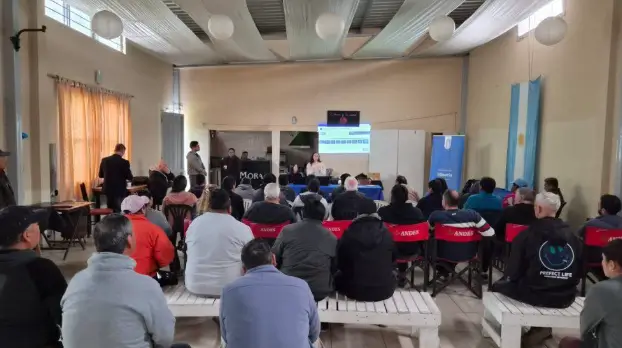
Mendoza’s Directorate of Mining has launched a province-wide Provisional Registry of Brick Producers and provided training to more than 40 producers in El Algarrobal on the procedures required to regularise their activities. The measure extends the province’s mining sector reorganisation to its most artisanal activities. The authorities now aim to establish where brick kilns operate and under what conditions, many of them run by families.
By Panorama Minero
The registry is intended solely for information gathering, and registration does not replace the legal and environmental regularisation procedures. Its purpose is to provide a basis for the subsequent stages of a process that the province has been developing since 2025.
The initiative arose at the request of the producers themselves and operates through a digital form. A separate form must be completed for each property or plot of land where brickmaking takes place, regardless of how many producers work there. This approach organises the survey around the production site.
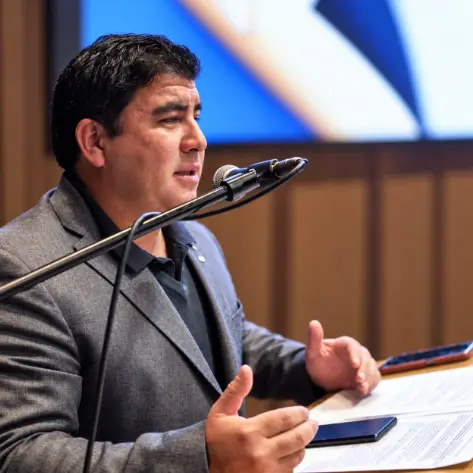
The training session in El Algarrobal focused on the Initial Report (Informe de Partida) and the requirements for submitting it. Javier Frías, Coordinator of the Sustainable Development Department at the Directorate of Mining, stated that these meetings provide an opportunity to “listen to the sector’s needs”. Carmen Biedma, a representative of the environmental technical department, noted that it is “essential that producers understand the procedures”.
The inclusion of brickmakers in this programme reflects their classification within the mining sector, placing them under the same regulatory system as major mining projects, although with different scales of operation and management tools.
One Authority for Two Different Scales
Brickmaking operations are classified as third-category mines, and their active processing plants are also subject to the regulatory framework. Resolution 450/2025 had already classified brickmaking, cement and concrete industries as mineral processing plants. A distinctive feature of the sector is that clay extraction, moulding, drying and firing all take place on the same property.
Mendoza has more than 500 operations associated with third-category minerals, including aggregates, clays, limestone and gypsum, many of them family-run or small-scale businesses. This geographical dispersion contrasts with metallic mining, where oversight is concentrated on specific, highly structured projects.
The Environmental Impact Report (IIA) for PSJ envisages 157.261 million tonnes of ore and a 16-year mine life. By contrast, the brickmaker registration form asks whether clay is extracted manually or using a backhoe loader.
This difference in scale explains why the province opted for a dedicated instrument for the sector, following fieldwork that preceded the regulations.
From Survey to Regulation
The process began in October 2025 with a multisectoral meeting on small-scale producers and continued in January 2026 with a working group involving the Municipality of Las Heras, producers and local residents.
In March, the Mining Environmental Authority conducted a survey in Jocolí, Lavalle. In June, a workshop in El Algarrobal brought together more than 50 producers.
In August, Mining Resolution 540/26 and Environmental Management and Oversight Resolution 55/26 introduced a specific Annex III to the Initial Report.
The regulations recognise characteristics specific to the sector, including informality, artisanal production and the lack of professional technical assistance.
In September, the ProNaPre mining working group included working practices in third-category mines among its three priority areas.
The registry now forms part of this process as a province-wide diagnostic tool, at a time when the sector-specific requirements have already been established.
El Algarrobal: The First Test of the Framework
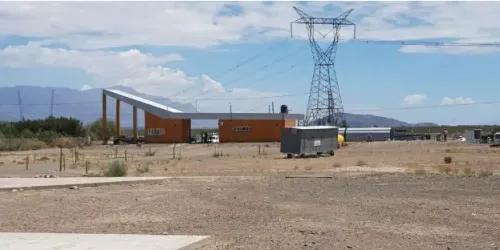
El Algarrobal has the highest concentration of brickmaking establishments in the province. Production there is predominantly artisanal, characterised by labour-intensive processes, limited mechanisation and informal operations.
A 2015 territorial assessment by Universidad Maza had already identified both active and abandoned brickworks in the district, attributing part of the lack of government action to overlapping responsibilities among public agencies.
Against this background, Annex III requires the georeferencing of each area of the property, identification of fuels and nearby dwellings, assessment of emissions from the firing process, and submission of a Remediation Plan including a budget and sworn declaration.
The plan must be implemented within a maximum period of six months following its approval, unless a justified exception is granted.
For a family-run operation without technical assistance, these requirements represent a significant change, and this is where the effectiveness of the support promised by the province will be assessed.
The system Mendoza is developing to assess world-scale copper projects must also extend to the kilns producing bricks for local construction, with regulations proportionate to each scale of operation and sustained oversight capabilities throughout the province.