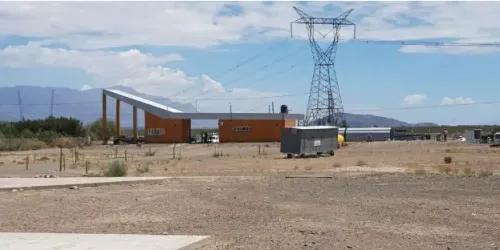
Catamarca has taken an institutional step by formally approving, through Law No. 5972, the Agreement of Accession to National Law No. 24,331 for the establishment of the province's Free Trade Zone. The facility will be located in the Tinogasta department, where lithium projects such as Tres Quebradas, operated by Zijin-Liex, and Tres Cruces, operated by Minera Cordillera, are located.
By Panorama Minero
The initiative, approved during a Senate session, grants the provincial executive the administrative and management powers required to advance the establishment of the commercial and industrial zone.
In explaining the legislation, Pamela López, Senator for Tinogasta, emphasised that its approval represents significant progress towards transforming the province's productive and economic structure, with the aim of attracting investment and generating sustainable employment in the region.
The passage of the law completed the legislative process, which included amendments to the original proposal. The requirement to establish the Free Trade Zone at a single geographical location was removed, and the Tinogasta department was designated as the general area for the development of the complex, leaving its exact location to be determined.
This amendment followed a request from representatives of business organisations and government authorities in Fiambalá, a mining district within Tinogasta, seeking inclusion in the benefits provided under the regime.
Consequently, the legal framework provides for the necessary procedures to extend the regime to the municipalities of Tinogasta or Fiambalá, in accordance with current regulations.
“A Turning Point”
Following the final approval of the law, Ernesto Andrada, Mayor of Tinogasta, welcomed the legislative decision and stated that the initiative would mark “a turning point for our entire region”.
Andrada highlighted the coordinated work undertaken with Senator Pamela López and the provincial government's efforts with national authorities to move the administrative process forward.
However, the mayor clarified that the enactment of the law marks the beginning of a new implementation stage.
Immediate priorities include carrying out the basic infrastructure works required by the national government, for which funding sources will be coordinated between the province and the municipality.
Regarding territorial discussions, Andrada called for political differences to be overcome and emphasised the historical relationship between Tinogasta and Fiambalá, describing them as “sister communities” focused on joint development.
In terms of human resources, the mayor confirmed that the municipality has initiated discussions with the National University of Catamarca (UNCa) and the National Technological University (UTN) to implement technical and professional training programmes.
The aim of this educational initiative is to provide young people in the area with training in advance, ensuring they are prepared to access skilled employment opportunities as new companies establish operations in the region.