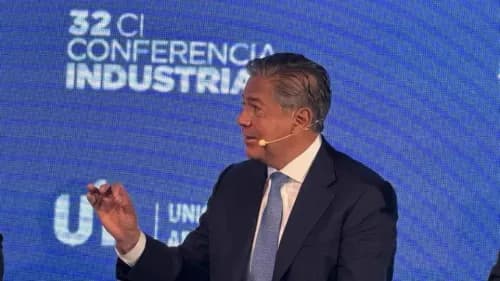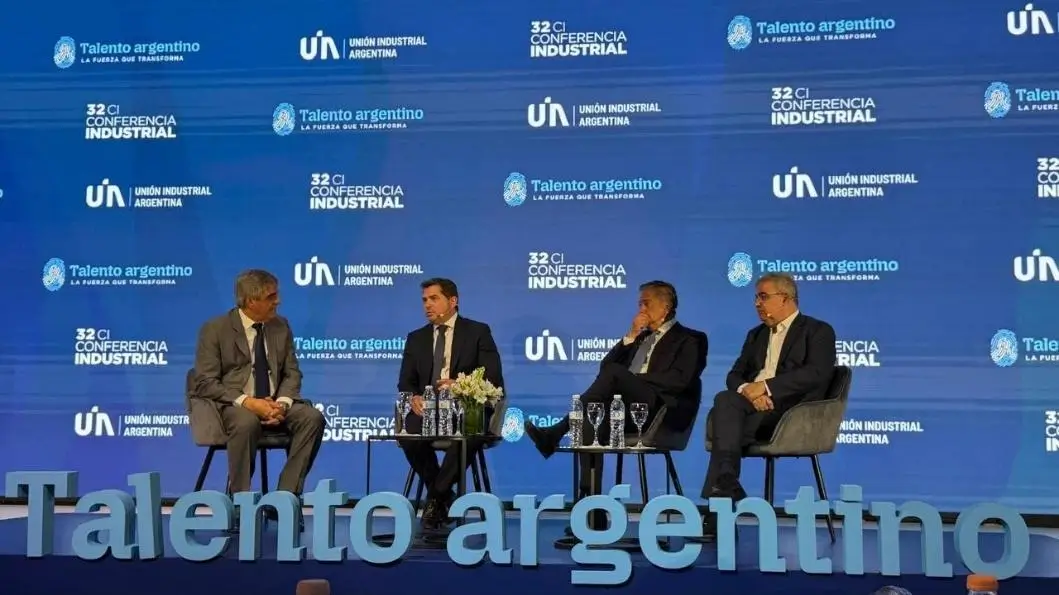
The governors of Catamarca, Raúl Jalil; San Juan, Marcelo Orrego; and Neuquén, Rolando Figueroa, outlined to the Argentine Industrial Union (UIA) how mining and energy can be integrated into the manufacturing sector’s value chains. The discussion took place during the 32nd Industrial Conference, at a time when industrial activity has recorded nine consecutive months of decline.
By Panorama Minero
The event featured two panels of governors under the theme “The New Geography of Development: Energy, Mining and Value Chains”.
The first panel brought together Catamarca Governor Raúl Jalil, San Juan Governor Marcelo Orrego and Neuquén Governor Rolando Figueroa, alongside the President of the Argentine Chamber of Mining Companies (CAEM), Roberto Cacciola. The second featured Córdoba Governor Martín Llaryora and Santa Fe Governor Maximiliano Pullaro.
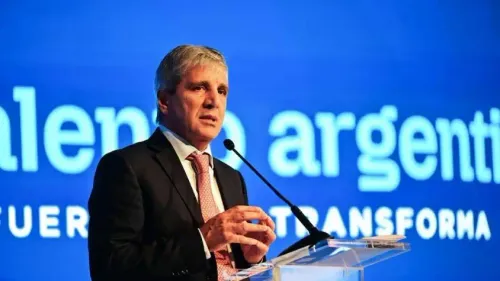
The conference opened with Minister of Economy Luis Caputo and Buenos Aires City Mayor Jorge Macri, and concluded with the President of the UIA and Chief of Cabinet Diego Santilli.
Among the general conclusions, business leaders reiterated the need to reduce the tax burden and the cost of doing business in Argentina, and to move towards a uniform tax framework that would ease pressure on small and medium-sized enterprises.
Catamarca: From Lithium to Copper
Jalil once again highlighted the RIGI and stated that the favourable period for lithium mining “prepares us for something bigger”, referring to copper.
According to the Governor, the regime accelerated investments that were already planned in the province while also creating the need to train workers and develop suppliers capable of joining the value chain.
Building on this experience, he maintained that Catamarca is better prepared for the upcoming copper development cycle.
Jalil recalled that, in September, a UIA delegation led by its President visited the province. He stated that their joint efforts are aimed at integrating industrial suppliers into the opportunities created by mining.
He also presented progress in mining investment, local supplier development and connectivity through the Bi-Oceanic Corridor, highlighting that public-private cooperation had helped sustain job creation and consolidate the regional energy transition.
Jalil cautioned that mining “will not solve all problems on its own, although, together with oil and gas, it will contribute to further stabilising the economy”.
San Juan and Neuquén: Infrastructure and Suppliers
Orrego focused on the infrastructure required to support investment.
According to the Governor, San Juan secured more than US$1 billion in funding, allocated, among other purposes, to infrastructure works aimed at improving safety and reducing logistics costs.
Describing the province’s strategy, Orrego stated that “we do not simply sit behind a counter waiting” and explained that San Juan actively seeks investment.
He also advocated diversified development, with mining as a driving force, and outlined measures introduced by his administration to reduce the tax burden.
Figueroa, meanwhile, described a paradigm shift for Neuquén’s economy, driven by the opportunity to bring its energy resources to international markets.
He maintained that Vaca Muerta requires a network of companies, services and suppliers, and that provinces should complement one another rather than compete.
The Industrial Sector’s Perspective
The manufacturing sector’s assessment offered another perspective.
Llaryora argued that Argentina needs a national industrial development strategy encompassing both emerging activities and established companies.
He highlighted the importance of agribusiness in Córdoba, Santa Fe and the interior of Buenos Aires Province, where he identified more than 470 major companies.
Pullaro agreed on the need to discuss the federal tax system and recalled that Santa Fe had provided ARS 80 billion in tax relief to productive sectors through its 2026 tax legislation.