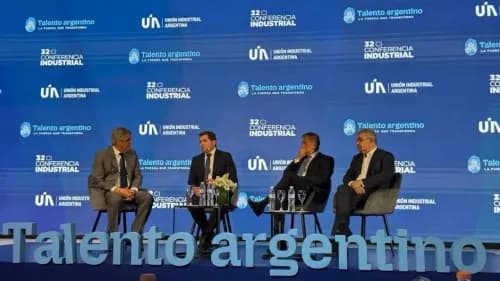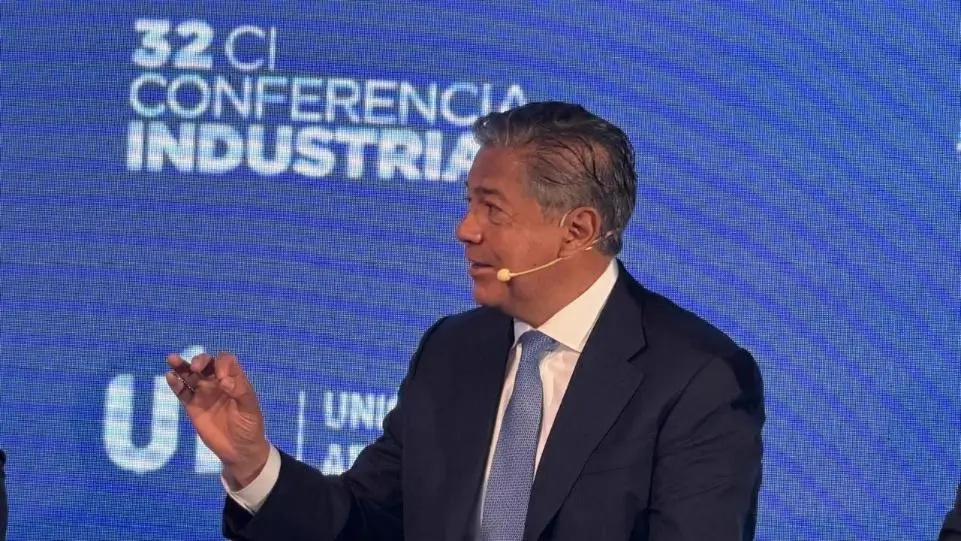
Neuquén Governor Rolando Figueroa defended before the Argentine Industrial Union (UIA) the development model his administration has pursued since December 2023, with Vaca Muerta as its driving force and infrastructure, productive competitiveness and a more equitable distribution of federal resources as its central priorities. He made his remarks during a panel at the 32nd Industrial Conference, alongside Catamarca Governor Raúl Jalil and San Juan Governor Marcelo Orrego.
By Panorama Minero
Figueroa described a paradigm shift for the provincial economy, driven by the opportunity to bring its energy resources to international markets. He contrasted this situation with the previous system, in which, according to the Governor, prices were set by decree and the Province received considerably less than market value for its resources.
He argued that this new phase requires competitiveness, coordinated efforts and the development of a productive network capable of supporting the expansion of the formation.
The Governor sought to clarify one point: Vaca Muerta cannot be understood solely as a geological formation or as an isolated economic activity.
"Vaca Muerta is just a rock," he stated, adding that it is a necessary but insufficient condition.
To sustain energy development, he explained, a network of companies, workers, services, infrastructure and suppliers is needed to transform production into economic activity both within and beyond Neuquén.
Local Suppliers
One of the central themes of his presentation was strengthening the role of suppliers based in Neuquén.
Figueroa stated that the Province is working with operating companies to increase the participation of local firms in the value chain and that part of the revenue generated from the exploitation of underground resources is redistributed to support this growth.
He emphasised that purchases are made through transparent tendering processes and warned against procurement practices that tend to concentrate operations among a small group of companies.
The Governor also argued that Vaca Muerta's development should not be viewed as competition between provinces.
He mentioned the participation of companies from Santa Fe, Mendoza, Córdoba, Buenos Aires and La Pampa, as well as firms from Patagonia.
An Infrastructure Programme Under Way
The second major theme was the shift in his administration's priorities.
Figueroa recalled that he had agreed on a Governance Pact with municipalities and established addressing an infrastructure backlog equivalent to a US$4 billion debt to the population as a priority.
To finance the programme, he mentioned loans from multilateral organisations, the issuance of public debt securities and the Province's own resources, alongside mechanisms for corporate participation in infrastructure projects linked to Vaca Muerta.
According to his figures, the Province is undertaking an unprecedented volume of infrastructure development in its history: the construction and paving of 1,000 kilometres of provincial roads, 100,000 square metres of school buildings, a further 100,000 square metres of hospital facilities and 50,000 square metres of prisons and police stations, as well as extensions to gas and fibre-optic networks.
The Governor maintained that these infrastructure works must continue to support productive growth.
Gross Receipts Tax and Federal Revenue Sharing
Figueroa stated that Neuquén maintains an effective Gross Receipts Tax rate that he described as low.
He also announced that provincial planning envisages, from 2028 and subject to certain contracting requirements, eliminating this tax for companies participating in the value chain.
Finally, he shifted the discussion to the distribution of national resources and called for a debate on a new federal revenue-sharing arrangement.
He argued that provinces currently receive a smaller proportion of government resources than they did during the early years of Argentina's return to democracy, despite having assumed additional responsibilities.
He also questioned Neuquén's allocation coefficient under the secondary distribution of federal revenues, comparing it with those of other jurisdictions.
Figueroa maintained that the debate over federalism must be comprehensive.