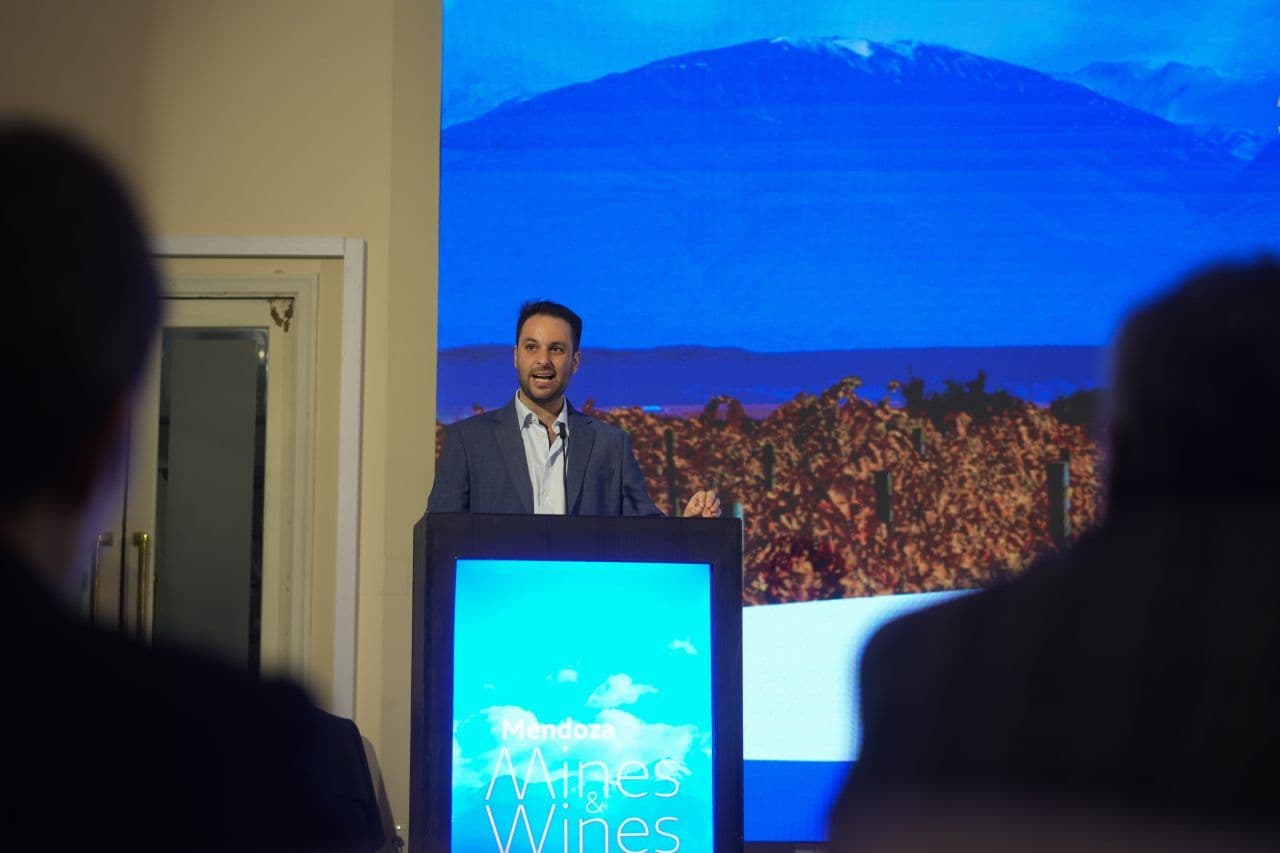
At an event held at the Mendoza Stock Exchange, Argentina Metals formally introduced itself in Mendoza. The event served as a platform to present not only the company's arrival in the province, but also the model through which it plans to grow within one of the regions that is beginning to regain exploration momentum.
By Panorama Minero
The presentation came just days after the company's listing on the TSX Venture Exchange, a milestone that, for Argentina Metals, represents far more than stock market validation. According to Raymond Harari, this step marks the beginning of a new phase in the company's expansion strategy.
"This is not the culmination of a process; it is the beginning of a much bigger process," he said.
That statement encapsulates much of what the company is now seeking to build. In just over a year, Argentina Metals has assembled one of the largest private exploration portfolios in Mendoza, focused on Malargüe and with significant exposure to areas associated with the province's western copper corridor and properties located within Malargüe Western Mining District (MDMO).
Rapid Portfolio Building
The company's expansion began in November 2025, when it announced the acquisition of Las Estrellas, Zascar, Vecindario, and La Herradura. That transaction marked its initial entry into Mendoza and represented the first stage of a strategy based on consolidating a large land position. From that point onward, growth was gradual but continuous.
The most significant transaction came in January 2026, with the acquisition of the Mendoza Portfolio from Mirasol Resources, through Nueva Gran Victoria S.A. That transaction added 14 new properties, several of which already held approved Environmental Impact Declarations (DIA) within MDMO I, allowing the company to strengthen its position in an area that now hosts much of Mendoza's new exploration activity.
The portfolio was subsequently expanded with the addition of El Salado and La Quimera, followed by Angellica, Roma, Veneto, and Belluno, bringing the total inventory to 24 properties covering approximately 146,000 hectares of highly prospective geological ground, according to the company.
Within that portfolio, Las Estrellas is currently the company's most technically advanced project. There, Argentina Metals has already reported geochemical surveys, surface sampling, ground magnetics, and the generation of structural drill targets. Its proximity to El Perdido—the Kobrea Exploraciones project currently undergoing deep drilling—also positions the area as one of the most prospective exploration sectors within MDMO I.
Exploring to Create Value
Beyond the size of its portfolio, Harari made clear the operating model Argentina Metals intends to follow. The company is pursuing the classic junior mining strategy: securing early-stage ground, carrying out systematic exploration, generating geological information, drilling targets, and creating value through discovery.
This process aims to reduce geological uncertainty and transform early-stage prospects into projects capable of attracting investment capital or corporate interest. Within this framework, the company does not necessarily envision itself as the eventual mine operator.
"We will advance as far as the major companies allow us to," Harari explained.
That statement summarizes a central aspect of the junior mining business model. The objective may be to advance projects toward resource definition, while also remaining open to the possibility of a major mining company acquiring the asset.
"If a major company wants what we have, we have no problem handing over the keys," he added.
The approach reflects a model that is becoming increasingly common throughout the region: junior companies assume the initial exploration risk, validate geological potential, and retain the option of monetizing projects before construction begins.
The Logic Behind the Acquisitions
Harari also explained how the company's acquisition strategy in Mendoza was structured. According to him, many of the agreements with property owners were based on equity participation rather than more traditional structures involving royalties or milestone-based payments.
The objective behind this model is to align interests. Instead of having each property compete for budget allocation or individual results, all stakeholders share exposure to the overall performance of the portfolio.
According to Harari, this structure provides greater operational flexibility and allows exploration capital to be allocated according to geological priorities rather than contractual commitments that could constrain exploration activities.
Mendoza as a Strategic Decision
Another key point of the presentation was Harari's explanation of why the company chose Mendoza as its growth platform.
"The short answer is Impulsa Mendoza," he said.
Harari particularly praised the institutional framework that the province has been developing to support early-stage mining projects, describing it as a decisive factor for companies that depend on risk capital.
In that regard, he explained that mineral exploration faces two major risks: geological risk and political risk. While geological risk is unavoidable and inherent to the business, political risk can determine investor interest.
His view is that Mendoza currently offers a framework that reduces that uncertainty and allows medium-term exploration programs to be planned with greater predictability.