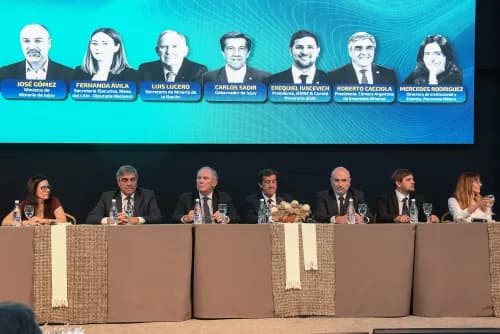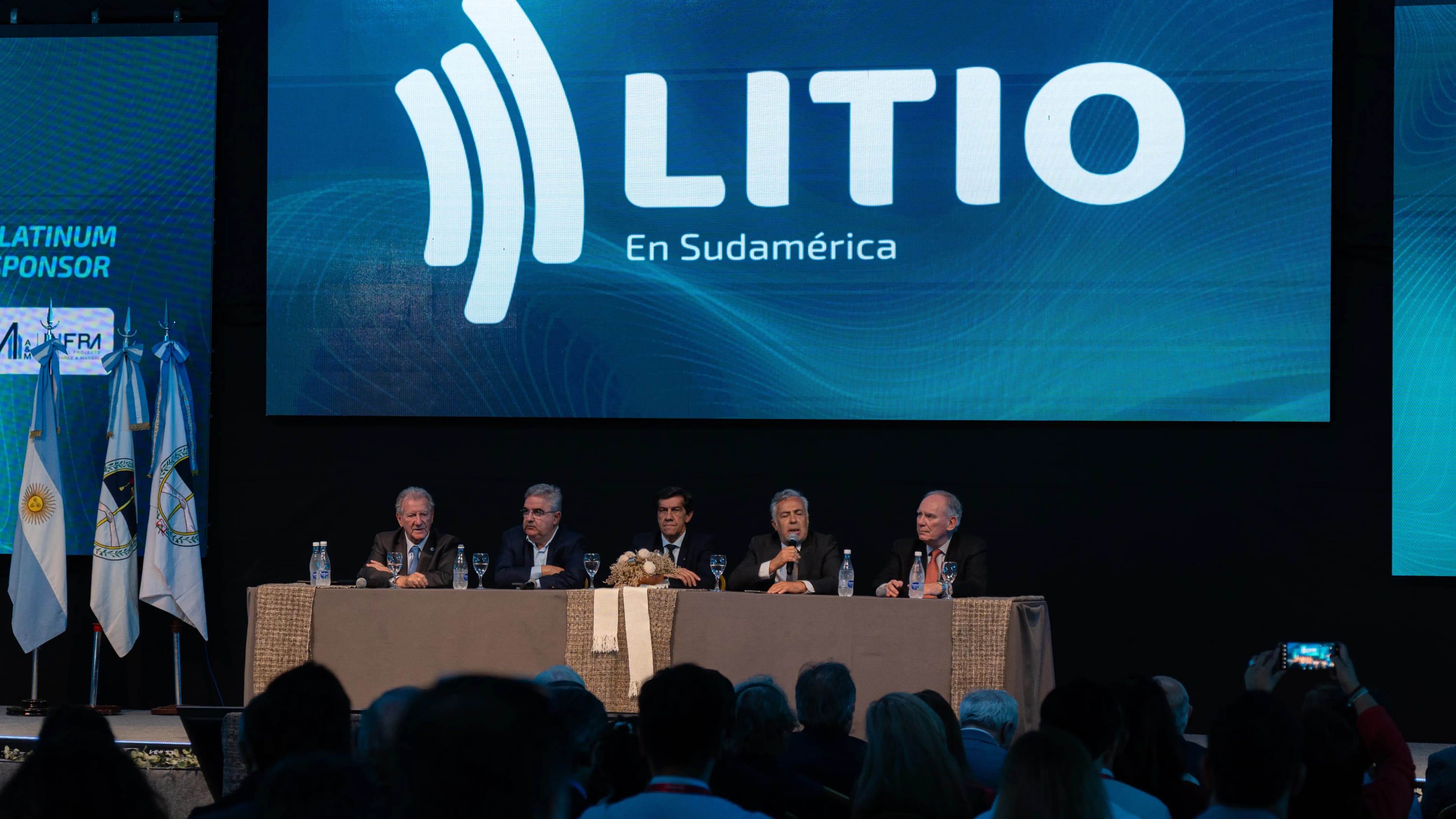
At the closing ceremony, leaders from Jujuy, Catamarca, Mendoza and Salta agreed that the new mining cycle requires stability, infrastructure, suppliers and training to translate investment into employment and regional development. Luis Lucero called for maintaining the institutional and economic conditions that have driven the sector.
By Panorama Minero
Building a mining-oriented Argentina is no longer simply a discussion about geological resources and investment projects, but has become a debate about the productive model that the provinces can develop. This was the common message at the close of Panorama Minero’s Lithium in South America Seminar, held on 7 and 8 October in San Salvador de Jujuy, where the governors of Jujuy, Catamarca and Mendoza, the deputy governor of Salta and Argentina’s Secretary of Mining, Luis Lucero, agreed that the challenge now is to transform the growth of lithium and copper into employment, infrastructure, suppliers and development across the country.
With more than 1,500 people attending the second day and diplomatic delegations from over 10 countries, including the United States, China, the United Kingdom, India, New Zealand, the United Arab Emirates, France and Saudi Arabia, the closing panel, entitled “Building a Mining-Oriented Argentina,” served as a political summary of the two days of discussions.
The consensus among the different provinces was clear: there is an unprecedented international window of opportunity for Argentine mining, but taking advantage of it requires continuity, clear rules, infrastructure investment and a strategy to ensure that development reaches local communities.
Jujuy: Employment, Suppliers and Community Development
The governor of Jujuy, Carlos Sadir, opened the panel by acknowledging the international interest generated by the event and focusing on the current situation of Argentine mining, particularly lithium and copper.
For the governor, the combination of a more orderly macroeconomic environment and provincial policies has helped consolidate conditions for attracting investment.
“There is a business climate that looks much better, obviously, with more appropriate control of all macroeconomic variables, but fundamentally because of the political decisions made by each of the provinces,” he stated.
Sadir emphasised that Jujuy has been working with lithium for more than a decade and highlighted the province’s legal certainty, respect for contracts and support for the Incentive Regime for Large Investments (RIGI).
“We provinces have been working particularly with lithium, Catamarca and Jujuy since 2014. Catamarca even earlier, and Salta has also been doing so, not only in lithium but in mining in general,” he noted.
In this context, he highlighted that Jujuy has two projects covered by the RIGI, one already under development and another close to obtaining approval, and identified the objective of maintaining the province’s leadership in lithium production and advancing mining exports.
However, the central focus of his remarks was an issue that featured throughout much of the seminar: how to ensure that mining growth translates into opportunities for communities.
“The great challenge is for this to mean job creation, direct and indirect employment, and the development and training of mining suppliers, particularly from our communities,” he stated.
Sadir linked this strategy to education and vocational training. The province, he explained, is working with JEMSE, universities and provincial organisations to expand training and create conditions for residents of mining areas to access more highly skilled jobs.
“We need our people to be better trained, better prepared and more knowledgeable, so that they can also access all kinds of jobs at mining companies, at all the operations we have, even carrying out highly specialised tasks,” he stated.
For the governor, the ultimate objective is to prevent mining activity from generating wealth without leaving permanent capabilities in the areas where it operates. “We want our people to be better off, for our communities to develop, improve and participate actively,” he summarised.
Sadir also highlighted Mendoza’s efforts to revive mining activity and congratulated Cornejo on the progress of copper projects. At the same time, he emphasised the joint work of the Lithium Roundtable to strengthen suppliers and education in producing provinces.
Catamarca: Consolidating the Model and Expanding Its Scale
The governor of Catamarca, Raúl Jalil, argued that Argentine mining development must be understood within a new geopolitical and technological environment, marked by artificial intelligence, robotics and the transformation of global supply chains.
In this context, he defended the provinces’ decision to coordinate policies and particularly highlighted the creation of the Lithium Roundtable and, more recently, the Copper Roundtable.
“The National Constitution states that natural resources belong to the provinces, and creating a region has been a good decision,” he stated.
Jalil argued that investors need provincial stability but also macroeconomic predictability, and defended the governors’ support for the RIGI.
However, the Catamarca governor went a step further and raised a discussion about the future of the regime: investment incentives should not be limited to a specific period. “We also need to rethink the RIGI so that it is not a special regime, but a permanent regime,” he stated.
For Catamarca, mining is already part of an economic diversification strategy. Jalil highlighted the growth in exports and anticipated even greater expansion with the addition of copper.
“We have doubled exports; next year we are going to triple them, and next year, with copper, we are going to be competing there, but I think we are going to increase them fivefold,” he stated.
The governor also focused on the need to develop a broader supplier chain, particularly for small and medium-scale mining. “It will be important for us to bring small producers together, or to have policies for small producers, to create synergies with companies of a different size,” he suggested.
At the same time, he defended a strategy combining mining, infrastructure and regional development. Catamarca uses mining trusts and resources associated with the activity to finance public works and improve roads, connectivity and services in productive areas.
According to Jalil, the objective is to avoid the so-called “natural resource curse” and use an extractive activity to build other economic capabilities. “We do not want it to become the natural resource curse,” he stated. To achieve this, he noted, the Lithium Roundtable must serve as a forum to “unify public, fiscal and environmental policies.”
The governor also insisted on the need to communicate more effectively about the environmental impact of new lithium production technologies, particularly direct extraction.
“Most mining companies are working on direct extraction, which generates less environmental impact,” he noted, calling for better public information on water consumption and the benefits associated with the energy transition.
Mendoza: “We Have to Start” the Copper Engine
The remarks by the governor of Mendoza, Alfredo Cornejo, centred on a political position: the province wants to regain a significant position within Argentina’s metal mining industry, with copper as its main priority.
Cornejo acknowledged that Mendoza is beginning the process but highlighted its joint work with the national government and the Secretariat of Mining to take advantage of the international opportunity.
“Mendoza’s economy is extremely diverse,” he noted. However, he added a statement that summarised his position: “Like Argentina, we are incomplete if we do not develop metal mining.”
The province amended its mining procedures code and made progress in approving exploration and exploitation projects. The main objective is copper, although Cornejo also mentioned lithium exploration.
Among the key projects is PSJ Cobre Mendocino, which Mendoza considers one of the developments with the greatest potential to move forward in the short term because of its proximity to roads and power lines.
Cornejo estimated that, if the process continues as planned, Argentina could have copper production from Mendoza and Catamarca towards the end of 2027 or the beginning of 2028. “It is the smallest of Argentina’s copper projects, but it is the most accessible,” he explained.
For the governor, the international environment offers an opportunity that Mendoza cannot afford to miss, particularly because of demand associated with electromobility and critical minerals. “There is an opportunity for our people, to improve activity and further expand our diversified productive structure,” he stated.
Cornejo described mining as a third major economic engine alongside traditional activities and energy development. “Argentina cannot depend on a good harvest in the Pampas for foreign currency. We had to start the gas and oil engine, and we are doing so. And we had this third engine, mining, which we need to start,” he emphasised.
The Mendoza governor also stressed that mining expansion must maintain environmental standards and have social support. “Every project must include all the necessary environmental safeguards and obtain the approval and support of all communities,” he stated.
His assessment was emphatic: Argentina is not yet a mining country, but it is moving towards becoming one. “Argentina is not currently a mining country and has not been a mining country, but it is moving in that direction and working hard to achieve it,” he noted.
Salta: Infrastructure and Regional Scale
The deputy governor of Salta, Antonio Marocco, brought a regional perspective to the closing session. With Governor Gustavo Sáenz absent due to scheduling commitments, he highlighted that the four provinces represented different territories but faced a common responsibility.
“We have different realities, but we share a responsibility: to turn this productive potential into sustained development for our people,” he stated.
For Marocco, the challenge does not end with the arrival of an investment. The state must create the conditions for economic opportunities to reach communities, local companies and workers.
“Investments open up opportunities; the decisions we make must ensure that those opportunities reach every community,” he said.
The deputy governor identified workforce training and supplier development as priorities, but also raised one of the main bottlenecks to mining growth in northwestern Argentina: infrastructure.
“We have specific tasks: improving roads, railways and energy infrastructure, training workers, facilitating financing for our companies and incorporating knowledge to add value,” he listed.
Within this framework, he highlighted the importance of National Route 51 and railway connectivity in integrating Salta with the rest of the region and export markets.
Marocco also emphasised the need for coordinated work among the provinces through the Lithium Roundtable and the Copper Roundtable.
“The Lithium Roundtable and the Copper Roundtable express that same willingness: to coordinate priorities, harmonise criteria and strengthen suppliers, allowing us to build regional scale and plan beyond each individual project,” he stated.
The Salta deputy governor added a third component: environmental protection and community participation. “We must also protect water, carry out transparent environmental monitoring and listen to communities,” he stated.
For Marocco, building a mining-oriented Argentina requires sharing responsibilities among the state, companies, universities and workers.
“Companies must invest and fulfil their commitments, while universities and workers have much to contribute to developing capabilities that remain in our territory,” he stated.
National Government: Maintaining the Conditions That Made Growth Possible
Argentina’s Secretary of Mining, Luis Lucero, closed the event with a message focused on preserving the direction adopted by the sector.
After two days of presentations on lithium, copper, critical minerals, investment, financing, infrastructure, suppliers and technological development, Lucero described the seminar as a demonstration of the vitality of Argentine mining. “This event reflects the reality, the vitality of Argentina’s mining sector,” he stated.
The official particularly highlighted attendance at the seminar and the presence of international representatives, which he considered a sign of the interest the country is generating.
However, his main message was institutional: the mining opportunity depends on maintaining the conditions that have allowed investments to begin moving forward.
“We must continue along this same path, in this same direction, improving in every aspect we can, but above all persevering with the institutional, legal and economic conditions that are making this possible,” he stated.
Lucero also highlighted the work of the provinces and the companies and suppliers participating in mining development.
“Please keep it up. A great deal of Argentina’s future depends on continuing what has been done, just as it has been done so far,” he concluded.