As the competition to turn mineral resources into actual investment intensifies, a growing part of the discussion is shifting toward Argentina’s provinces. San Juan, Mendoza and Jujuy are approaching the opportunity from different stages of mining development, but their governors agree on several factors they see as critical for projects to move forward: predictability, infrastructure, permitting and the ability to sustain those conditions over time.
By Panorama Minero
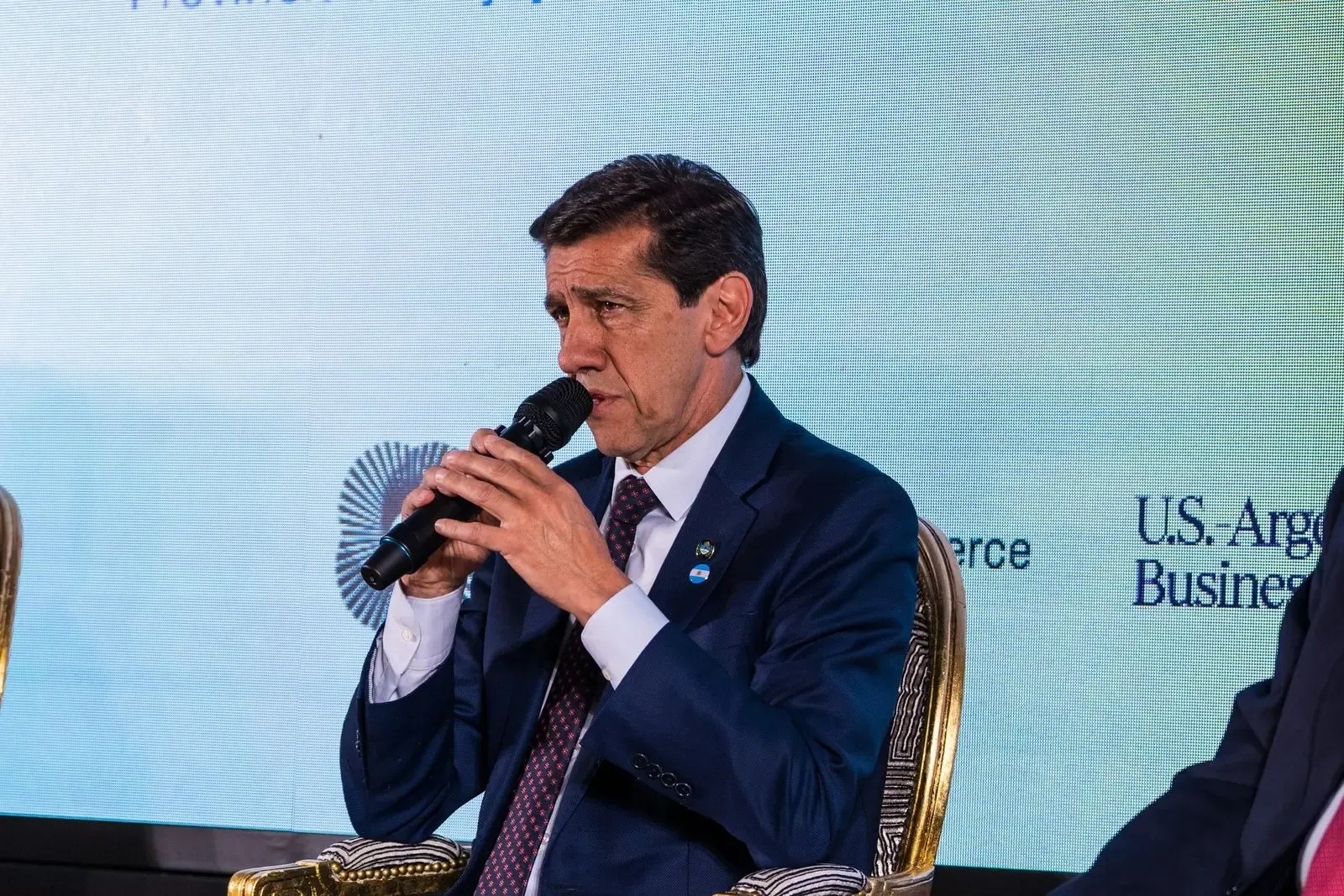
Marcelo Orrego, Alfredo Cornejo and Carlos Sadir addressed that agenda during a governors’ discussion in Buenos Aires as part of the US-Argentina Forum on Critical Minerals. The session was moderated by Alejandro Díaz, CEO of AmCham Argentina.
The differences between the three provinces provide a snapshot of the various stages of Argentina’s mining development. Jujuy has an established mining industry, with lithium accounting for a significant share of its exports. San Juan has a long mining track record and hosts many of the major copper projects that could transform the scale of Argentina’s mining industry over the next decade. Mendoza, meanwhile, is entering a new stage of development after years of restrictions and debate surrounding mining activity.
Cornejo: two conditions that are beginning to converge
For Mendoza Governor Alfredo Cornejo, the current environment brings together two conditions that Argentina has not always been able to achieve at the same time: a national economy seeking to stabilize its key variables and provincial governments willing to compete for mining investment.
Cornejo identified those two factors as central to the sector’s development: macroeconomic stability at the national level and provincial governments capable of facilitating investment, streamlining procedures and providing predictability.
His assessment is particularly relevant for Mendoza. The province is seeking to regain ground on Argentina’s mining map and reached a milestone this year with the approval of PSJ Cobre Mendocino under the country’s Large Investment Incentive Regime, known as RIGI. The project includes an open-pit mine and a concentrator designed to process approximately 10 million tonnes of copper and gold-bearing mineralization per year.
In that context, Cornejo listed a competitive tax burden, skilled human resources, legal certainty and administrative procedures capable of keeping pace with investment timelines among the attributes a jurisdiction can offer.
He also highlighted the importance of securing broad political support for major project-related decisions. For investments that may operate for decades, the ability to maintain the rules beyond a single government term becomes part of the risk assessment.
He summarized his message going forward in a simple statement: “Let’s stay the course and work together.”
Sadir: production also reveals what is still missing
Carlos Sadir approaches the discussion from a different position. Jujuy has an established mining industry and two commercial-scale lithium operations, in a provincial economy where the sector already plays a decisive role.
“Mining represents more than 75% of our exports,” the governor said. Provincial statistics reflect that scale: in 2025, Jujuy exported approximately US$953 million in mining products, ranking as Argentina’s third-largest mining-exporting province and accounting for around 15.9% of the country’s mining exports.
For Sadir, that experience also makes it easier to identify the constraints that emerge as the industry grows. Infrastructure is one of them.
The governor placed particular emphasis on road conditions and the connectivity required by a province that combines mining production in the Puna highlands with a strategic position toward Chile and Pacific ports.
Speaking about road infrastructure, Sadir was particularly critical, warning that some routes are “deteriorating at an alarming rate.”
The issue reflects a defining characteristic of mining geography in Argentina’s northwest: many projects are located far from major population centres and depend on corridors capable of handling the constant movement of workers, supplies and production.
Energy and natural gas requirements add another layer, along with international connectivity. For Jujuy, improving access to Chile could generate benefits beyond mining and enhance the logistics competitiveness of other productive sectors.
Jujuy’s experience therefore offers a different perspective: production growth is beginning to require infrastructure capable of keeping pace with an industry that already occupies a central place in the provincial economy.
Orrego: faster permitting without compromising oversight
In San Juan, Marcelo Orrego focused on another part of the equation: administrative timelines.
The governor argued for more efficient permitting procedures for mining projects, without compromising the rigor of environmental and technical oversight. Permitting speed is increasingly becoming a competitive variable as major mining investors compare jurisdictions before making capital allocation decisions.
San Juan is facing that challenge with a copper pipeline that could substantially transform the provincial economy. Vicuña, El Pachón, Los Azules and other globally significant developments represent potential investments worth billions of dollars and will require infrastructure, suppliers and workers on a scale the province has yet to experience.
For Orrego, one of the key assets needed to navigate that process is trust.
The recent agreement between Vicuña and the provincial government provides a concrete example. It includes an extraordinary US$250 million contribution for strategic infrastructure, along with other economic components associated with the project’s future development.
But the governor placed those works within a broader provincial strategy. His view is that infrastructure developed around mining projects should also be available to other economic sectors in San Juan.
Wine production, pistachios and dehydrated tomatoes were among the examples used to illustrate an idea that is increasingly entering the discussion around major mining developments: mining infrastructure can generate economic value beyond the mine itself when planned as part of a broader regional strategy.
Three provinces, one long-term challenge
The positions of the three governors converge on an issue that is particularly important for an industry in which projects can take more than a decade to move from discovery through studies, permitting, financing and construction before reaching production.
The investment horizon of a mining project is considerably longer than the term of any provincial or national administration.
That difference in timelines turns continuity into an economic variable. A copper project may span several governments before producing its first tonne and continue operating for decades after recovering its initial investment.
Legal certainty, fiscal stability, administrative procedures and infrastructure are therefore closely connected. Provinces may hold exceptional geological resources, but competition for capital is also determined by the conditions surrounding those resources.

Each jurisdiction enters that competition from a different position. Jujuy needs infrastructure capable of supporting an industry that is already producing; San Juan must prepare for a copper pipeline of unprecedented scale; and Mendoza is seeking to demonstrate that its renewed mining push can translate into concrete projects that remain viable over the long term.
All three, however, face the same question: how to turn the current window of opportunity for Argentine mining into investments capable of enduring economic cycles, changes of government and decades of operation.