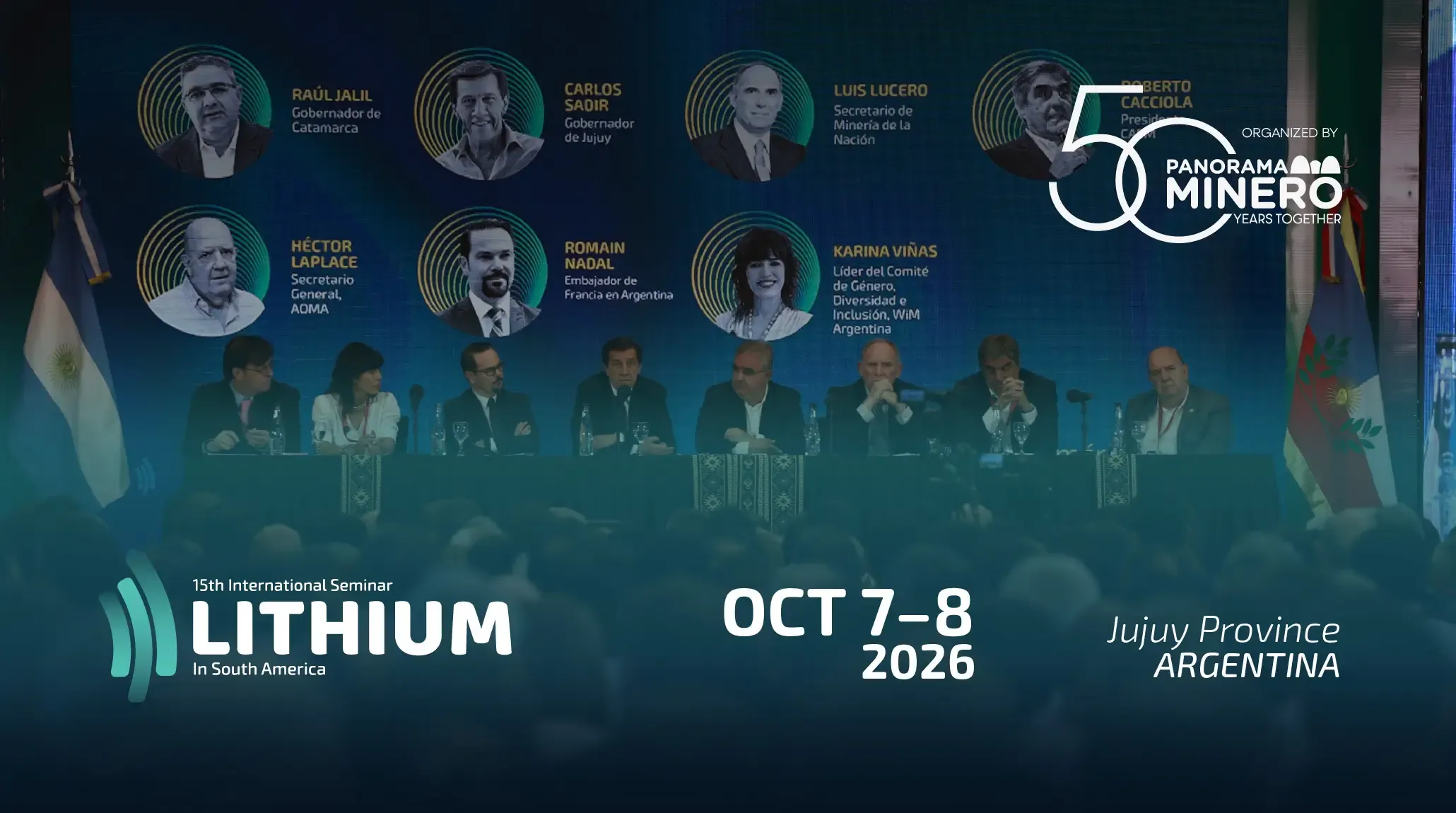
Just two days remain until Jujuy once again becomes one of the main gathering points for the international lithium industry. On Wednesday 7 and Thursday 8 October, Panorama Minero will hold the 15th edition of Lithium in South America, a conference that has tracked the sector's growth since 2011 and that this year will bring together representatives of the companies leading Argentine production, projects under development, governments, international organizations, analysts, scientists, suppliers and leaders from the main consumer markets.
The event comes at a moment when the discussion around Argentine lithium is beginning to shift in scale. According to the latest market report prepared by the National Directorate for Mining Promotion and Economics, Argentina was the fastest-growing producer among the main global players in 2025, with year-on-year growth of 62% and output of 120,000 tonnes of lithium carbonate equivalent (LCE). The country has seven producing operations, 16 projects in advanced stages and more than 40 initiatives in prospecting and exploration.
The projections show the leap that could occur over the next decade: Argentine production would exceed 400,000 tonnes of LCE by 2030 and reach about 573,000 tonnes in 2035. To make that expansion happen, the sector could require US$12.7 billion in investment between 2026 and 2030, with a peak of more than US$4 billion in 2027 alone.
It is precisely in that transition, from potential to execution, that much of the agenda starting on Wednesday in Jujuy is positioned.
"Today a lithium decision no longer depends only on price or on the quality of a resource. Access to capital, geopolitics, infrastructure, regulation, costs, technology, water, suppliers and the real ability to bring a project into production all come into play. We designed this edition to connect all of those dimensions, with fresh, first-hand information, alongside the players who are actually making those decisions," said Agustín López Muñoz, Director of Communications at Panorama Minero.
From the territory to capital: where the next stage begins
The first day will begin by focusing on the three provinces that concentrate Argentine lithium development. The business chambers of Jujuy, Salta and Catamarca will open the conversation from the territory, with a diagnosis of suppliers, infrastructure, employment, permits, exploration and the conditions needed to support the new scale of mining activity in the northwest. It will be a relaxed conversation, moderated by the hosts of the popular online show La Fábrica Podcast.
The discussion will move immediately to an international dimension: how to finance the construction of new projects in a global economy shaped by competition for critical minerals. Representatives of MIGA, of the World Bank Group, of the French Development Agency and of the European Union will address access to capital, risk mitigation, infrastructure and international cooperation.
The debate takes on particular relevance given the volume of capital that projected growth will require. The adoption of new technologies also adds pressure to that equation: roughly half of Argentina's advanced-stage projects plan to use direct lithium extraction (DLE), a technology that can require significantly higher capital investment per tonne of LCE produced than traditional methods.
One of the event's main institutional moments will follow. Governors Carlos Sadir, Gustavo Sáenz and Raúl Jalil, together with authorities from the Lithium Roundtable, the national Secretariat of Mining and the Argentine Chamber of Mining Companies, will analyze the evolution of an industry that is simultaneously going through production, ramp-up, expansions and the construction of new capacity. More governors and sector players are expected to join the opening, with the aim of integrating the Lithium Roundtable into the rest of the national political coordination forums.
New rules and an industry beginning to be measured by performance
The afternoon agenda will begin with the new regulations of the Mining Investment Law 24,196. The main provisions of Decree 482/2026 will be presented, which updates a regime in force for more than three decades and introduces changes related to imports, service providers, regional integration, digitalization and administrative procedures.
One of the central conversations of this edition will follow: "Operating growth."
Representatives of Rio Tinto Lithium, Albemarle, EXAR, Eramet and CNGR will discuss a reality different from that of the sector's early years of expansion. With seven operations active and several projects going through ramp-up or expansion stages, the debate no longer centers only on identifying resources or announcing future capacity. Costs, recovery, operational stability, infrastructure, talent, suppliers and speed of execution are beginning to determine which projects can remain competitive through the market's different cycles.
That transformation can already be seen in Argentina's operations. Fénix exceeded 31,000 tonnes of LCE in 2025 and ran at practically full capacity; Olaroz reached about 34,000 tonnes, with more than 85% utilization of its installed capacity; and Cauchari-Olaroz also exceeded 34,000 tonnes, at above 80%. Meanwhile, more recent operations such as Centenario-Ratones, Sal de Oro and Tres Quebradas, although still in the early stages of production maturity, are already delivering product to the market.
"Argentina can no longer be explained by its potential alone. Today we have operations producing, plants going through ramp-up, expansions underway and projects defining their next investments. We want to put on the table what companies are solving on the ground, what they had to change and where the bottlenecks appear when it is time to produce at scale," organizers explained.
The United States, Europe and China: lithium within a new global geography
Geopolitics will take center stage, though from different perspectives.
A dedicated panel will analyze the relationship between Argentina and the United States on critical minerals, in a context where supply security, access to resources and the diversification of production chains have become elements of economic and industrial policy. Argentine and US specialists and representatives will address the opportunities opening up in investment, infrastructure, financing and value addition.
The panel comes after two recent milestones in the bilateral relationship: the signing in February of the Agreement on Reciprocal Trade and Investment (ARTI) and, in late September, the launch of the Andes-Atlantic Corridor, a financing scheme of up to US$7 billion through 2027 for infrastructure, energy and critical minerals, which aims to link the deposits of the Argentine northwest and Vaca Muerta with Atlantic ports.
The participation of MIGA, the French Development Agency and the European Union will complete another dimension of that map: multilateral financing and international cooperation to turn mineral resources into projects, infrastructure and productive development.
China and Asia will also have a prominent place given their industrial and technological weight in the chain. Yang Jianyu, vice president of CNGR South America and a global industry reference, will deliver one of the program's keynotes and analyze the relationship between resources, costs and the value chain of lithium iron phosphate (LFP) batteries.
Next, international specialists José Hofer and Andrew Leyland, of SC Insights, will focus on the positioning of Latin American lithium relative to Asia: what products the industry demands, how infrastructure, costs and regulation weigh in, and how Latin America competes against the rise of new production hubs.
The commercial dimension also helps explain this discussion. More than 80% of Argentina's lithium exports went to China in 2025, while projections to 2035 anticipate a growing relative weight for the United States and the European Union in global demand.
The focus of the event, therefore, will not be to present a choice between markets, but to analyze how Argentina can expand its production scale and diversify opportunities in a global chain increasingly shaped by industrial, commercial and geopolitical decisions.
Joe Lowry and an uncomfortable question for the market
The close of Wednesday's conferences will feature Joe Lowry, one of the most recognized analysts in the international industry, with more than three decades of experience, and founder of Global Lithium, who will come to Jujuy to pose a question running through much of today's debate: is lithium still a misunderstood industry?
The conversation will address why Argentina is well positioned to expand its role: the quality and variety of its salars, almost three decades of commercial operating experience, the ability to produce lithium carbonate in the country and an investment framework that, with RIGI, offers tax, customs and foreign-exchange stability for 30 years. Lowry will also analyze the relationship with China and how a diversified investor base, bringing together capital from the United States, Japan, Australia and China, gives the country room to choose partners and negotiate with a clear understanding of the value of its resources.
He will also offer criteria for separating real opportunities from promotional announcements: the chemistry of each brine, the scope of direct lithium extraction, a category that groups very different processes, and the difference between announcing capacity, producing the first material and operating successfully over time. And he will raise what the country needs to resolve to turn its advantage into lasting value: predictability, infrastructure, development of local capabilities and an understanding of lithium as a chemical industry.
Lowry will also sign copies of his book Lithium Confidential, scheduled before the Welcome to Jujuy Cocktail, which will close the first day alongside authorities, executives, sponsors, speakers and special guests.
Four views on one of lithium's toughest variables: price
The second day will take the discussion directly to the market.
Representatives of S&P Global Energy, Argus, Fastmarkets and CRU will share the stage to analyze prices, capacity, inventories, battery demand, stationary storage, futures and price-formation mechanisms.
The context makes for a particularly relevant discussion. Global lithium demand rose from 1.2 million tonnes of LCE in 2024 to approximately 1.5 million in 2025, growth of 26.8%, and could reach about 3.5 million tonnes in 2035.
At the same time, the surplus that characterized the market in recent years would begin to shrink progressively. The projections in the latest official report show supply of approximately 3.37 million tonnes of LCE in 2035 against demand of close to 3.53 million, with the possibility that the market enters structural deficit over the next decade.
"We are not looking for four identical forecasts. We want to understand why different readings of the same market can exist, where consensus appears and what signals producers, developers and investors should watch before making a decision," said López Muñoz.
Rincón and the step-change in Argentine production
The agenda will continue with a dedicated presentation of the Rincón project, one of the developments in the new generation of assets set to increase Argentine capacity in the coming years, led by Luis Hidalgo, Project Manager at Rio Tinto Lithium.
The presentation fits into a broader trend. National installed capacity, estimated at about 215,000 tonnes of LCE in 2025, could exceed 680,000 tonnes by 2035, while projected output for that year is around 573,000 tonnes.
Under a base scenario of US$20,000 per tonne of LCE, that volume could equate to annual exports of close to US$11.4 billion. These are projections, not guaranteed results: their realization will depend on investment, infrastructure, macroeconomic conditions and the ability to turn a broad project pipeline into competitive operations.
After the salar: the questions that arise once production begins
As the industry gains scale, the technical discussions change too.
Specialists linked to Lithium Argentina, Ganfeng Lithium and Eramet Eramine, among others, will address what happens "after the salar": engineering decisions, recovery, selectivity, water balance, brine characterization, processing, secondary streams, operational stability and scalability.
Science and academia will then take over in "The Next Lithium Frontier," with researchers and specialists discussing new extraction routes, brine reinjection, energy efficiency, advanced materials and the challenge of taking developments from the lab to industrial scale.
The expansion of DLE adds a concrete dimension to these debates. Two of the currently producing operations use direct extraction technologies and roughly half of the advanced projects plan to incorporate them, making Argentina one of the most interesting places to watch their performance at commercial scale.
"We don't think of the program as a succession of panels. There is a deliberate path. We start with the diagnosis of the territory, move through capital, policy, geopolitics, markets and operations; then go into engineering, technology, water and science, and end back in the provinces. Each layer affects the next and allows for a much more complete understanding of the industry," said López Muñoz.
Three countries in the race for critical minerals
The final stretch will once again widen the regional lens.
Representatives of Argentina, Brazil and Chile will analyze how each country is positioning itself in the global race for critical minerals, combining resources, investment, production capabilities, mining and industrial policy, supply security and energy transition. This block is developed in partnership with Fundar, an event partner.
The comparison gains relevance given the weight South America retains in the global resource base. Argentina, Bolivia and Chile together hold around 45% of the world's lithium resources, while Argentina alone concentrates approximately 21% of identified resources and close to 12% of global reserves.
From strategy to the territory
The conference will close by returning to where it began: the provinces. If the first day opened with the perspective of the business chambers, the close will be led by the public sector.
The top mining authorities and officials from related sectors in Jujuy, Salta and Catamarca will analyze how to translate the international positioning of critical minerals into infrastructure, suppliers, human capital, innovation, competitiveness and long-term productive development.
The discussion sums up the challenge running through both days. Argentina has one of the world's largest lithium resource bases and a pipeline capable of multiplying its output over the next decade. But the next leap no longer depends only on what lies beneath the salars: it will depend on how much capital can be mobilized, what infrastructure is built, how operations and their costs evolve, which technologies manage to scale and how the country fits into a global market in transformation.
"Lithium in South America was born when many of these discussions still seemed far off. Fifteen editions later, Argentina produces at a completely different scale and has an even bigger opportunity ahead. Our goal is to bring market, policy, investment, technology and territory into one conversation to understand which decisions will shape the industry's coming years," concluded López Muñoz.
Two days of business and international meetings
Beyond the conferences, the edition will have a strong business component. Over the two days there will be pre-scheduled meetings, networking spaces, international delegations, government delegations, producing companies and projects at different stages of development, along with representatives of the technology, financial, scientific, institutional and services sectors.
Breaks were designed to facilitate meetings and new connections among participants. The first day will end with an official reception with the host province, while on Thursday there will be a final networking space. Following the event, an institutional working session of the Lithium Roundtable will take place.
"We want anyone who finishes the two days to leave Jujuy with information they didn't have when they arrived. Fresh, renewed, first-hand information from those who are producing, investing, regulating, financing, developing technology and following the market daily. That combination is what we aim to build at every edition," said López Muñoz.
Since its first edition in 2011, Lithium in South America has tracked the transformation of an industry that was then beginning to gain space on the international mining agenda and that today sits at the center of global strategies on batteries, energy transition and supply security.
In its 15th edition, the event returns to Jujuy with a substantially different Argentine industry: more operations, greater capacity, new projects, large-scale investment and an agenda that no longer limits itself to discussing the resource's potential, but the conditions needed to turn it into competitive production and long-term development.
The countdown has begun. Lithium in South America 2026 will open its doors this Wednesday, 7 October, in Jujuy for two days of conferences, business meetings and corporate activity alongside the players shaping the lithium industry today.