The lithium industry approaches October in a very different position than just a few years ago. The country closed 2025 with mineral exports of US$905 million, its highest figure on record, and raised the number of producing operations to seven. At the same time, new expansions and projects are moving forward in an industry that no longer discusses only resources and potential: it is beginning to measure performance, competitiveness, execution capacity and the conditions needed to sustain a new scale of growth.
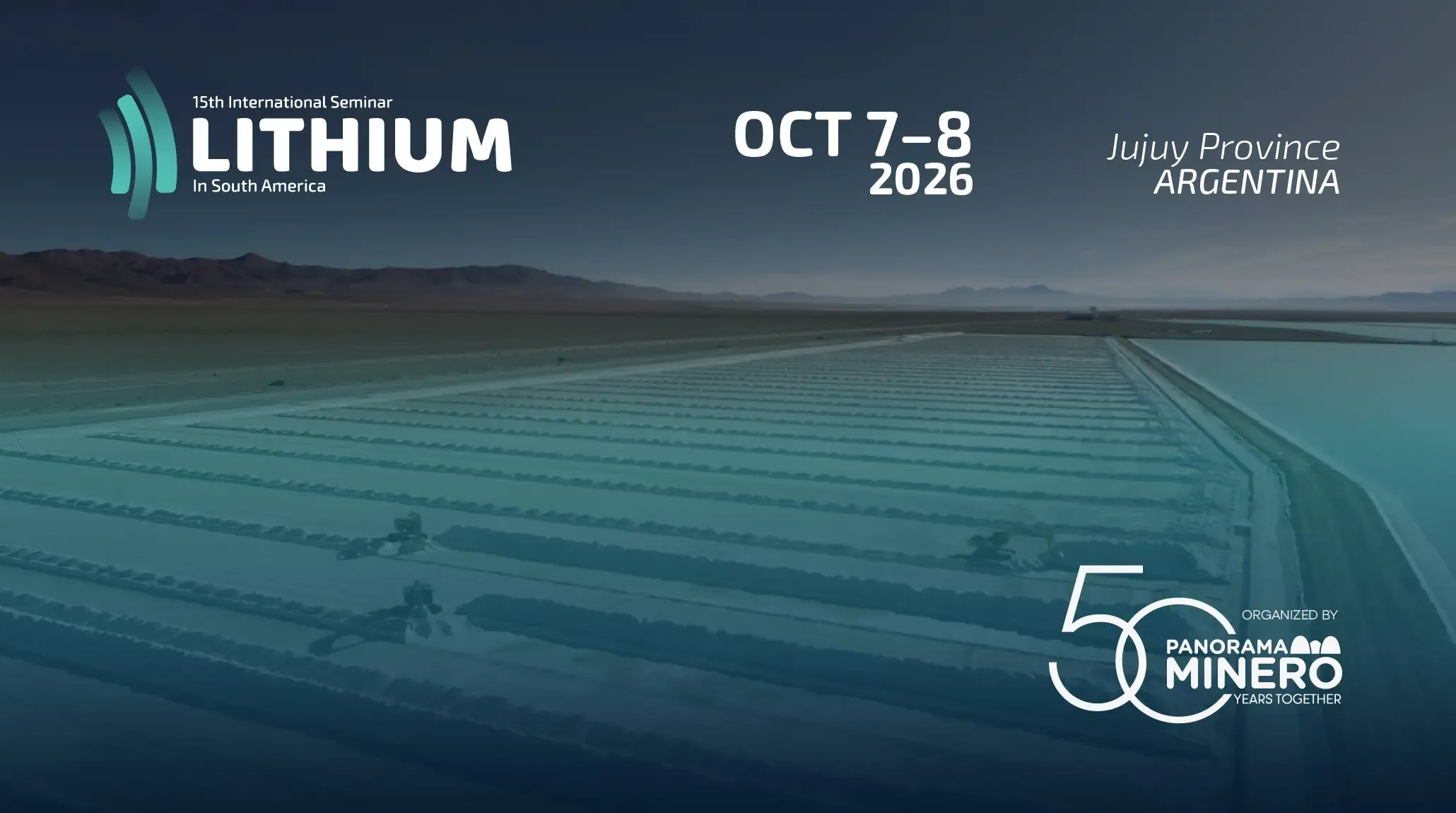
That shift will be the throughline of Lithium in South America 2026, the international conference organized by Panorama Minero, which will hold its 15th edition on October 7 and 8 in Jujuy.
Over two days, the program will cover nearly every discussion currently running through the sector: from production conditions in the Argentine northwest to international competition for critical minerals; from access to capital to the real-world operation of projects; from the United States and China to price formation; and from direct lithium extraction to the questions science has yet to answer.
"This year's program starts from a concrete reality: Argentina is now producing lithium at a very different scale, and the conversation necessarily has to evolve. We want to discuss what it takes for projects to work, expand, become competitive, and find their place in a global market that is also changing," said organizers from Panorama Minero.
From the territory to capital: where the next stage begins
The first day will begin from the territory itself. The mining chambers of Jujuy, Salta and Catamarca will open the discussion on exploration, operational performance, suppliers, infrastructure, talent and new investment, across the three provinces that concentrate the core of Argentina's lithium production.
The conversation will quickly move to the international stage. Representatives from MIGA, part of the World Bank Group; the French Development Agency; and the European Union will discuss financing, risk mitigation, infrastructure and international cooperation at a moment when turning mineral resources into production requires growing volumes of capital and mechanisms capable of reducing the risk of long-term projects.
The financial dimension is already visible in concrete projects. In March, Rio Tinto secured a US$1.175 billion financing package from IFC, IDB Invest, Export Finance Australia and JBIC for Rincón, its US$2.5 billion development in Salta, expected to reach an approximate capacity of 60,000 tonnes per year of battery-grade lithium carbonate.
Next, the institutional opening will bring together the governors of Jujuy, Salta and Catamarca, along with the Lithium Roundtable, the national Secretariat of Mining and the Argentine Chamber of Mining Companies. Shared infrastructure, suppliers, employment, competitiveness, inter-provincial coordination and the relationship between the national government and the provinces will be part of a conversation aimed at determining what the territory needs to support larger-scale investment.
New rules and an industry beginning to be measured by performance
The regulatory landscape will also get a dedicated slot. The conference will examine the scope of Decree 482/2026, which updated the regulations of the Mining Investment Law 24,196 for the first time in more than three decades. The new rules introduced changes to procedures, imports, digitalization and the scope for service providers, among other aspects relevant to companies and projects.
From there, the program will move directly into operations. Rio Tinto Lithium, Albemarle, EXAR, Eramet and CNGR will share the same conversation on costs, ramp-up, expansions, infrastructure, talent, suppliers and operational stability.
The shift in focus is deliberate: with major operations already active and new capacity coming online, Argentina now has an industrial base broad enough to begin comparing concrete experiences.
"For years the big question was how much lithium Argentina could produce. That question still matters, but it's no longer enough. Today we need to talk about everything else: costs, suppliers, infrastructure, predictability, talent and execution capacity. These are the issues that come up when an industry starts to mature," organizers added.
The United States, China and a supply chain under dispute
Geopolitics will take center stage, though from different angles. One panel will look specifically at the Argentina–United States relationship and the opportunities opened up by the growing importance of critical minerals within US economic and supply-security policy. In 2026, the two countries signed a trade and investment agreement that includes critical materials among strategic sectors, as Washington deepens policies aimed at reducing vulnerabilities in its supply chains.
The conversation will center on what that scenario could mean for Argentina in terms of investment, infrastructure, financing and new alliances, without losing sight of the country's diversified positioning and its ties to other markets.
China will also have a concrete presence, though from another point in the chain. The conference will address the relationship between lithium resources, costs and integration into the LFP battery supply chain. The expansion of this chemistry has become one of the central shifts in the market: according to the International Energy Agency, LFP batteries account for around 90% of new stationary storage systems deployed globally.
The presentation will also put into perspective the competition between South American brines and growing hard-rock production in Africa, along with the weight of lithium's cost within cathode active materials and batteries.
The discussion will continue with specialists from SC Insights, who will address what Asia looks for in its international suppliers and how the different development models of Argentina, Chile, Bolivia and Brazil compete with one another.
The question is no longer simply who holds the resource. Product quality, infrastructure, costs, regulation, incentives, processing and market access are increasingly determining where the chain's next investments will land.
Joe Lowry and an uncomfortable question for the market
The first day's conference sessions will close with Joe Lowry, founder of Global Lithium LLC and one of the most experienced international specialists in the sector.
Under a deliberately provocative question, "Lithium: still a misunderstood industry?", Lowry will look at price cycles, the growth of stationary storage, the evolution of supply, and the particularities of a business that, in his view, should be understood as a chemical industry rather than simply a conventional mining market.
The talk will also turn its focus to Argentina and South America and to the commercial relationship with China, connecting the transformations of the past decade with the decisions that could define the next one.
Afterward, Lowry will sign copies of "Lithium Confidential: Confessions of a Corporate Misfit," his new book on more than three decades inside the industry.
Five views on one of lithium's toughest variables: price
If the first day covers territory, investment, operations and geopolitics, the second will open by looking directly at technology and the market.
After presentations on end-to-end optimization of direct lithium extraction processes and new projects, S&P Global, Argus Media, Benchmark Mineral Intelligence, Fastmarkets and CRU will share the same panel to compare their readings on prices, supply, inventories, energy storage, battery demand, futures and price-formation mechanisms.
The panel's composition is one of the agenda's central points: specialized organizations that track the same market with their own methodologies and sources will discuss where consensus exists, where differences emerge, and what signals producers, buyers and investors should watch heading into 2027.
Rincón and the step-change in Argentine production
After the market panel, Rio Tinto Lithium will present the Rincón project.
The development is one of the most visible examples of the change in scale underway in Argentine lithium. Rio Tinto is committing US$2.5 billion to its expansion and expects an approximate capacity of 60,000 tonnes per year of battery-grade lithium carbonate, with first production from the commercial-scale plant expected in 2028.
The company also projects taking its global lithium capacity to around 200,000 tonnes of lithium carbonate equivalent by 2028, with Argentina as one of the main platforms for that strategy.
After the salar: the questions that arise once production begins
The second half of the day will shift scale again. Lithium Argentina, Eramine and Ganfeng Lithium, together with technology and academic specialists, will address what happens after the salar: once a project becomes a mine and reaches production, what do companies encounter, what specific challenges does lithium production in the Argentine northwest bring, and what lessons have been learned at the country's producing projects.
Earlier, Aquatech will address an issue that is gaining traction as direct lithium extraction moves toward commercial applications: optimizing extraction alone is no longer enough. Water recovery, purification, concentration, conversion and reagent consumption are all part of the final cost of producing a competitive lithium chemical.
The program will then take that discussion a step further with a block dedicated specifically to science and technology. Researchers from CONICET, CIDMEJu and other research institutions will debate the questions that still have no answer and those getting closer to one: new extraction routes, brine reinjection, advanced materials, energy efficiency, selectivity, and real possibilities for scaling lab-developed technologies or adding value from the laboratory.
The scientific agenda also responds to a shift in the global market. The IEA projects that, among the critical minerals tied to the energy transition, lithium will see the fastest demand growth through 2040, with consumption more than tripling under currently stated policies.
Three countries, one shared question: what to do with critical minerals
The final stretch will widen the lens once more. Specialists from Argentina, Brazil and Chile will compare how three countries with different production structures, institutions and resources are responding to the same international pressure: turning demand for critical minerals into investment while also building their own economic capabilities.
Industrial policy, investment promotion, state participation, supply security and the room for maneuver available to producing countries will all be part of the analysis.
The conference will close with a return to the territory, with representatives from Jujuy, Salta and Catamarca. The final panel will aim to connect major international trends with subnational decisions on infrastructure, suppliers, human capital, innovation, competitiveness and long-term planning.
In this way, the agenda will end in the same conceptual place where it began: what a region needs once it moves from managing only resources to managing an industry of a much larger scale.
"Lithium in South America was born when many of today's discussions still seemed far off. Fifteen editions later, Argentina has major producing operations and the conversation is a different one. This edition aims to connect market, policy, technology and territory to understand which decisions will define the industry's coming years," organizers from Panorama Minero summarized.
The 15th edition of Lithium in South America will take place on October 7 and 8 in Jujuy. The program will combine conferences, executive panels, international keynotes, business meetings and networking spaces, and will close with a working day of the Lithium Roundtable. The full agenda, speakers and participation options are available on the event's official website: www.litioensudamerica.com.ar/en.