The lithium industry enters 2026 with a different conversation than the one that defined the years of accelerated expansion. New productive capacity is entering the market, prices are showing signs of recovery, and a pipeline of projects is once again putting investment decisions under scrutiny. At the same time, the growth of energy storage is adding a new demand vector, and competition over supply chains keeps lithium on the strategic agenda of the world's leading economies.
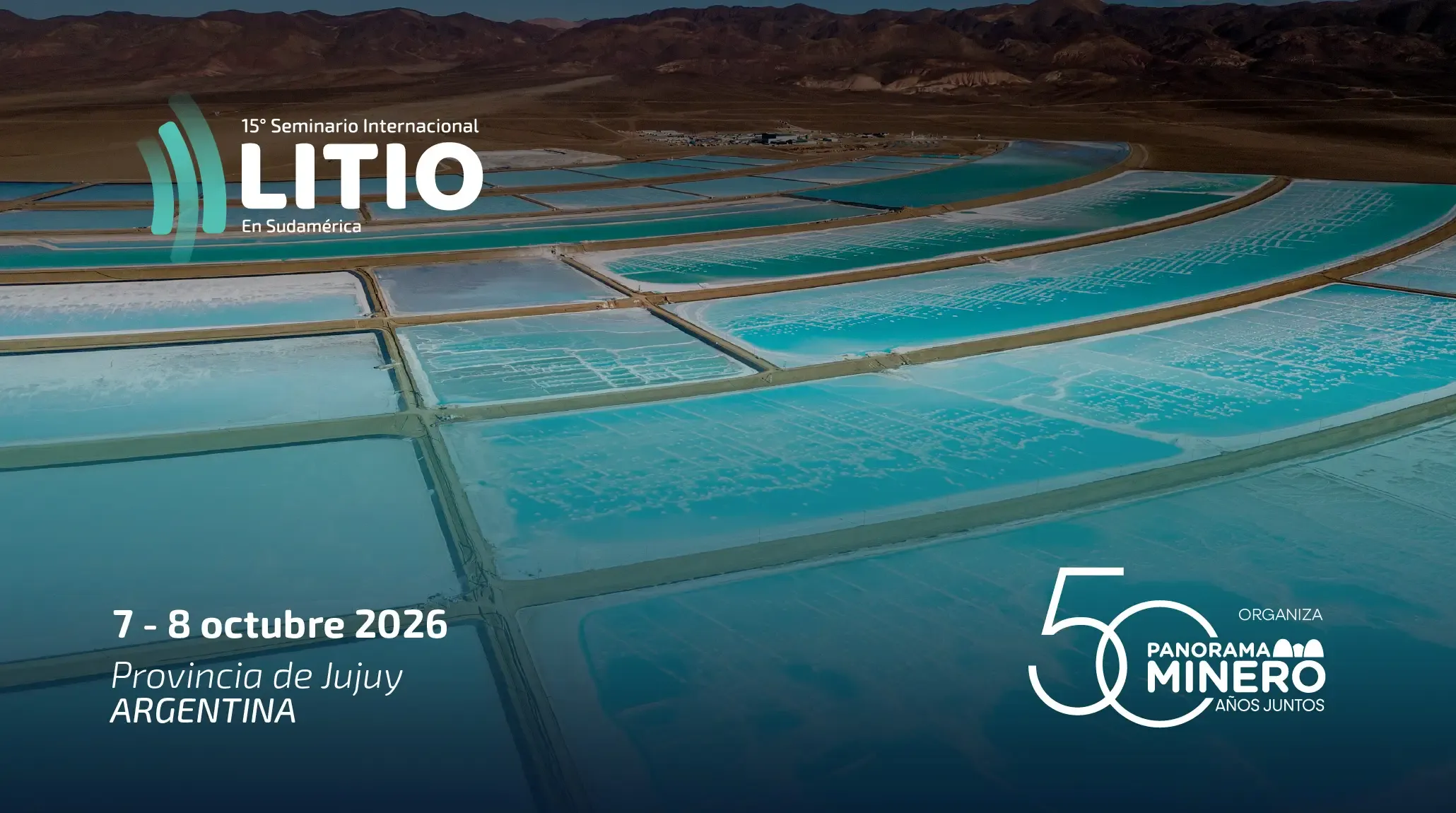
That scenario will run through the 15th edition of Lithium in South America, to be held on October 7 and 8 in the province of Jujuy, bringing together producers, project developers, market analysts, authorities, investors, suppliers and specialists from Argentina and abroad. It is a long-standing international conference and business gathering in the sector, organized by Panorama Minero on a rotating basis across the provinces of Salta, Jujuy and Catamarca.
The 2026 edition also arrives at a particular moment for the local industry. Argentina currently has seven lithium projects in production and a new generation of developments under construction or in advanced stages, while companies already operating in the country are working on expansions, ramp-ups and new technological schemes.
Against that backdrop, a central part of the agenda will be devoted to a question now running through much of the market: what conditions need to be in place for the next generation of projects to move into production. Available capital, costs, infrastructure, regulatory frameworks and price outlooks are increasingly tied to final investment decisions. In Argentina, that discussion also includes the impact of the Incentive Regime for Large Investments (RIGI) and the conditions needed for existing resources to be converted into new productive capacity.
"Lithium in South America was created to closely follow the industry's transformation, and in this edition that means putting on the agenda the decisions that will define the sector's next stage: which projects move forward, with what capital and under what conditions," organizers of the event said.
Argentina's lithium numbers
The country now has more than 55 lithium projects, of which 20 are in operation or in advanced stages of development, according to data from the National Secretariat of Mining. Total identified resources reach 216 million tonnes of LCE, with 23 million tonnes in proven reserves in salt flats. Argentina's lithium production grew 67% during 2025, according to the USGS Mineral Commodity Summaries 2026.
At the regional level, South America accounts for close to 30% of global lithium production, and various industry consultancies project that by 2027 the region could overtake Australia as the world's leading lithium-producing area. On the demand side, the International Energy Agency estimates that global lithium consumption could grow fivefold by 2040, with a risk of a shortfall of up to 40% as early as 2035 if new productive capacity is not brought online in time.
From price to contracts: how lithium is traded
Market developments will occupy another central space at the conference. After the sharp correction recorded following the previous cycle's highs, the industry has begun moving through a rebalancing scenario between supply and demand that again puts the focus on price outlooks and the decisions made by producers and buyers.
But the debate no longer centers solely on how much a tonne of lithium carbonate is worth. How price references, supply contracts and purchasing strategies are built will be one of the core themes of Lithium in South America 2026. The agenda will draw on the views of specialists and international agencies that track the market daily, alongside companies directly involved in production and trading.
China and an increasingly global industry
China will again hold a relevant place in that conversation. Its weight in battery manufacturing, electromobility, mineral processing and lithium consumption means that decisions made in that market have direct effects on producers and projects around the world. The conference will address how China buys, what signals its domestic market is sending, and what role South America could play within its supply and investment strategies, alongside the efforts of the United States, Europe and other economies to diversify their critical mineral supply chains.
For Argentina, this competition opens up an additional discussion. The country is increasing its production while receiving capital and maintaining trade relationships with players from different economic blocs, a position that makes Argentine lithium an increasingly watched asset within the global reorganization of supply chains.
Producers facing the next stage
The agenda will also bring the discussion to operational ground. Representatives from some of the leading lithium companies present in Argentina will take part in conversations focused on the current state of their operations, planned expansions and the conditions they face to keep developing assets in the country.
Accumulated experience is becoming especially relevant. Argentina has moved past a stage in which lithium's potential was concentrated mostly in future projects: today there are operations in production, plants going through ramp-up processes, and new developments seeking to reach construction. Lithium recovery, selectivity, water use, brine characterization, processing and new technologies are all part of a discussion that gains depth as projects move toward industrial scale. Within that framework, Direct Lithium Extraction (DLE) will have a presence on the program, with a focus on the shift from pilot tests and plants toward commercial applications and its coexistence with traditional evaporation schemes.
A demand landscape that is also changing
Electromobility will continue to be the main structural driver of consumption, but it will no longer be the only variable under analysis. The rapid growth of energy storage systems (ESS) is adding a new source of demand for lithium-ion batteries, with implications for the chemistries used, raw material needs and consumption projections for the coming years. The advance of LFP batteries, the development of stationary storage and the evolution of the electric vehicle market will be part of a broader conversation about what kind of demand the industry's new production will need to supply.
A program focused on government, financing and market
The opening day, on October 7, will bring together the three governors of the Lithium Roundtable: Carlos Sadir (Jujuy), Raúl Jalil (Catamarca) and Gustavo Sáenz (Salta), alongside the national Secretary of Mining, Luis Lucero, and the president of the Argentine Chamber of Mining Companies, Roberto Cacciola, in the opening panel on investment, infrastructure and coordination between the national government and the provinces.
The program also includes an international perspective on sector financing, with the participation of representatives from the World Bank (MIGA), the Inter-American Development Bank, the Embassy of France in Argentina and the Delegation of the European Union to Argentina. They are joined by a panel on the relationship between Argentina and the United States on critical minerals, with the participation of the Secretariat of International Economic Relations.
On the corporate side, operating executives from Rio Tinto Lithium (Carlos Carrillo), Albemarle (Luciano Berenstein), EXAR (Simón Pérez Alsina), Eramet (Guillermo Simonutti) and CNGR (Nicolás Damin) will take part, along with Andrew Layland and José Hofer, of SC Insights, in a block dedicated to Asian demand and the regulatory models of the Lithium Triangle.
One of the day's most anticipated moments will be the talk by Joe Lowry, founder of Global Lithium LLC, who will also present and sign copies of his book "Lithium Confidential: Confessions of a Corporate Misfit" at the close of the opening day.
Fifteen editions following the sector's transformation
Lithium in South America was born in 2011, when the regional industry operated at a very different scale than today. Fifteen editions later, the event continues its traditional run in the Argentine northwest, in a landscape where South America holds close to half of the world's lithium resources and Argentina has established itself as the fourth-largest global producer.
The previous edition brought together more than 1,900 attendees, while the event has recorded more than 300 participating companies, representatives from more than 20 countries and more than 2,800 business meetings.
That scale is recognized by the sector's own leading figures. Franco Mignacco, chair of the Shareholders' Committee at Exar, described Lithium in South America as one of the industry's most important events globally: "Lithium in South America has evolved from a regional gathering into one of the most important global events in the industry. The combination of participants and its location in a producing jurisdiction make it an essential stop on my calendar every year."
In 2026, the discussion shifts again. With more production available and a pipeline looking to take its next leap, the challenge is no longer just about gauging the resource's potential, but about understanding which projects will move forward, under what conditions, with what capital, and to supply which market. Lithium in South America 2026 will take place on October 7 and 8 in Jujuy, Argentina. The full agenda, speakers and participation options are available on the event's official website: www.litioensudamerica.com.ar/en.
FOR MORE INFORMATION
+54 9 11 6360-4077
www.litioensudamerica.com.ar/en
COMMUNICATIONS & PRESS
Agustín López Muñoz, Director of Communications
Guido Borelina, Public & Institutional Relations Associate