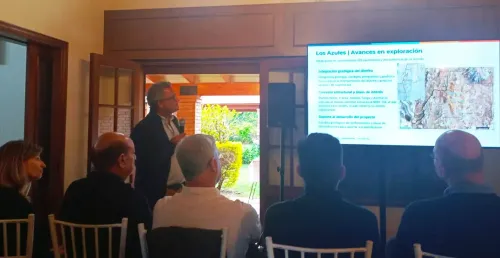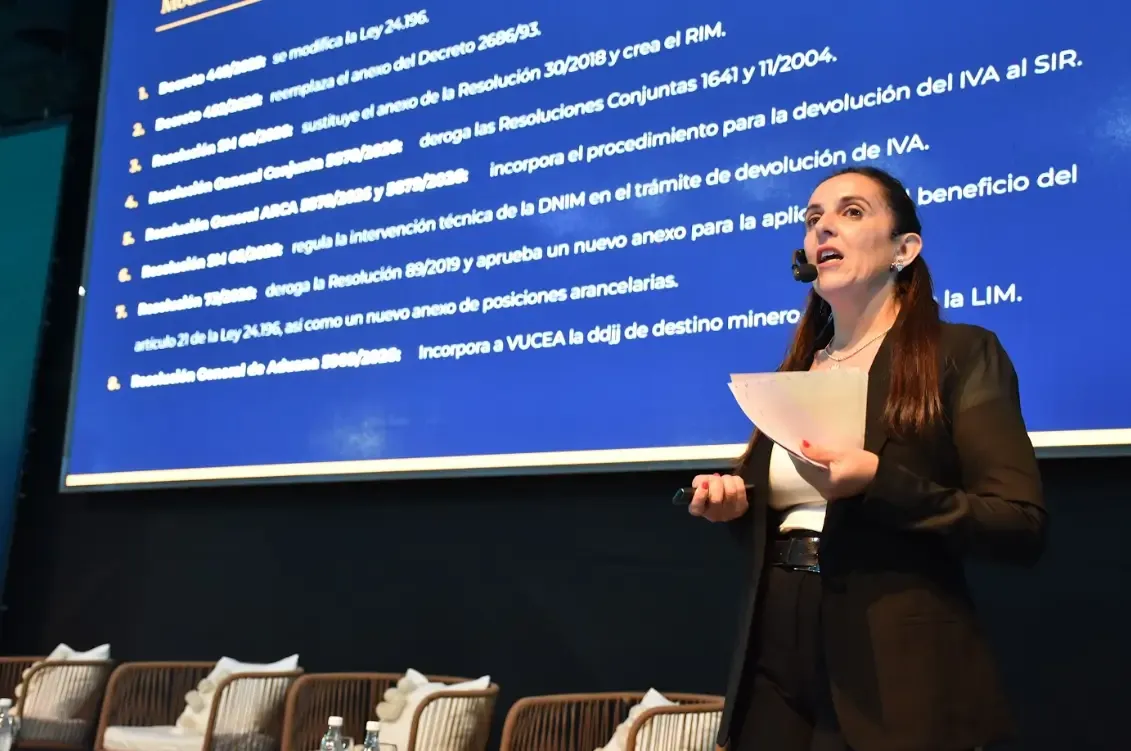
The Secretariat of Mining is moving forward with a comprehensive reform of the mining investment regime: digitalization, ex post controls, imports without certificates, regional integration within 500 kilometres and new rules for suppliers. María Eugenia Bais explained how the new system will work.
By Panorama Minero
More than three decades after the original regulations of the Mining Investment Law, Argentina has launched a comprehensive reform of the regime aimed at changing the way the State administers, monitors and processes the benefits granted to companies in the sector.
The change is contained in Decree 482/2026, which entirely replaced the Annex to Decree 2686/1993, and a second stage has now begun: implementing the new rules in the actual systems and procedures used by companies. The regulation was published on 23 June and modified aspects related to registration, sworn statements, suppliers, regional integration, imports, investment monitoring and environmental instruments.
During the 15th International Lithium in South America Seminar, the National Director of Mining Investments at Argentina’s National Secretariat of Mining, María Eugenia Bais, explained the scope of the reform in detail and outlined how one of the most visible changes for companies will be implemented: the new mechanism for importing goods under the benefits of Law 24,196.
A Complete Reform After 33 Years
Bais explained that the starting point was an amendment to Law 24,196 itself, which allowed the Executive Branch to modify Articles 18, 25 and 26, relating to reporting and monitoring obligations concerning investments.
The problem identified by the Secretariat of Mining was operational. The State was required to directly monitor investments made by beneficiaries, using a volume of information that, according to the official, was practically impossible to process. “Clearly, that was impossible to carry out,” Bais explained during her presentation.
Following the legislative amendment, the objective changed: to enable the State to verify projected investments and those actually made through cross-checking information between government agencies. This required updating the implementing decree. However, the Secretariat decided not to limit itself to amending the affected articles. “For the first time in history, the decree is being amended in its entirety,” Bais emphasized.
Decree 482/2026 thus entirely replaced the 1993 regulations. The new regulation seeks to adapt the regime to current production, technological and administrative conditions and reduce bureaucratic burdens without eliminating monitoring mechanisms.
Seven Principles to Change the Relationship Between Companies and the State
The reform was structured around seven guiding principles: digital modernization, simplification, transparency and traceability, regulatory consistency, a focus on the regulated party, professional management and efficient oversight.
One of the main objectives is to put an end to the circulation of the same information among different government agencies.
Bais explained that for years a company could submit certain documentation to the Secretariat of Mining and then have to submit similar information again to ARCA or Customs. “Files and procedures did not communicate with each other across the different areas of the State,” she described.
The new system aims to allow that information to be shared and cross-checked within the public administration itself.
The reform also seeks to organize a regulatory framework that had accumulated partial amendments over several decades. According to Bais, some enquiries received from companies concerned provisions that had already been regulated since 1993, but whose location and wording made them difficult to understand.
The new regulations, she explained, use a different legislative drafting technique and reorganize the regime to facilitate its interpretation.
One example concerns suppliers. Previously, they were regulated under Article 21. They have now been moved to the beginning of the regulations, alongside the other parties covered by the regime.
The amendment was also aligned with Administrative Procedure Law 19,549 and its implementing regulations, updating a regime originally designed in the 1990s.
Less Information, but Greater Oversight
One of the central concepts of Bais’s presentation was that simplification does not mean less oversight. “None of this prevents the Secretariat of Mining from continuing to exercise its oversight,” she stated.
The change involves modifying the type of oversight. As she explained, the previous system had focused too heavily on administrative procedures and required a quantity of information that subsequently proved difficult to process.
The new approach will be to request less information, but concentrate government resources on verifying it. “Today we request little information, but the little information we request, we verify,” she summarized.
The new system incorporates statistical criteria and risk detection, with oversight aimed at identifying where the State should concentrate its efforts.
The other change concerns timing: the emphasis on prior controls is reduced and ex post oversight following the use of benefits is strengthened. This means that companies will be able to use certain benefits under a simplified system, while the administration will subsequently verify compliance with the corresponding conditions.
The regulations themselves establish mechanisms for exchanging information between ARCA and the mining authority to improve the regime’s traceability and oversight.
What Changes for Mining Companies
Bais was emphatic in distinguishing between the benefits of the regime and the way they are accessed. “Nothing changes in the sense that the benefits do not change, who can be a beneficiary does not change, and the obligations imposed on beneficiaries do not change,” she emphasized.
What changes is how registration is requested, how the register is updated and how obligations are fulfilled.
Among the new features are a mandatory electronic address and a precise definition of a “mining project”. From now on, sworn statements must be submitted for each project.
Decree 482 defines a mining project as the set of actions, works and assets intended for the discovery, assessment, preparation, development, extraction, transport and commercialization of minerals from one or more deposits. It also covers projects involving mineral industrialization or beneficiation processes under the conditions established by law.
The definition is relevant because it allows the regime to move away from being structured solely around the beneficiary company and instead be organized around the project as the unit of monitoring.
Regional Integration: From 200 to 500 Kilometres
One of the changes that could have the greatest impact on production chains is the expansion of the regional integration criterion. The radius has increased from 200 to 500 kilometres.
The amendment seeks to allow greater coordination among deposits, processing plants and industrial facilities linked to mining. The regulations establish that treatment processes installed within that radius may be considered regionally integrated when they meet the conditions concerning the participation of mineral inputs provided for under the regime.
For Bais, this is a particularly relevant amendment for companies that have an industrial operation related to mining but do not own deposits.
Furthermore, the regulations provide for the authority to extend the radius even further when sufficient infrastructure does not exist or when regions have low levels of industrialization and manufacturing employment.
The objective is to expand the territory in which the value chain linked to a mining project can develop.
Suppliers: A Regime That Has Changed in Scale
The reform also consolidates the position of mining service providers within the regime. During her presentation, Bais showed how the composition of registrations had changed since the regime was established.
In the early years of Law 24,196, approximately one in every five registered parties was a supplier. In 2024, according to the data presented by the official, the number of registered suppliers already exceeded the number of companies directly involved in mining activity.
The Secretariat’s interpretation is that the regime ceased to be exclusively a tool for producing companies and began to be used by a growing part of the value chain.
Decree 482 incorporates specific conditions for mining service providers and establishes rules for their registration, continued participation, suspension and eventual removal from the register.
In this way, the reform seeks to organize a sector that has acquired greater importance as investment in exploration, construction and production has grown.
The Import Certificate Is Eliminated
One of the most concrete changes will be the elimination of the import certificate that companies used to access the tariff benefit provided for under Article 21 of Law 24,196. The mechanism will be replaced by a sworn declaration of mining use.
Companies will have to submit a declaration to the Secretariat of Mining containing basic information about the goods they intend to import and their intended mining use. The declaration will be sent digitally to Customs through the Argentine Foreign Trade Single Window (VUCEA).
The regulations establish that the declaration must identify the goods or group of goods and their tariff classifications, and that it will be used as supporting documentation for import clearance.
Bais explained that the new form will be substantially simpler than the previous procedure. “It will not require the invoice, the amount, the supplier or the origin of the product,” she stated.
The declaration will be received by the Secretariat of Mining and subsequently entered into the VUCEA system, allowing the information to reach Customs directly.
ARCA formalized this new procedure through General Resolution 5909/2026, published on 5 October. The regulation incorporates the sworn declaration of mining use into VUCEA and establishes its validation through the Malvina Information System.
The system also eliminates the need to physically submit the declaration. Once electronic validation has been completed, provided there are no inconsistencies, the system allows the customs declaration to be officially registered.
The Change That Begins Operating in October
Bais’s presentation also included practical information for companies: she explained the implementation schedule for the new import procedure.
As she detailed, during the transition the previous system will continue operating and will subsequently be replaced by the new interoperable procedure.
The Secretariat plans to bring the new procedure into operation on 19 October and begin using it fully on 20 October.
The change will not be merely regulatory. The official herself emphasized that one of the main challenges is translating the reform into computer systems and day-to-day operations. “When the way things are done is reformed, publishing regulations in the Official Gazette is not enough; other things also have to be done,” she explained.
At the same time, the Secretariat is conducting internal training for its technical teams. The intention is to ensure that officials can apply the new rules and prevent the reform from remaining limited to the regulatory text.
Investments Made: More Economic Information and New Oversight
Another relevant change concerns Article 18 of Law 24,196, which requires beneficiaries to report investments actually made.
The legislative amendment allowed the State to stop relying exclusively on documentation submitted by each company and to cross-check information with other agencies.
To strengthen this process, the new regime incorporates an economic and financial report prepared by an authorized professional, which must accompany the corresponding annual sworn statement.
The Secretariat thus seeks to obtain more consistent information to verify investments made. The decree also establishes that declarations corresponding to fiscal years prior to 2025 do not require this economic and financial report.
The general approach is for the State to receive structured information, cross-check it against other databases and concentrate oversight on cases presenting greater risks.
Environmental Insurance and VAT Refunds
The reform also introduced changes in two sensitive areas of the regime: environmental guarantees and VAT refunds during exploration.
Regarding environmental matters, the new decree allows Mandatory Environmental Insurance (SAO) to be used to demonstrate the provision established to address environmental alterations, subject to assessment by the enforcement authority. The regulations maintain the possibility of establishing the special provision for projects that are not covered by the insurance or that continue to choose that instrument.
At the same time, the Secretariat has already made progress in digitalizing the refund of VAT tax credits for mining exploration.
The procedure was transferred to ARCA’s Comprehensive Recovery System (SIR), eliminating the paper-based process used for years. The Secretariat retains responsibility for the technical assessment to verify that expenditure, goods and services are effectively linked to registered exploration projects.
Coordination with the RIGI
The update also addresses the relationship between the regime established under Law 24,196 and the Large Investment Incentive Regime (RIGI).
The Secretariat of Mining reported in August that the procedural reform incorporated mechanisms for coordination between the two regimes to facilitate continuity of registration for projects accessing both promotional frameworks.
This seeks to prevent a company from having to navigate disconnected administrative procedures when the same project is covered by different investment promotion instruments.
The Next Challenge: Changing the Culture of the Regime
For Bais, the most important change is not yet complete. The regulatory reform has already been published, but the implementation and adaptation stage for companies is now beginning. “The implementing decree opens up a path for us to follow, but clearly that path has to be followed,” she stated.
The official argued that the change also requires a modification in the way companies use the regime. “The beneficiary has to make this cultural change, to understand the regime in a different way,” she told a packed audience in the event’s main marquee.
In this regard, the Secretariat of Mining is preparing training sessions for beneficiaries. The objective will be to explain the new procedures, support the transition and reduce errors in the application of the new rules.
In addition, the Secretariat published reference documentation, templates for the economic and financial report, and the list of projects registered under the regime.
Ultimately, the reform does not change the core benefits of Law 24,196, but it does change the way companies, suppliers and the State interact with them. The transition from files and certificates to digital declarations, interoperability, information cross-checking and ex post controls aims to transform a regime designed in 1993 into a tool adapted to a mining industry that today has larger-scale projects, broader supplier chains and new investment needs.