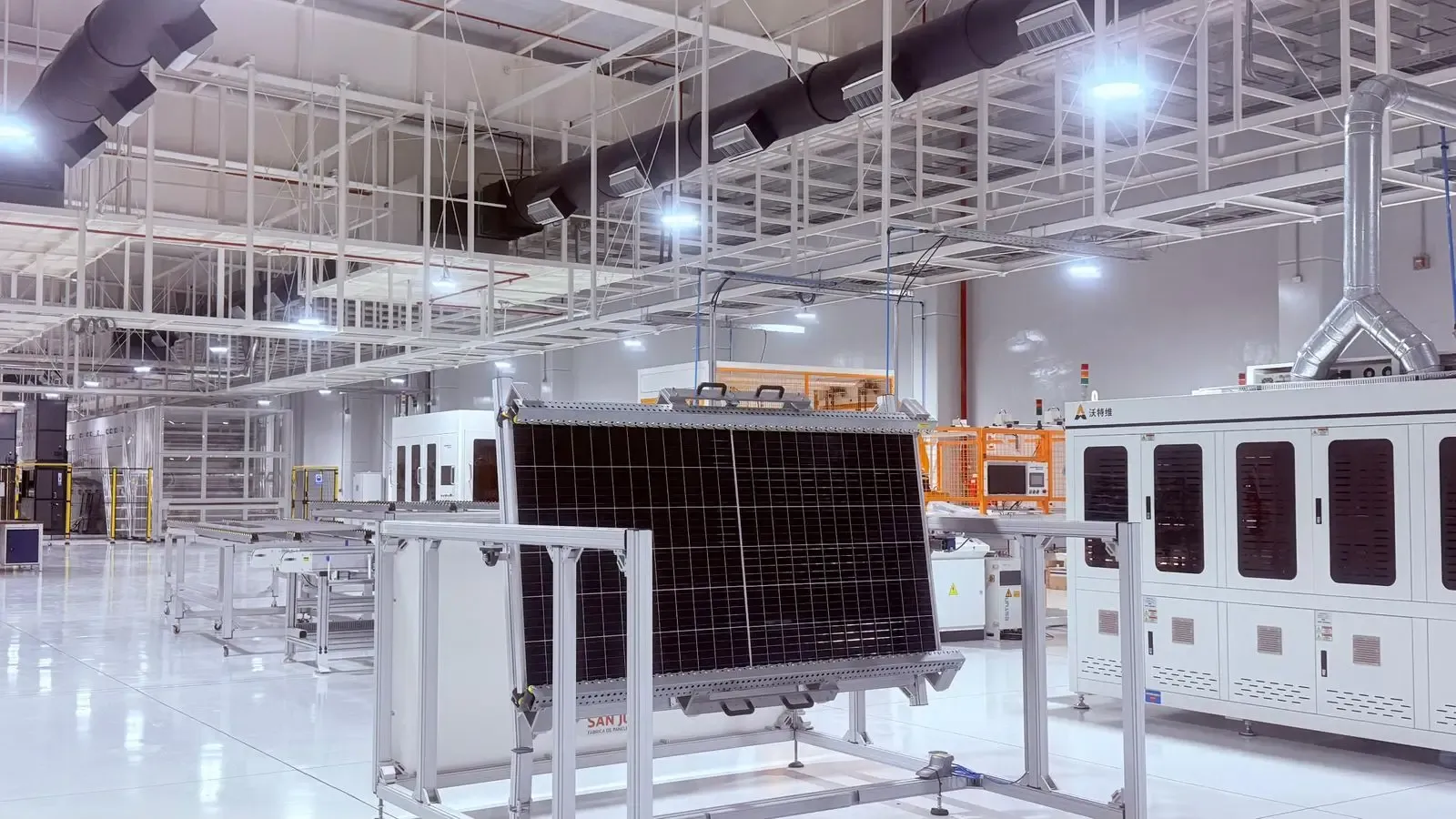
San Juan Province is entering the final commissioning stage of its solar panel manufacturing facility led by Empresa Provincial de Energía Sociedad del Estado, EPSE, in a strategic move to integrate renewable generation, local industry and future copper mining demand.
By Panorama Minero
Lucas Estrada, President of EPSE, confirmed that the laminator, the core unit of the production line, has been installed at the Pocito plant and has successfully completed its initial operational tests. The equipment was imported from China and transported to Argentina via Chile before being delivered to San Juan.
The project is now progressing through full line integration, including synchronization testing across all production units. Empty-run trials are being conducted prior to the use of certified inputs, a necessary step toward international product certification and commercial rollout.
Industrial Capacity and International Standards
The plant will have an annual production capacity exceeding 450 megawatts, equivalent to roughly 800,000 solar panels per year. Standard modules will range between 630 and 650 watts and are intended for both domestic deployment and export markets.
International certifications will allow commercialization in demanding jurisdictions such as Europe and the United States. Technical teams from China, Spain and Germany participated in the development and installation process, contributing advanced manufacturing know-how.
While the overall schedule remains intact, EPSE acknowledged that national import conditions and foreign currency access remain key variables. Input-based operational testing is expected to begin by mid-year, subject to material delivery between May and June.
Solar Energy as Strategic Support for Copper Mining
San Juan’s strategy extends beyond renewable generation. The objective is to complete the photovoltaic value chain within the province, reduce import dependence and generate skilled industrial employment.
This positioning becomes particularly relevant in light of the projected expansion of large-scale copper mining projects, which will require increasing volumes of stable and competitive energy supply over the coming years.
Through its integration into Argentina’s Interconnected System, San Juan can supply mining projects from high-efficiency solar zones such as Tocota, widely regarded as one of the most favorable locations globally for photovoltaic generation due to its radiation levels and climate conditions.
The ability to supply clean energy locally to major mining operations strengthens the province’s competitiveness and reduces reliance on distant consumption hubs.
Grid Expansion and High-Voltage Infrastructure
San Juan currently operates 21 solar parks, with two additional projects under construction. Installed capacity stands at nearly 600 megawatts and is expected to approach 780 to 800 megawatts once current projects are completed.
Further expansion will require high-voltage transmission investment. A new 500 kV connection to Argentina’s national grid has been identified as a strategic priority, aimed at reinforcing system reliability and expanding export capacity.
The province’s renewable roadmap began in 2008 with an agreement signed with Argentina’s National Atomic Energy Commission, which led to the launch of South America’s first solar park in 2011 and laid the groundwork for the current manufacturing initiative.