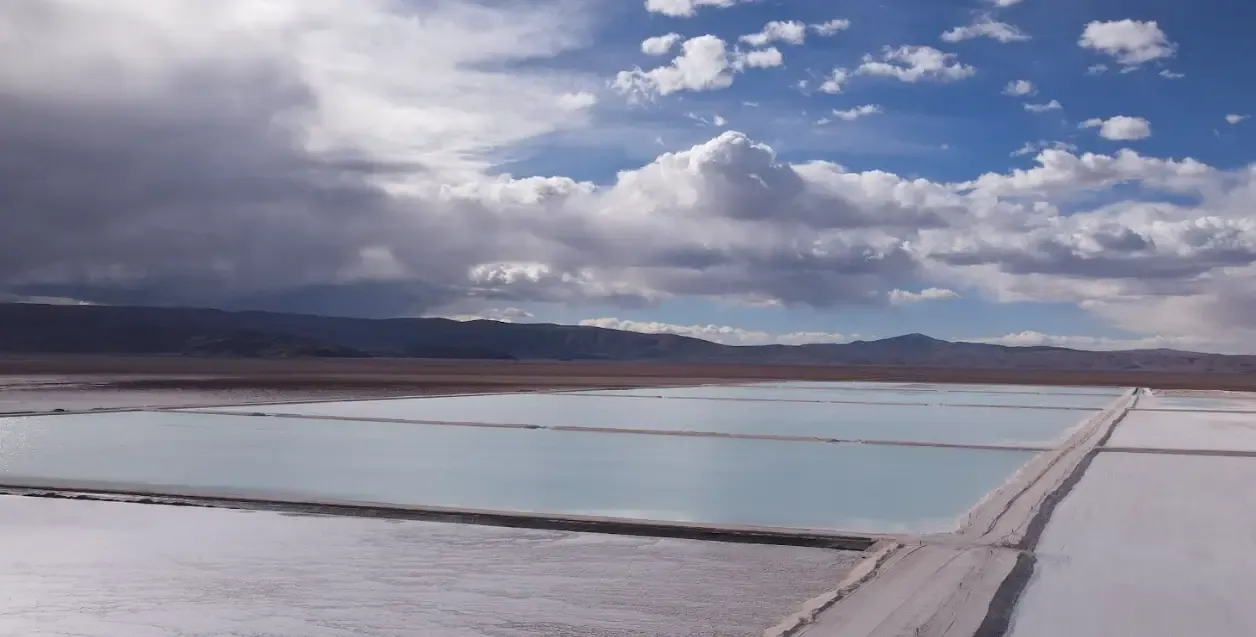
While Argentina's copper industry remains largely a story of untapped potential, and gold and silver continue to benefit from higher international prices, lithium is experiencing a genuine boom in production and exports. Although prices have declined significantly since mid-year, this does not diminish the transformation already underway in Argentina's Puna region. The lithium boom has already begun.
By Andrés Domínguez
Head of the Mining Division, INVECQ Economic Consulting
Argentina's lithium boom is already a reality. During the first nine months of 2026, the country's lithium exports reached US$1.624 billion, an increase of 173% year-on-year. This figure significantly exceeds the amounts exported in several previous full years. Lithium now accounts for more than 24% of Argentina's total mining exports, compared with 15% in 2025, and has become the country's second-largest mineral export after gold.
This is happening as overall mining exports are also reaching record highs: US$6.723 billion between January and September, up 59% from the same period a year earlier.
Two factors are driving this growth. The main one is the increase in lithium export volumes, which rose 45% year-on-year between January and September. Prices also improved compared with 2025, but underlying these figures is a genuine expansion of the industry's physical production capacity.
In October, South Korea's POSCO inaugurated the second plant at Sal de Oro, while Rio Tinto continues commissioning Sal de Vida and expanding Fénix in Catamarca. The company is also developing the Rincón expansion in Salta, a US$2.5 billion investment expected to begin large-scale production in 2028. These are concrete examples of an industry that continues to add production capacity.
Production: Real Expansion, With Signs of a Slowdown
Production figures confirm this growth, although signs of a slowdown are beginning to emerge. Between January and August 2026, physical lithium carbonate production increased 40% year-on-year and stood 68% above the 2022–2025 monthly average.
However, after reaching nearly 12,000 tonnes in June, production declined 21% month-on-month in July and a further 9% in August. Year-on-year growth also moderated, from 59% in June to 9% in August.
Although these figures are not seasonally adjusted, they point to a recent slowdown that warrants close monitoring. This does not undermine the cumulative increase in production, but it does indicate that growth is no longer accelerating at the strong pace recorded earlier in the year, calling for greater caution regarding its trajectory over the coming months.
Lithium development is also creating new jobs. Direct registered employment now exceeds 5,300 positions, compared with fewer than 2,000 five years ago. For relatively small and geographically isolated economies such as those of the Puna, this growth is significant.
These are also formal jobs offering comparatively high wages. Nevertheless, delays in the publication of more recent sectoral employment statistics call for caution when assessing labor market developments over the past few months.
A New Regional Economy in the Puna
Lithium is already transforming the Puna's economy. It has entered Argentina's top 10 export sectors and now surpasses traditional regional export industries such as grapes, peanuts, lemons, and pears and apples.
But lithium does not compete with or undermine other economic activities. For a country historically dependent on a relatively small number of agricultural export sectors, diversifying its export basket and adding new sources of foreign currency, investment and employment is a positive development.
This is particularly relevant because the transformation is taking place in a region where tourism and certain traditional regional products have historically played important roles, but where the productive structure has remained relatively undiversified, with subsistence agriculture and limited exports.
The arrival of investments worth hundreds of millions of dollars, new industrial plants, energy infrastructure, technology and services is already reshaping northwestern Argentina and the Puna.
Private Investment and the Role of the State
The private sector has been at the forefront of this process. At different stages, the industry has attracted Australian, US, French, Chinese, British, South Korean and Japanese capital, alongside Argentine business groups and an extensive network of companies primarily engaged in exploration, commonly known as junior mining companies.
However, this is not exclusively a private-sector story. Provincial governments also play an important role and have developed different institutional models.
In Jujuy, JEMSE holds mining properties and equity interests in projects, including an 8.5% stake in Sales de Jujuy.
In Catamarca, CAMYEN holds mining rights and can conduct exploration and mining activities independently or in partnership with third parties. It also has an extensive portfolio of mining properties available for potential public-private partnerships.
In Salta, REMSA administers and coordinates mining projects, facilitates investment and participates in energy infrastructure relevant to the mining industry.
Despite their different structures, these companies can serve as intermediaries connecting investors, provincial governments and local communities. They are complemented by trust funds, special contributions and other mechanisms through which part of the resources generated by mining is allocated to productive infrastructure and local public works.
There is no single model, nor should there necessarily be one. Each province is developing its own instruments. These mechanisms can support local development, provided they maintain a balance between provincial needs and the economic timelines of mining investments.
The Lithium Roundtable: A Positive Experience
Another institutional asset deserves attention: the Lithium Roundtable (Mesa del Litio).
Since 2021, Salta, Jujuy and Catamarca—provinces with different governments and political backgrounds—have maintained a formal coordination mechanism covering production, investment, regulation, environmental matters, taxation, industrialization and supplier development. This coordination has also survived changes in provincial leadership.
The contrast with other Argentine regions is worth highlighting: rather than competing against one another for the same investment, the provinces are seeking to cooperate.
And this approach has already produced tangible results. Salta and Catamarca have developed joint protocols for projects located along their shared borders, covering investment, royalties and other taxes, as well as environmental coordination and oversight mechanisms.
As we know, provincial governments are also primarily responsible for mining and environmental permits and oversight. If production continues to grow, their technical capabilities will necessarily have to expand as well.
This means more qualified professionals, better information systems, stronger environmental impact assessment capabilities and sufficient resources to supervise increasingly large and technologically complex operations.
Against a backdrop of severe fiscal constraints at the national level, preserving these technical teams should be regarded as part of the institutional infrastructure required by the mining industry.
Supplier Development: Building Capacity Without Holding Back Investment
Local supplier development deserves particular attention. The three provinces share this objective, and for understandable reasons: an industry can only achieve genuine social legitimacy when a significant share of its benefits remains within the communities and territories where it operates.
Local procurement targets can support productive development, but they must be accompanied by training, financing and supplier capacity-building policies. No law or quota can immediately create technical capabilities that do not yet exist in a region.
The objective should not simply be to require companies to purchase locally, but to enable more local businesses to compete, meet the standards of major mining companies and grow alongside them.
The challenge is to combine local participation with global standards, without slowing investment.
International Prices: Recovery Followed by a Recent Decline
International prices have once again demonstrated the lithium market's considerable volatility.
After reaching very low levels in 2025, with an average of just US$8,098 per tonne in June, lithium carbonate prices recovered strongly in 2026, reaching US$23,816 per tonne in May.
Since then, however, prices have undergone another correction, falling to US$13,750 per tonne as of October 16, a decline of approximately 42% from May.
The downward trend continued during the second half of October, reaching new lows around October 23, although prices recovered partially in subsequent trading sessions.
As of October 28, quotations remained below their October 16 levels, confirming a period of pronounced volatility.
Despite this decline, October prices remained well above their levels a year earlier. In other words, the market is displaying two simultaneous trends: a substantial recovery compared with 2025 and a sharp decline from the highs reached during 2026.
Behind these movements are expectations of increased global supply, uncertainty surrounding electric vehicle demand in China and stronger demand for batteries used in energy storage systems.
For Argentina, this volatility is far from insignificant. It can affect export revenues, company margins and investment decisions for new projects.
The increase in production is already a reality, but profitability and the pace of future investment remain dependent, among other factors, on international prices. All projections should therefore be treated with caution.
Challenges Ahead
The path forward is not without obstacles.
Some smaller projects or those at an early stage of development face difficulties securing financing. Behind the large projects moving forward lies a segment of the project pipeline that is considerably more sensitive to commodity prices, the cost of capital, individual companies' financial positions and Argentina's macroeconomic conditions.
The slowdown in certain production indicators and, particularly, the volatility of international prices now make it necessary to distinguish between capacity that has already been installed and investments that have yet to receive final approval.
Infrastructure and Human Capital
Other structural bottlenecks remain.
The first is infrastructure. The Puna needs energy, roads, connectivity and logistics to support an industry operating on a fundamentally different scale from that of a decade ago.
The second is human capital. As activity expands, the need for specialized trades will become increasingly evident, including chemical technicians, mechanics, electricians, plant operators, workers trained for high-altitude conditions and mine safety specialists.
At the professional level, Argentina starts from a stronger position, but this cannot be taken for granted. More mining means greater demand for geologists, mining engineers, environmental specialists and other professionals whose training takes years.
Infrastructure and human capital development are long-term investments. Without them, mining growth will face increasingly significant constraints.
Achievements That Are Here to Stay
We have examined the positive developments as well as some of the challenges and risks still facing the lithium industry in particular and Argentine mining more broadly.
Yet there is a fundamental difference compared with just a few years ago: a substantial share of the industry's potential has already become reality.
Companies currently producing have constructed assets and operating facilities. Recent expansions, ongoing developments and new projects under construction will gradually add further capacity.
Nevertheless, prices, financing conditions and regulatory changes can accelerate or delay new investments and expansions.
The moderation in monthly production figures should not be confused with a reversal of the transformation already achieved.
Argentina now has seven lithium operations producing, with others expected to enter production soon, record exports and a region that has developed institutions, its first supplier networks and industry-specific expertise. What has been achieved is already in place.
If economic and regulatory conditions remain predictable, access to financing improves, and bottlenecks involving infrastructure, human capital, competitive suppliers and institutional capacity are addressed, lithium has room to continue increasing both production and exports.
We are no longer talking solely about resources beneath the ground or projects outlined in a PowerPoint presentation.
Lithium is already one of Argentina's leading export sectors and an economic driver for Salta, Catamarca and Jujuy. In this case, the boom has already begun.