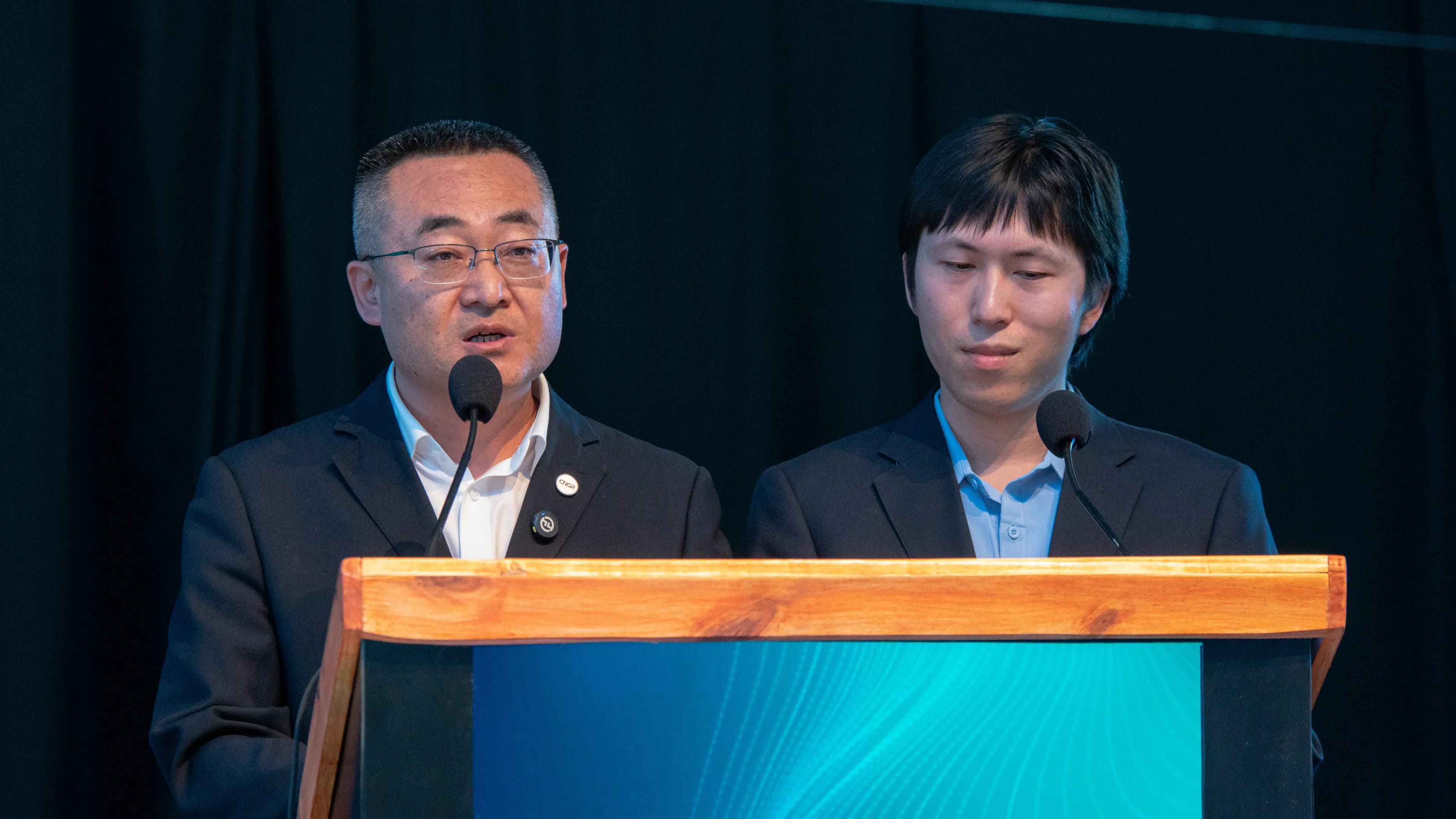
Yang Jianyu, Vice President of CNGR South America, analysed the global market, production costs, the growth of LFP batteries and Argentina’s strategic advantages towards 2030 during a presentation in Jujuy.
By Panorama Minero
China’s lithium industry views Argentina with a combination of interest in its resources, attention to its costs and expectations regarding its ability to become an industrial player in the global battery supply chain. This was one of the main conclusions of the presentation delivered by Yang Jianyu, Vice President of CNGR South America, during Panorama Minero’s Lithium in South America Seminar in Jujuy.
The presentation, delivered in Chinese with consecutive interpretation into Spanish, covered four areas: the global demand outlook, the distribution of resources, the comparison of costs between brines and hard rock, and the technologies and strategies that could define lithium supply over the next decade.
CNGR’s perspective is based on a structural change. According to the data presented by Yang, batteries already account for 88% of global lithium consumption, while ceramics, glass, greases, lubricants and other traditional uses represent just 12%. “This means that lithium is no longer an ordinary industrial mineral, but an energy metal defined by the battery industry,” the executive stated.
For CNGR, understanding this transformation is essential to interpreting price volatility. Lithium is no longer determined primarily by traditional industrial applications and has become increasingly dependent on the performance of electric vehicles and energy storage systems.
LFP: Lithium Carbonate Gains Prominence
Technological transformation is also changing the composition of demand. Yang explained that there are two main routes for converting lithium salts into battery materials.
The first involves ternary batteries, which use lithium hydroxide together with nickel, cobalt and manganese to manufacture NCM/NCA precursors and subsequently cathodes through sintering processes.
The second is the LFP route, based on lithium iron phosphate, which uses lithium carbonate together with ferrous phosphate and enables the cathode material to be manufactured directly through sintering.
The difference is relevant for salt flat producers because, according to the presentation, lithium salts account for between 40% and 50% of the cost of an LFP battery.
CNGR operates precisely at both ends of this chain. Yang described the company as an integrated supplier of new energy materials, with a position consolidated over many years among the world’s leading producers of NCM precursors and rapid expansion in LFP.
For the Chinese company, therefore, lithium has a dual importance: it is a central cost component and, at the same time, a critical factor in ensuring supply.
Global Demand Is Heading Towards Another Leap
The data presented by Yang show an industry that has already undergone an initial expansion phase but still faces considerable growth ahead.
In 2025, global mine production reached approximately 290,000 tonnes of lithium metal content, a year-on-year increase of 31%. Consumption reached around 263,000 tonnes, growing by nearly 20%.
Most of the increase in demand came from two sectors. Electric vehicles accounted for approximately 63% of demand, while energy storage began consolidating its position as the second major growth driver.
The fact that production slightly exceeded consumption during 2025 contributed, according to CNGR’s explanation, to downward pressure on prices during the first half of the year. A recovery began in the second half and, by 2026, the market was moving towards a better balance between supply and demand. In this context, Yang placed prices in a range of US$17,000 to US$19,000 per tonne.
The long-term outlook is even more demanding. According to the data used in the presentation, the International Energy Agency projects that global lithium demand will increase from 165,000 tonnes of lithium content in 2023 to approximately 530,000 tonnes in 2030, roughly three times as much.
For 2035, the estimate presented stands at around 850,000 tonnes of lithium metal content, equivalent to approximately 4.5 million tonnes of lithium carbonate equivalent (LCE). In an optimistic scenario, demand could even reach between 5 million and 9 million tonnes of LCE.
The consequence for supply is direct: the industry will need to continue bringing new projects on stream over the next decade. Yang recalled that developing a mine can take between seven and 12 years from exploration to the start of production, making resource security a strategic variable.
Argentina: Extensive Resources Yet to Be Converted into Reserves
The second part of the presentation focused on the geographical distribution of resources. Yang divided lithium sources into three main categories. The first comprises brines, concentrated particularly in South America’s Lithium Triangle and in Chinese regions such as Qinghai and Xizang. The second consists of hard-rock minerals, primarily spodumene in Australia and other minerals such as lepidolite in China. The third includes emerging resources such as clays in Mexico, volcanic rocks in the United States and geothermal brines.
The differences between resources and reserves are particularly important for Argentina.
In terms of reserves, Chile ranks first with 9.2 million tonnes, followed by Australia with 8.4 million tonnes. In identified resources, however, the top three positions are held by the United States, Argentina and Bolivia, with approximately 30 million, 28 million and 23 million tonnes, respectively.
Argentina therefore presents a particular characteristic: it has approximately 28 million tonnes of resources, but only 4.4 million tonnes of reserves.
For Yang, this gap represents one of the country’s main opportunities. “Argentina has 28 million tonnes of resources, but only 4.4 million tonnes of reserves,” he explained. CNGR’s interpretation is that a significant quantity of resources still needs to undergo exploration, assessment and conversion processes before becoming economically exploitable reserves.
Argentina’s opportunity over the next decade would therefore lie not only in projects currently in production, but also in converting a greater proportion of its geological resources into reserves and subsequently into industrial capacity.
The Cost Curve That Explains Competition
The other variable that, according to CNGR, places Argentina in a relevant position is cost. Yang presented a cash cost curve comparing the different production routes. At the most competitive end are high-quality salt flats, with costs of approximately US$3,500 to US$4,000 per tonne.
Other salt flats and certain hard-rock projects fall within a range of US$4,500 to US$8,500 per tonne. At the upper end are lepidolite and some new mining projects, with costs that can reach between US$12,000 and US$18,000 per tonne. According to the executive, the price decline during 2025 served as a test of this cost structure.
When the price reached approximately US$9,000 per tonne, higher-cost operations began recording losses and some reduced production. As the market recovered towards the US$17,000 to US$19,000 range, some of that capacity once again found conditions for profitability.
For CNGR, the long-term price tends to be influenced by marginal costs. During downturns, higher-cost producers are the first to leave the market. By contrast, low-cost salt flats have greater capacity to withstand market cycles and constitute, according to Yang, “the anchor” most valued by investors.
Argentina’s Position Compared with Africa and Hard Rock
In this landscape, competition is not limited to South America. The growth of hard-rock lithium production, particularly in Africa, is one of the developments CNGR is monitoring for the coming years.
Higher-cost projects can enter the market during periods of elevated prices, but become more exposed when oversupply occurs. This mechanism could change the composition of global supply towards 2030.
For Argentina, CNGR’s assessment is different. The country combines a large resource base with costs that, according to the presentation, stand at approximately US$4,500 to US$5,600 per tonne. This is complemented by the development of direct lithium extraction (DLE) technologies, which could alter the cost curve and enable the recovery of a greater quantity of lithium contained in brines.
“Argentina, with the world’s second-largest resources and the fastest growth, together with the adoption of the RIGI, is moving from being a resource powerhouse to an industrial powerhouse,” Yang stated.
The statement summarizes much of the Chinese perspective: Argentina’s attractiveness lies not only in the quantity of lithium contained in its salt flats, but also in the combination of geological scale, costs, technology, investment and the ability to advance industrialization.
DLE, Energy Storage and New Batteries
The next stage of supply will also feature new technological developments. Yang identified three main routes for increasing future supply. The first is the expansion of DLE on an industrial scale over the next five years, particularly in Chile and Argentina.
The second involves unconventional resources, such as clays, rocks and geothermal brines, particularly those located close to major consumer markets.
The third is battery recycling, which is beginning to be considered a form of “urban mining”.
Together, these three sources will determine, according to CNGR, the elasticity and sustainability of global supply.
On the demand side, new drivers are also emerging. Energy storage is becoming a second major growth curve, while LFP batteries and technologies with higher nickel content continue to evolve.
In the longer term, lithium-metal batteries and solid-state batteries are emerging. In an optimistic scenario presented by Yang, these technologies could achieve a market share of up to 22% by 2035.
The result would be demand less concentrated in electric vehicles. “Lithium demand is moving from having a single driver, electric vehicles, to being driven by multiple factors,” he explained.
Argentina: Resources, Industry and International Strategy
The presentation also offered a geopolitical perspective. Yang argued that lithium has ceased to be merely a critical mineral and has become a component of industrial competition among major powers.
Chile is advancing the development of its salt flats and direct extraction technologies. Argentina combines provincial state capital and foreign capital. The United States has included lithium among its critical minerals and is seeking to strengthen its own supply chains.
In this scenario, the Lithium Triangle retains a central position. According to the data presented by CNGR, it accounts for approximately 40% to 43% of global resources.
According to the Chinese executive, Argentina’s window of opportunity combines two factors that are difficult to find simultaneously: large-scale resources and a competitive position on the cost curve.
For CNGR, this combination could prove decisive over the next ten years. “When prices fall, lepidolite and African mines are the first to leave the market. That is precisely the elimination mechanism of the cost curve,” Yang stated.
He added that, looking ahead, the expansion of DLE and the strategies of resource-rich countries create a dual opportunity for Argentina: “a window of opportunity in terms of resources and costs.”
From the perspective of one of China’s leading battery materials companies, Argentina’s challenge will be to transform its geological advantage into an industrial platform capable of responding to global demand that will continue to grow, with competitive costs, technology, security of supply and greater integration of the value chain.