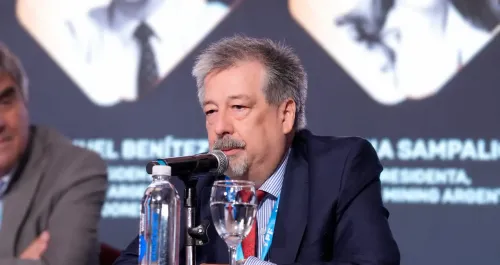
A world that prioritizes the supply of safe, affordable, and sustainable energy cannot dispense with nuclear power generation. This was emphasized by Luis López, a representative of the CNEA, who highlighted the need to resume uranium production in Argentina in order to reduce the imports currently used to meet the requirements of the country’s nuclear power plants.
By Panorama Minero
Uranium, as a critical input for nuclear power generation at both the local and global levels, took center stage at the start of the second day of Argentina Gold, Silver and Copper 2025, the annual summit organized by Panorama Minero at the Golden Center Eventos.
According to Luis López, Specialist in Uranium Resources at the National Atomic Energy Commission (CNEA), the uranium cycle is fully sustainable. “Uranium mining is, strictly speaking, a low-intensity mining activity. Only about 59,000 tonnes per year are needed to meet global demand,” noted the expert, who contributed his insights during the panel ‘Uranium: Strategic Importance and High Relevance in the Current Context’.
By definition, he explained, uranium is the main fuel used by nuclear reactors operating around the world. “All stages of the uranium production cycle must be carried out following best practices, protecting the environment and benefiting local and regional economies,” he stated.
He pointed out that nine parts of natural uranium are required to produce each part of enriched uranium—the type that powers 94% of the global nuclear power industry. “From the moment a deposit is discovered to the time it enters operation, 20 to 40 years can pass. That is no minor detail,” he warned.
Uranium reserves and production, he added, are highly concentrated in a small number of countries. “There is a major asymmetry between the nations that produce uranium and those that consume it. On one end is Kazakhstan, which exports nearly everything it produces, and on the other is the United States, which is a net importer,” he explained.
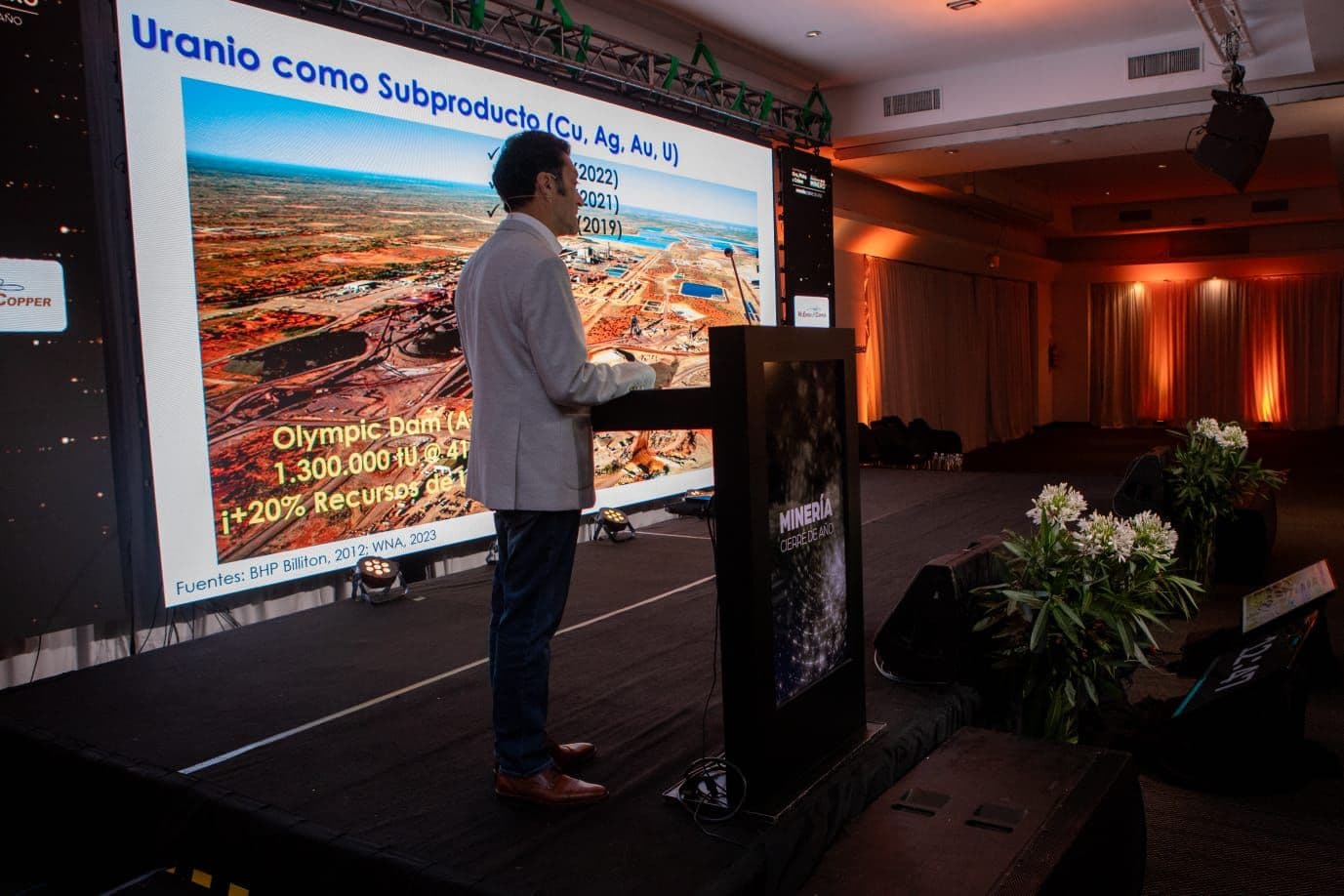
Regarding production methods, he specified that the most widely used is in-situ leaching (representing 60% of global output), followed by underground mining (18%) and open-pit mining (16%). “Uranium can also be obtained as a by-product of various minerals. It is estimated that by 2026, this method will yield 200 tonnes annually—the same volume used by Argentina,” he clarified.
A fluctuating market
Uranium can be considered a commodity, as nearly 80% of its production is exported. However, López noted that supply security is generally prioritized over market conditions. “About 75% of current global production comes from state-owned companies (in Kazakhstan, that figure rises to 87%),” he illustrated.
Around 5% of global nuclear fuel, he added, comes from recycled spent fuel. “Today, a kilogram of uranium costs just over US$200 in a highly volatile international market. An acceleration of the energy transition will likely increase uranium consumption,” he projected.
Argentina, he pointed out, has three operating nuclear power plants: Atucha I, Atucha II, and Embalse. “Installed capacity represents 4% of the national energy matrix, but the sector can generate more than double that amount in terms of electricity, as it is a baseload source that produces continuously,” he explained.
A new strategy
From very early on, López noted, the country developed various deposits, reaching a historical total of 2,700 tonnes of uranium. “Open-pit mining is the most commonly implemented technique, accounting for 82% of total production,” he detailed.
Uranium concentrate imports, he recalled, began in 1992, while domestic production ceased in 1997. “The material arrives by ship, mainly from Canada, the Czech Republic, and Kazakhstan. It is then transported by land to Córdoba and later to Ezeiza, from where it is dispatched as fuel to the three nuclear power plants,” he said.
According to López, Cerro Solo (managed by CNEA and currently on standby), Ivana (in advanced exploration and nearing pre-feasibility), and Sierra Pintada (formerly in production and still containing exploitable resources) are among Argentina’s most promising projects. “There are 33,650 tonnes of identified resources (indicated + inferred) in the country. The greatest potential lies in three provinces: Mendoza, Río Negro, and Chubut,” he specified.
In all three, he highlighted, extensive sustainability work is underway, including the development of new mining procedure codes, the promotion of community participation, and the signing of provincial agreements with academic institutions and research centers.
“In the entire import process, the country is spending between US$60 and US$70 million per year. It is time to design a new strategy in this field. There is strong potential both to identify and develop new resources and to reactivate dormant projects,” he concluded.