The accelerated growth of mining in Northwestern Argentina (NOA), driven in recent years by lithium and now by the imminence of copper projects, highlights the need for infrastructure development in the provinces that make up the Argentine Lithium Triangle: Salta, Jujuy, and Catamarca.
By Panorama Minero
Roads, logistics, and strategic works have ceased to be operational variables and have become critical factors of competitiveness and predictability. At times, however, they advance at a slower pace than that of the projects and also slower than what is desired by provincial governments, suppliers, and companies.
National Route 51
In this context, the case of National Route 51 represents a significant example, as it constitutes a strategic link of the bi-oceanic corridor with access to Chilean ports through the Sico Pass. It is also part of the connection between Salta and Catamarca in the Salar del Hombre Muerto, in an area where both provinces share mining interests. The areas crossed or connected by National Route 51 have historically been central to the mining industry; it is enough to mention the Tincalayu mine, at one time one of the largest borate complexes. And now, with the establishment of lithium projects in the jurisdictions of Salta and Catamarca, activity in the region has grown exponentially.
At the beginning of this week, two events occurred. First, a storm affected a large part of the Salta puna and the Calchaquí Valleys. Attributed to the La Niña cycle and typical of the region’s summer season, several sections of mining routes collapsed, particularly several segments of the critical National Route 51. The impact is unquestionable; however, it is also worth highlighting that, thanks to current mining activity, the immediate response in reopening the routes was evident, with the participation of machinery from mining companies and suppliers—something that in other times required more time, with the State as the sole operator.
The other event also featured National Route 51. The Governor of Salta, Gustavo Sáenz, reiterated in a meeting held this Monday with the National Minister of the Interior, Diego Santilli, the need to move forward with critical infrastructure works for productive development.
“These are works that will substantially improve the productive matrix of our province,” Sáenz stated in a joint press conference with the Minister of the Interior.
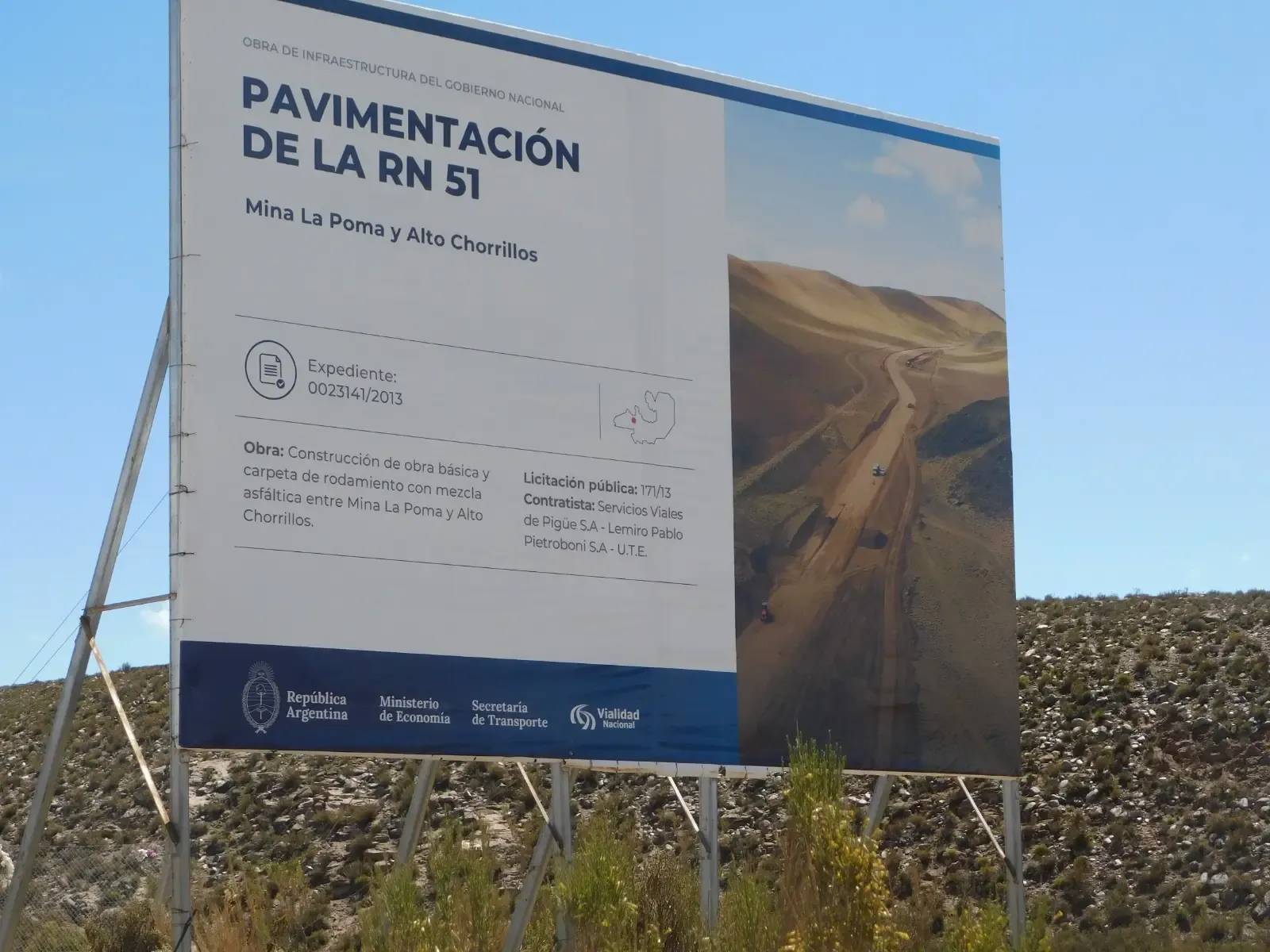
In 2025, Salta decided to provide financial assistance to the national government for the paving of National Route 51. In this context, the governor signed a Memorandum of Agreement with the National Highway Administration for the execution of works on the Mina La Poma – Alto Chorrillos section, Section II of the San Antonio de los Cobres – Cauchari stretch.
“I formalized the decision to invest provincial resources in paving a route that is essential for Salta and northern Argentina. With our financial assistance, this long-announced work will be able to materialize,” Sáenz stated at the time of signing. This Monday, following the meeting with Santilli, he reaffirmed the decision to assume execution of the work, which will be financed by FONPLATA, the Development Bank that promotes the integration of its member countries (Argentina, Bolivia, Brazil, Paraguay, and Uruguay) through credit operations and non-reimbursable resources.
Public–private coordination
One of the most widespread consensuses in the sector is that the State cannot, on its own, address the works demanded by the exponential growth of mining in the NOA, but neither can the private sector replace public planning. Hence, provinces are seeking to advance schemes of public–private participation, co-financing, and shared maintenance of critical infrastructure.
Some companies are already evaluating or executing direct contributions to roads and access routes, aware that infrastructure is part of the project viability equation. Such is the case of the section of National Route 43 in Catamarca, which is advancing with contributions from POSCO, Galan Lithium, and Lake Resources, and which connects that province with Salta through the Salar del Hombre Muerto, where POSCO operates the Sal de Oro lithium project in both jurisdictions.
The challenge
The NOA is going through a historic window. The resources are there, investments are advancing, and projects are beginning to materialize. The challenge is for infrastructure to stop reacting to growth and start anticipating it. Each kilometer of road, each work planned on time, and each well-coordinated logistics decision can make a difference in the mining future of Salta and the region.