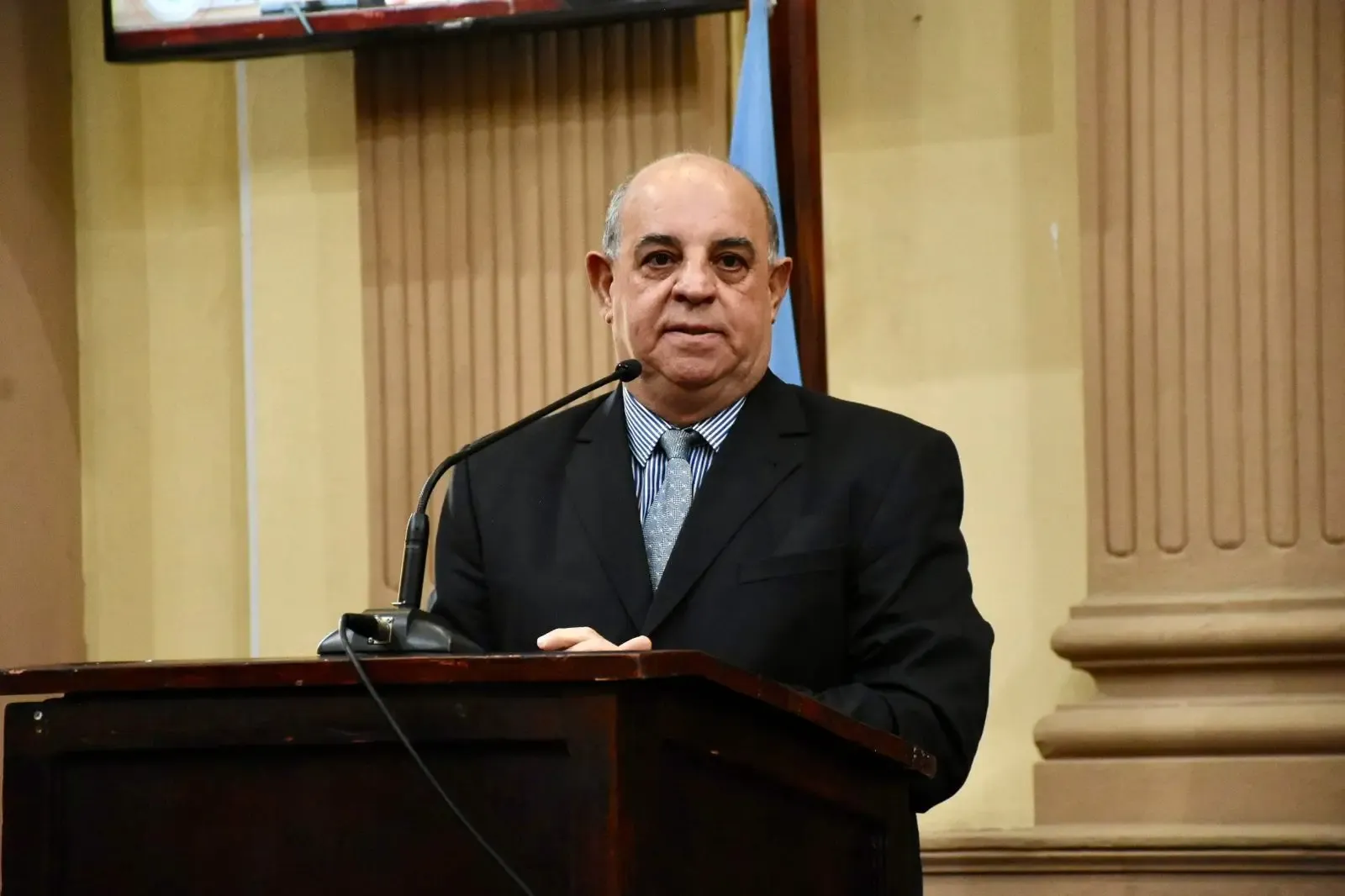
Ricardo Alonso is one of the most authoritative voices in mining and academic matters in Salta. Geologist, writer, he is Emeritus Professor at the National University of Salta, member of the National Academy of Sciences. In addition, he was Secretary of Mining of Salta in two terms and President of the Mining Commission of the Chamber of Deputies. Alonso shares a historical perspective on mining careers in Salta, the dynamics with industry demand, and current challenges.
By Panorama Minero
Does the supply of mining careers in Salta respond to the province’s real productive matrix?
The supply of mining careers has grown exponentially in the last decade. Salta has always been characterized by a strong geology program that started in 1950 and was consolidated in 1952 at the old Faculty of Natural Sciences of Salta when it was dependent on the National University of Tucumán.
And from 1973, with the new programs, hundreds of geologists graduated from this educational institution and applied their knowledge in the prospecting, exploration, and exploitation of mineral deposits in the Andean region. Others worked in groundwater, soils, petroleum, civil works, among many topics of interest in Earth sciences.
The old geologists were essential during the times of artisanal mining. And with the arrival of large investments in open-pit deposits and lithium, new knowledge requirements also appeared. Many decades ago, in Tartagal, a parallel career began in general drilling, first for oil and later for water and mining. Then mining technical programs began to be established, such as the one in Campo Quijano, diplomas and master’s degrees in mining at UCASAL and UNSa, high schools with mining orientation in various schools in the province of Salta, and the supply continued to grow at the pace of the activity’s progress. Many engineering programs also adapted their offerings to the new mining times that the province began to experience.
What gaps do you identify between the profiles trained by the university and those demanded by today’s mining industry?
The mining industry today has technical and environmental characteristics that were unthinkable decades ago. High excellence in all stages and processes. This led to a mutual adaptation between the required profiles and the knowledge taught and shared. It was a process of reciprocal adaptation. Added to this is the paradigm shift in new information technologies. And more recently, the AI revolution. All of this is part of permanent changes and adaptations. No knowledge is sufficient. Everything changes and nothing remains, as Heraclitus told us. A Darwinian adaptation is necessary. We continue teaching with classical academic knowledge. Students have a billion times more information on a cellphone at hand than we had with our stocked libraries, which unfortunately are becoming obsolete.
What role should technical programs have compared to undergraduate and engineering degrees in the Salta mining context?
As I always tell my students, it is important to obtain a degree that certifies possession of the knowledge of the branch or discipline they have developed. I experienced a period of great changes in the time I taught at the university, that is, the last four decades. I went from seeing only men studying geology to an almost complete change toward women. I went from seeing students finishing their degrees on time to others who extended them greatly because they were drawn to work in companies while studying. Some never graduated. Others graduated late. And some are still struggling. I met many students who left university to study technical programs. Some did very well and became competitive in the labor market, but much depended on the personal strength of those students. We also saw how companies hired sometimes students, sometimes technicians, and sometimes professionals according to their convenience. And this is because often a technician can do a good job that saves the company resources. I continue insisting that beyond all paradigm shifts that may occur over time, what matters is academic and professional training, in-depth studies of the subjects, the best possible education taking advantage of new technologies, AI, and all the tools science has put within anyone’s reach. The digital democratization of knowledge.
Do you believe mining education is designed for long-term development or for short-term extractive cycles?
When we teach at the university, we never think in terms of short-term cycles. We know the history and evolution of humanity. All ages of man were based on the use and exploitation of minerals. We know that since the Egyptians and before, that biblical thing of seven years of plenty and seven years of famine repeats, beyond knowing today that it is related to the Nile flood cycles. Not least, the silver that flowed from Potosí depended on the climatic-ocean cycles of La Niña years, because it was when it rained in the mountains and water accumulated in dams that allowed metallurgy and coinage of silver. We also know what happened with the discovery of artificial nitrates that caused devastation in northern Chile, which previously caused the War of the Pacific of 1879 and cut territories from entire republics, or with metals in the great wars. I maintain that we have had mining for more than 500 years and we will have mining for another 500 years. We teach for the long term without thinking about the immediate context. I maintain that a mine never runs out, so it is a mistake to talk about mine closures. There is a key law: when the grade or tenor of mineral exploitation decreases, reserves multiply geometrically.
How do you assess the level of coordination between universities, mining companies, and the provincial government?
That is what we need to talk about. The new mining authorities of the province of Salta are interested in that coordination. Mining companies are as well. There is a universe of topics that can be developed, such as practical field schools, scholarships for training in other provinces or countries, bringing professors from other universities to give serious and controlled in-person or virtual classes, paid internships in mines, funding for theses, professional and doctoral theses, digital repositories with the huge amount of local bibliographic information, etc., etc., in short, as I say, a wide universe.
Do mining companies actively participate in curriculum design or only as labor demanders?
Mining companies give opinions when asked. When they need a specific professional, they look for them and hire them. They do not beat around the bush. Both times I was Secretary of Mining of the province; I tried to ensure that our professionals were the first to work in the province’s mines. Sometimes it happened. Other times our professionals went to other provinces or countries. And Salta was filled with geologists, mining engineers, and other professionals from many provinces and many countries. That is, there is a dynamic that is not easy to regulate. One thing is what is ideally desired and another is the rules imposed by the market.
Is Salta producing its own knowledge in mining?
We have had, have, and will have great professionals trained entirely in our territory with our geological reality. The Andean reality, the great metallogeny of the Central Andes, which we have developed from the root. No one came to teach us anything. We went out to learn abroad. I am very respectful of foreign colleagues who were interested in the Andean structure and contributed their enormous knowledge. But the main developments were “made in house.” I have repeated endlessly that, for example, the entire history of lithium began in the 1970s at the National University of Salta through a geologist, Dr. Antonio Igarzábal, and a chemical engineer, Federico Poppi, both deceased. They left their disciples, and that is the true root of all the history of lithium in Salta. For more data, there are dozens of articles and books that rescue this history.
What potential does the university have to become a key player in applied research on lithium, copper, and other strategic minerals?
It already has it. All the potential given by its people, its students, and its professors in an impressive geological and geographical setting, with the tallest volcanoes in the world and a Puna full of minerals. Large salt flats and mineralized mountain roots. We were the first producers of sulfur and uranium in Argentina. We continue to be for borates. Now fully engaged with lithium, gold, and hopefully soon copper and silver. We have thorium and rare earths. The university’s institutes, both in geology and engineering, have enough brainpower to be key actors in new and future mining.