With an investment of US$559 million, the project moves toward feasibility and aims to become both the first case of metalliferous mining development in Mendoza and the project that puts Argentina back on the world copper map.
By Panorama Minero
The province of Mendoza is shifting its economic history by giving the green light to metalliferous mining as part of its productive matrix. After eighteen years of rigorous legislative scrutiny of Law 7,722, the provincial Legislature granted political approval for the Environmental Impact Statement (EIS) of the PSJ Cobre Mendocino project. The endorsement from the Chamber of Deputies was followed by approval in the Senate, with 29 votes in favor, 6 against, and one abstention.
This marks the first time since the implementation of the law in 2007 that a mining exploitation project involving first-category substances has cleared the political filter established in Article 3 of the regulation.
This political approval allows Mendoza to add a new economic engine to its current productive matrix, which has remained stagnant for more than a decade. This stagnation is one of the key factors that led many social and political actors to shift their stance toward supporting mining development.

The Road toward Feasibility and Construction
With the recent approval, the PSJ project now awaits the enactment of the law that formalizes the EIS. This step authorizes the company to begin the feasibility stage, a crucial technical and economic process.
While the estimated timeline for this stage ranges from six months to one year, the company has already expressed its intention to accelerate procedures as much as possible. This effort aims to shorten the wait before initiating construction of the deposit, a stage they plan to complete within 18 to 24 months.
A Second Attempt
The project, previously known as San Jorge, made progress in this second phase thanks to a clear political decision driven by the administration of Governor Alfredo Cornejo. Support from the provincial government was key to unlocking the process and obtaining approval in both chambers. The legislative approval of the EIS not only validates the project’s environmental proposal but also partially ends the long-standing halt to mining development in the province.
The initiative, focused on producing copper concentrate, moves forward under the framework of Law 7,722. However, the law continues to impose constraints. Even with the possibility of entering production, the project had to forgo its original plan to produce copper cathodes—initially estimated at 25,000 tons per cycle 14 years ago via the solvent extraction and electro winning (SXEW) method. As a result, all oxidized ore is now deemed waste and will be deposited in one of the project’s three waste dumps.
Six Decades of History
The approval of PSJ Cobre Mendocino clearly illustrates what it takes to develop a mining project whose history spans 65 years. Discovered in the 1960s, it underwent its first prospecting and general mapping more than six decades ago.
Since then, a long list of companies has been involved in the deposit until reaching the current design. Valenziano Martínez carried out the initial prospecting in the 1960s, followed by the first diamond drilling by Minera Aguilar between 1964 and 1968. In the 1970s, Exploraciones Falconbridge continued with drilling and mapping, while in the 1990s Recursos Argentinos S.A. conducted reverse circulation and diamond drilling. From 1996 to 1998, Grupo Minero Aconcagua S.A. carried out further drilling and an initial feasibility study. The last campaign before the legislative freeze was led by Coro Mining, with 58 drill holes between 2006 and 2007.
Over these six decades, the project accumulated US$62 million in exploration investment and a total of 33,000 meters of drilling. This exploration, completed before 2007, identified oxide, enriched, and primary mineralization, and allowed the project to reach a pre-feasibility stage and become fully modeled—unique in the province aside from Potasio Río Colorado, classified as non-metalliferous.
The 17-year exploration freeze brought on by legislative changes in Mendoza forced the project, which initially aimed to produce metallic copper, to adapt to a flotation process to produce copper concentrate. Most of the explored ore corresponds to oxides, which can only be processed through leaching—a method prohibited under current legislation—so it will be considered waste. The sulfide ore, explored to a lesser extent, is what enables the current design. For this reason, the initial mine life is projected at 16 years, although new exploration campaigns could extend it.
Corporate Structure and Investment
The initiative is being developed by Minera San Jorge S.A., composed of Swiss company Zonda Metals GmbH and Argentina’s Alberdi Energy.
Total investment prior to feasibility and detailed engineering is estimated at US$559 million. This figure is divided into two key components: US$461 million will go directly to the demanding construction phase, while US$81 million will fund initial operations.
Production
The PSJ Cobre Mendocino project anticipates sustained, long-term production. The mine will produce around 40,000 tonnes per year of fine copper derived from concentrate.
The initial operating horizon is set at 16 years, with significant potential to extend the mine life up to 27 years. More ambitious projections indicate that the project could reach up to 70,000 tonnes of copper in its second year of production.
Technical Details
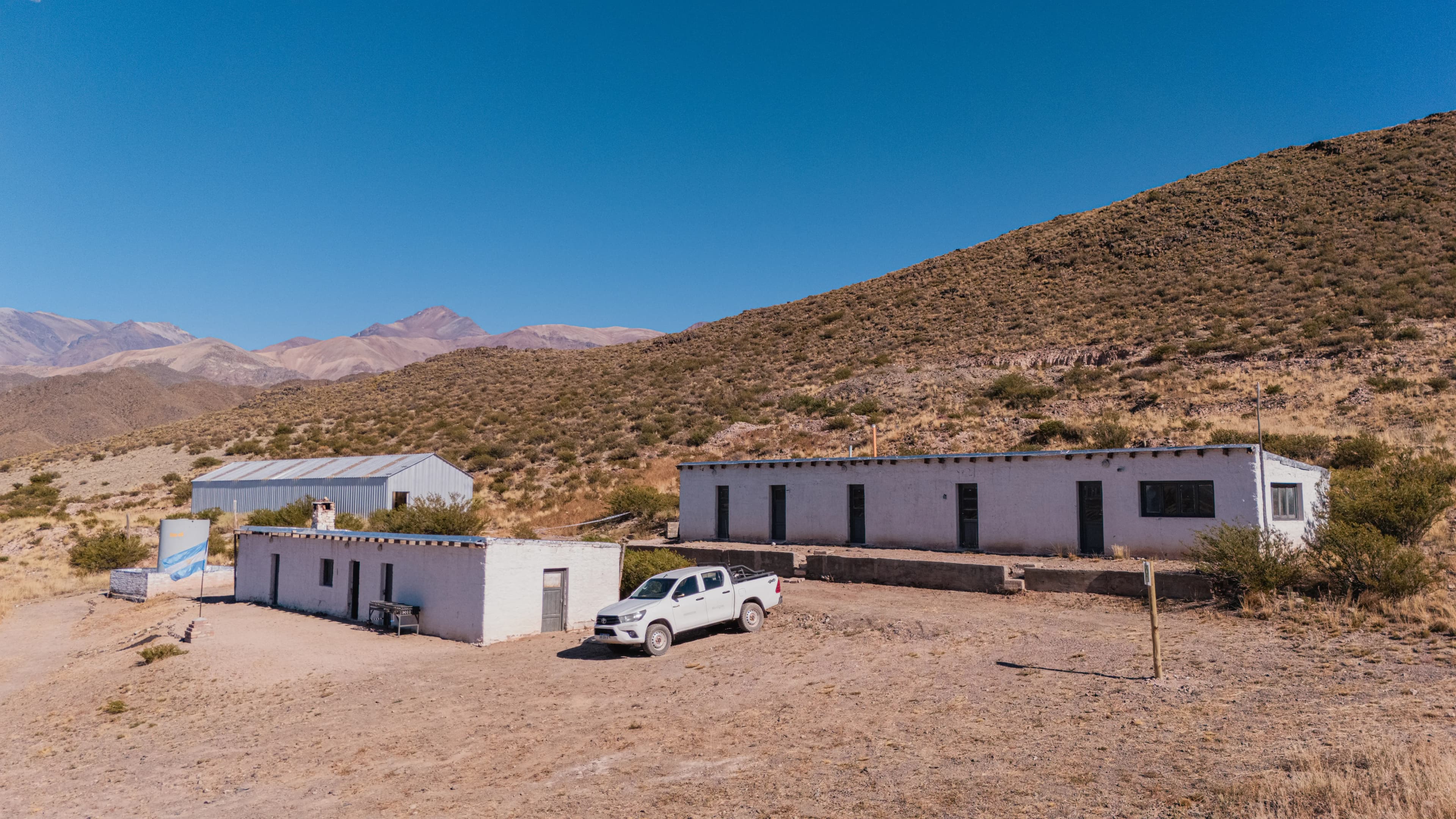
The deposit is located within Estancia Yalguaraz, where the project covers 9,984 hectares of concessions. Geologically, it corresponds to a porphyry system containing copper and gold oxides and sulfides. The average copper grade is 0.47%.
The mining operation is designed as an open-pit mine and follows a structured five-phase production sequence. Process engineering includes a concentrator plant with the capacity to process 10 Mt/year. The metallurgical circuit consists of crushing, grinding, flotation, and filtration, designed to optimize extraction. The final product will be a dry concentrate containing 25% copper and traces of gold. Laboratory tests confirmed high recovery rates: 90% for copper.
Waste Management
For waste handling, the plant will use a tailings storage facility employing thickened tailings technology, achieving 67% solids. This approach minimizes the volume of residual water and enhances the facility’s stability, which will span 216 hectares with a maximum height of 79.2 meters.
Additionally, the project classifies extracted material into three separate dumps—Low Grade, Oxides, and Waste—managing a total of 292.3 Mt accordingly.
Process water will be sourced from the El Tigre stream using a cable-supported intake system. Maximum water consumption is estimated at 141 L/s.