The provincial government redefines cement companies as mineral processing plants and formally integrates them into the mining system, with environmental evaluation under the jurisdiction of the Mining Directorate.
By Panorama Minero
Amid the comprehensive reorganization taking place in Mendoza’s mining sector, one of the less visible—but most significant—movements occurred within third-category mining. There, where the largest physical volume of the province’s mining production is concentrated, the government decided to advance a regulatory redefinition that fully affects a key sector: cement factories, concrete plants, and brickworks.
Through Resolution No. 450 of the Mining Directorate, the provincial government established that these industries are formally considered mineral processing plants, classifying them within the current mining-environmental framework. The measure does not introduce a new activity nor create unprecedented obligations, but it does set a technical-legal criterion that until now was applied diffusely or directly avoided.
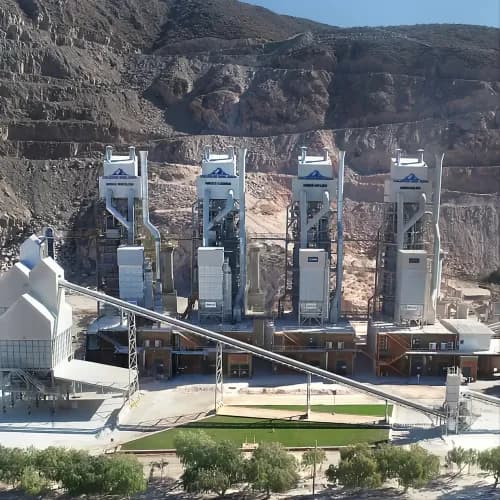
This is a clear signal toward a segment that historically distanced itself from mining classification, especially in the years when the word “mining” was politically uncomfortable in Mendoza. The change is not minor, considering that one of the country’s largest cement plants operates in the province, and that in terms of volume, cement constitutes Mendoza’s main mining production.
What Changes with the New Definition
The resolution is based on a technical report from the Geological Area of the Mining Directorate and a legal opinion reviewing the applicable regulatory framework. It establishes that any activity processing mineral-origin inputs through crushing, grinding, calcination, mixing, washing, or similar operations must be considered a mineral processing plant, even when the final product is manufactured.
The criterion is supported by a solid legal framework: National Law No. 24,585 on Environmental Protection for Mining Activity, the National Mining Code, Provincial Law No. 5,961 on Environmental Preservation, and the Mining Procedure Code of Mendoza. Within this framework, the resolution clarifies that cement factories, concrete plants, and brickworks carry out technical processes that fully fit the definition of mining activity for processing and beneficiation.
The most relevant practical effect is concrete and direct: these industries must submit an Environmental Impact Report (EIR) to the Mining Directorate, formally integrating into the province’s mining environmental evaluation system. From now on, the implementing authority will be the Mining Directorate, rather than other parallel sectorial schemes, representing a significant institutional change.
Additionally, these plants will be subject to the evaluation, monitoring, and environmental inspection mechanisms specific to the mining regime, with differentiated requirements according to processing volume and type of operation, as established in Provincial Decree No. 820/2006.
A Political Signal in the Mining Reorganization
Beyond the technical aspect, the decision has an evident political reading. In reconstructing provincial mining policy, Mendoza began by organizing metallic exploration, strengthening controls, creating environmental management units, and advancing large projects. Now, the same criterion reaches third-category mining, which for years remained in a gray area: neither fully industrial nor formally recognized as mining.
Cement is the clearest example of this ambiguity. Although it depends directly on the extraction and transformation of limestone and clay, its connection with the mining regime was, for a long time, deliberately attenuated. The resolution closes that gap and incorporates the sector into logic of uniform environmental control, with the explicit requirement to submit and update Environmental Impact Reports to the Mining Directorate, without implicit exceptions.
Cement, Mining, and the New Provincial Scenario
The change comes at a particular moment. Mendoza seeks to reposition mining as a strategic activity, with clear rules and effective state control. In this context, keeping the main production volume outside the mining radar was a difficult inconsistency to maintain.
The inclusion of cement plants as processing plants does not redefine the sector but formally integrates it into the mining-environmental framework currently being consolidated. It sends a signal both internally within the government and to the private sector: Mendoza’s mining is being organized as a system, from exploration to industrial transformation, without isolated compartments or implicit categories.
Within this framework, third-category mining ceases to be a peripheral area and becomes an explicit part of the provincial mining map. Cement, far from being an exception, now occupies the technical role it has always held: that of an industrial-scale mining activity, formally recognized and required to comply with mining environmental evaluation procedures before the Mining Directorate.
A Scope That Goes beyond Cement
Although public attention has focused on the cement sector due to its scale and visibility, the resolution is not limited exclusively to cement. The new criterion also applies to brickworks, aggregate processing plants, and other third-category ventures that process minerals through industrial operations.
In all these cases, the key is the same: the obligation to submit an Environmental Impact Report to the Mining Directorate, fully integrating into the province’s mining-environmental regime. In this way, the reorganization not only redefines categories but expands state control over a set of activities that for years operated at the margins of the formal mining system.