Governor Alfredo Cornejo addressed U.S. investors, with the legislative approval of environmental permits as one of the central themes of his presentation.
By Panorama Minero
Alfredo Cornejo spoke at the “US-Argentina Forum on Critical Minerals,” organized by the U.S. Chamber of Commerce, where he presented environmental approvals granted by law as one of the pillars of Mendoza’s shift toward mining.
During his participation in the “Conversation with Governors” panel, he structured the province’s presentation around two areas. On the one hand, business conditions: “low tax pressure, a good business climate, qualified human resources and legal certainty.” On the other, the logistics dimension, supported by access to Pacific ports.
Regarding the regulatory framework, he distinguished between two levels. At the provincial level, he highlighted environmental approvals enacted into law with “very broad majorities.” At the national level, he focused on the Large Investment Incentive Regime (RIGI), which he said provides “predictability and guarantees for developing long-term projects.” In this context, he warned that “there is a window of opportunity that Argentina cannot afford to miss.”
The Framework Supporting the Shift
Among the instruments supporting this shift, he mentioned the amendment of the Mining Procedures Code and the legislative route applied to permits, “approving them by law, providing legal certainty to many exploration projects and to one copper development project.”
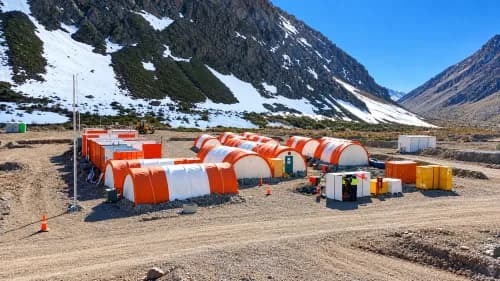
That project is PSJ Cobre Mendocino, developed on a deposit with 50 years of exploration history, as he recalled during his presentation.
Another element supporting this process is PSJ’s admission into the RIGI, approved on May 14, 2026, covering US$613,430,234 in eligible assets, within a reported total investment of US$891 million. The committed schedule establishes the start of construction in June 2027.
Social License: The Definition He Brought Before the Sector
Cornejo described the resistance that still persists toward the activity as “highly ideological, heavily concentrated around myths that have no scientific basis” and, at the same time, “very organized and very persistent,” a reality that, he argued, must be lived with.
Against this backdrop, he questioned the concept of social license itself: “I think this concept of social license needs to be explained very clearly, because what is social license? Half plus one of Mendoza’s population?”
His argument shifted the focus from seeking absolute consensus toward majority support. “The silent majority is not organized, but the silent majority is speaking, and that is why it must be led, and that is the role of politics,” he stated.
He described this stage as “a permanent battle that is not against anyone, but rather in favor of economic growth,” although he acknowledged that “remnants of that cultural battle” still remain.
Among the factors that contributed to the change in sentiment, he included two elements external to his administration: the support of business leaders linked to the agricultural sector, which previously “resisted it” and is now “beginning to support it, beginning to understand,” and the “change in the ideological winds in Argentina following the victory” of Javier Milei.
Mining Within the Productive Matrix
The economic argument begins with a definition regarding the limitations of the current productive structure: “the economy cannot be driven by agriculture alone, by the Pampas alone.”
Within this framework, he identified unconventional oil as one of the current generators of foreign currency and mining as another potential economic driver, while arguing that Mendoza’s traditional activities “must be complemented by others.”
He also incorporated energy into this strategy. “We have once again become an energy-producing province, including clean energy associated with future mining production, such as solar power,” he said.
Infrastructure: His Proposed Allocation of Costs
Regarding infrastructure, he drew a distinction between works for public use or linked to urban development, where government participation may be appropriate, and infrastructure directly associated with project development.
For road and railway projects, he called for an initial contribution from the National Government “so that, with private investment, perhaps as in other countries, initially with a government check (...) some projects that are essential for transporting minerals can get underway.”
As an example, he referred to electrical infrastructure: “The power line in the semi-urban area is being financed by the province, but the remainder of that line, which could even supply power to projects in San Juan through the northern part of Mendoza Province, is being funded by the company itself.”
On the provincial side, the project currently underway is the Mendoza Norte 220/132 kV Transformer Station, for which bids were opened on June 26, 2026, with five offers submitted, an official budget of US$48,657,769 and a 24-month construction period.