The visit by Antofagasta Minerals could mark a change in the Luksic Group’s relationship with Mendoza. The Chilean business family already had a presence in the province through CCU Argentina, the controlling shareholder of Aguas de Origen, one of the companies that sued the Mendoza Government to challenge the decree that kept Paramillos’ Environmental Impact Declaration in force.
By Panorama Minero
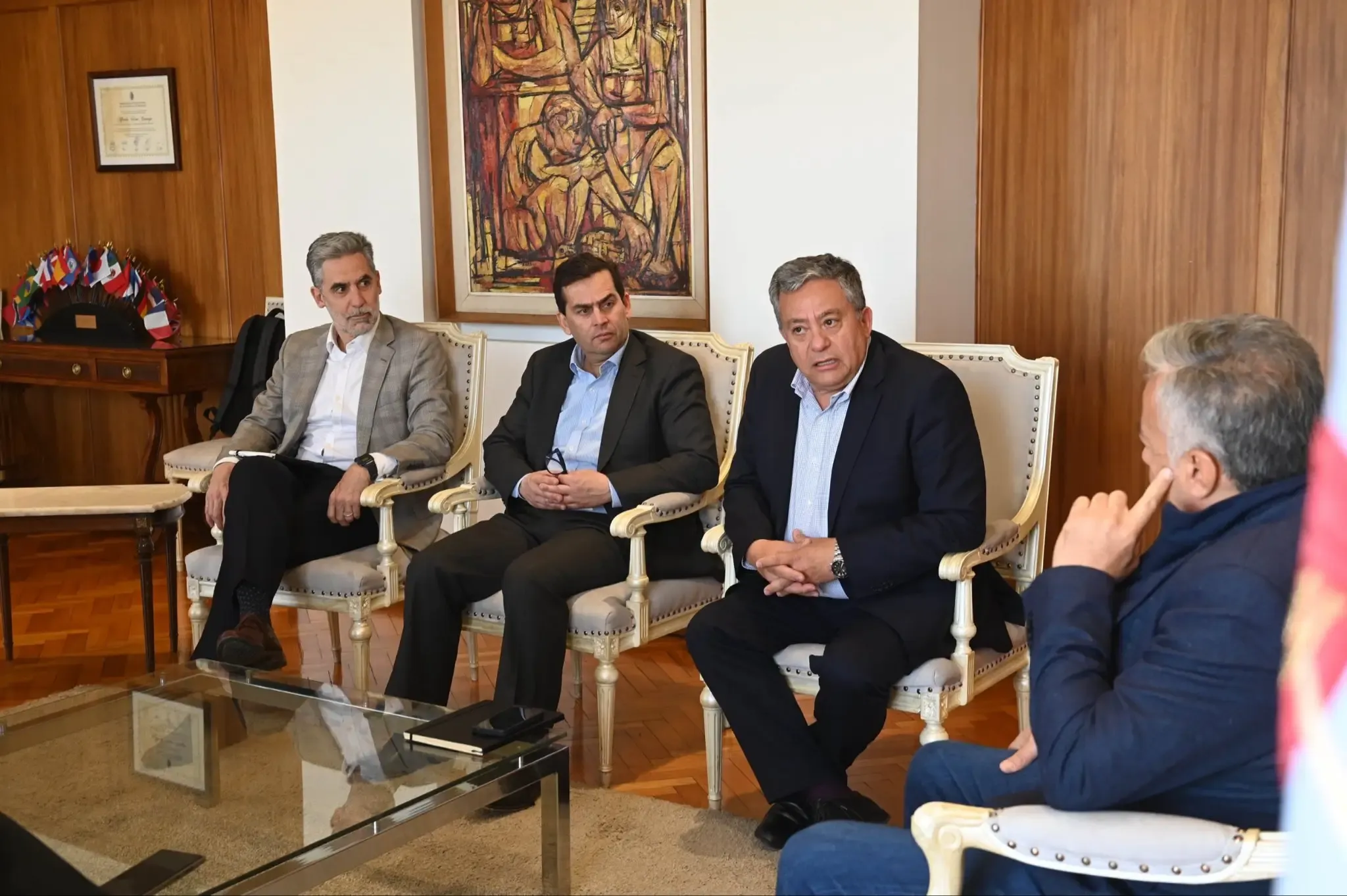
This time, the group presented itself before Alfredo Cornejo through its mining arm. Antofagasta Minerals is the company that gave rise to the Luksic family’s economic expansion, Chile’s largest private copper producer and one of the world’s largest pure-play copper producers.
The meeting changes the public face of the group’s relationship with Mendoza. Until now, its position in the province had been associated with the Villavicencio business and Aguas de Origen’s legal action against the Province. The arrival of Antofagasta Minerals brings into that same relationship a company specializing in the exploration, development and operation of large copper systems.
The Luksic Group Presents Itself through Its Mining Arm
“I met with representatives of Antofagasta Minerals, one of Chile’s leading mining companies, with operations also in Peru, Canada and the United States,” Cornejo said following the meeting.
“Mendoza’s geological potential represents a major opportunity for companies that lead copper production, a strategic mineral for the energy transition. This is complemented by a framework of legal certainty, clear rules and the development of mining districts, all fundamental conditions for attracting investment to our province,” the Governor added.
No investments or interests in specific projects were announced. Nor was it reported whether Paramillos was discussed during the meeting. The significance of the visit stems from the identity of the company and the current stage of Mendoza’s mining reorganization.
Antofagasta Minerals’ producing operations in Chile include Los Pelambres, located in the Coquimbo Region, while Centinela, Antucoya and Zaldívar are located in the Antofagasta Region. Outside Chile, the company maintains projects, properties and exploration activities in Peru, Canada and the United States as part of a growth strategy focused on the Americas.
Paramillos Shapes the Interpretation of the Meeting
The arrival of the Luksic family’s mining arm cannot be separated from the dispute that has kept Paramillos Sur at a standstill. Aguas de Origen, a company controlled by CCU Argentina, is acting together with Aguas Danone de Argentina as a plaintiff against the Government of Mendoza in the case related to the project’s exploration DIA.
The legal action seeks to overturn the decree through which then-Governor Rodolfo Suarez rejected the administrative appeal filed against the provincial resolutions that upheld the environmental approval. The lawsuit is directed against the Province and remains under review by the Supreme Court of Justice.
The Luksic family controls Antofagasta PLC and holds a central position in CCU. Since July 2024, it has controlled Aguas de Origen and consolidates its financial results.
In this way, the group was already part of Mendoza’s mining debate before the visit. However, its involvement had been through a company challenging the Paramillos DIA. The meeting with Cornejo now adds the company that concentrates the family’s mining expertise, copper assets and operating capabilities.
The Company That Built the Family’s Mining Position
The origins of the Luksic family’s business activities are directly linked to mining. Andrónico Luksic Abaroa began building his position in the industry during the second half of the 20th century, initially through investments and acquisitions of mining properties in northern Chile. That process eventually led to the creation of one of the country’s leading private copper production structures.
Today, Antofagasta PLC is listed on the London Stock Exchange and concentrates its mining division in Antofagasta Minerals. During 2025, the group produced 653,700 tonnes of copper, 211,300 ounces of gold and 15,800 tonnes of molybdenum. Los Pelambres accounted for 45% of copper production, Centinela 37%, Antucoya 12% and Zaldívar 6%.
The company closed the year with revenue of US$8.6 billion and EBITDA of US$5.2 billion, equivalent to a margin of 60.3%. In its latest annual report, it ranked among the five leading pure-play copper producers among listed companies.
During the first half of 2026, it produced 285,000 tonnes of copper, 9% less than in the same period of the previous year, mainly due to lower production at Los Pelambres and Centinela. The company expects a sequential recovery during the second half of the year.
Its strategy combines expansion of the districts where it already operates, greenfield exploration and the evaluation of opportunities with third parties. Antofagasta Minerals seeks to focus its growth on the main copper belts of the Americas, with work underway in Chile and Peru and a portfolio that includes Twin Metals in the United States.
Paramillos within the New Mining Landscape of Northern Mendoza
Paramillos is not a dispute involving an area with no previous exploration history. Historical studies identified a copper-molybdenum porphyry system located approximately 80 kilometres from the city of Mendoza and just over 30 kilometres from Uspallata.
Work carried out under the Plan Cordillerano combined geological mapping, geochemistry, induced polarization and drilling. The program completed 25 drill holes totalling nearly 6,000 metres and delineated an anomaly of approximately 4 square kilometres with an average grade of 0.58% copper.
The location has also taken on greater significance with the advancement of PSJ Cobre Mendocino and planning for the Northern Mining District. Mendoza has begun studies to organize an area that could bring together several copper systems around the province’s most advanced project. Paramillos lies within this belt but remains unable to generate new information.
A Relationship Entering a New Stage
Antofagasta Minerals’ visit does not change Paramillos’ legal situation, nor does it allow for the conclusion that the company has an interest in the project.
The change lies in the way the Luksic Group is beginning to present itself to the province. Until now, its position had been expressed through the water business. The meeting brings Antofagasta Minerals into the picture—the company that built the family’s mining position and possesses the technical and financial capacity to evaluate large copper systems.
The rapprochement comes as Mendoza seeks to expand its project portfolio, consolidate PSJ and structure the Northern Mining District in an area where Paramillos represents one of the main geological precedents.