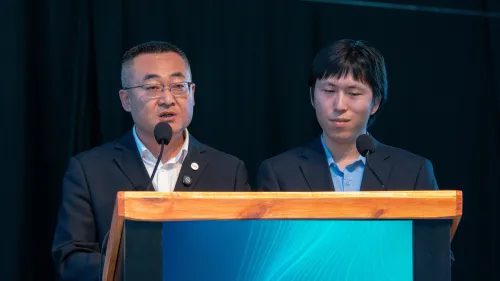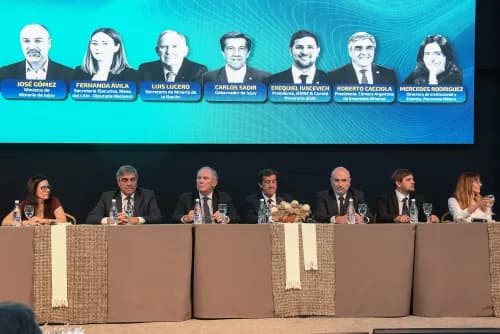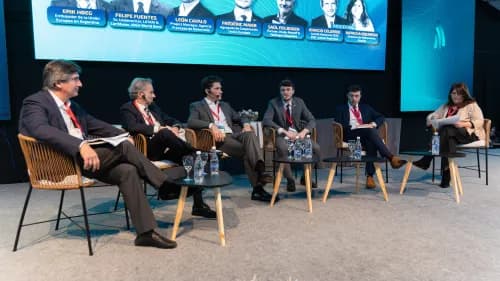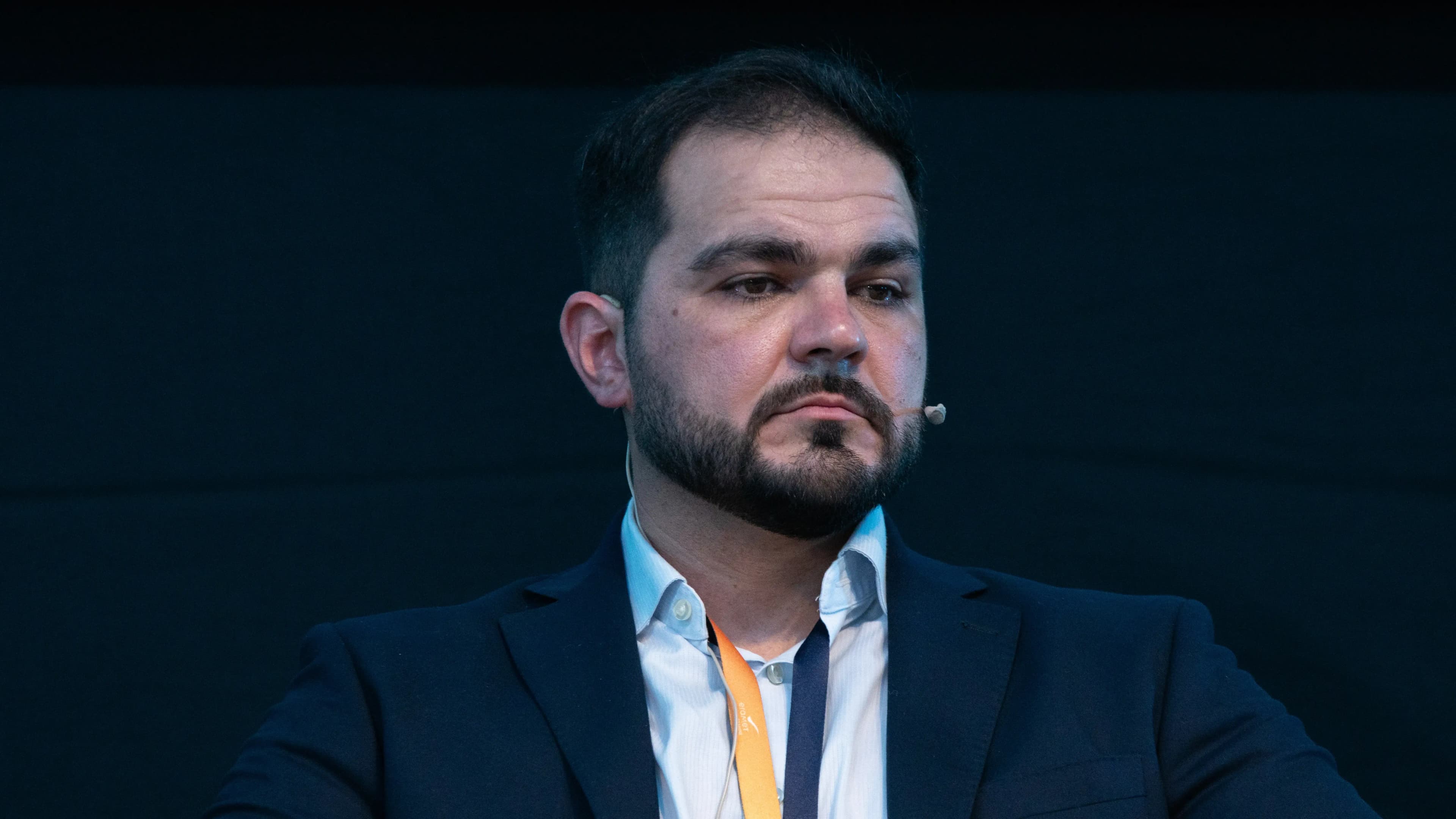
Guillermo Simonutti, COO of Eramet Eramine, highlighted the performance of direct lithium extraction at Centenario-Ratones and explained why the technology will be key to the next expansion. The French mining company is preparing a US$350 million plant expansion.
By Panorama Minero
Direct lithium extraction (DLE) has ceased to be a technological bet for Eramet and has become one of the pillars of its growth strategy in Argentina. The French company has successfully brought its technology to an industrial scale at the Centenario-Ratones project, in the Puna region of Salta, and is now seeking to draw on that experience to move forward with a new expansion phase.
“DLE has arrived to mark a milestone in the way lithium carbonate is produced,” stated Guillermo Simonutti, COO of Eramet Eramine, during the 15th edition of the Lithium in South America Seminar in Jujuy. For the executive, the performance achieved in Salta demonstrates that the technology can support a large-scale industrial operation.
“We are demonstrating that it really is possible to develop the first greenfield project in the Americas that is 100% based on DLE,” Simonutti noted.
Direct extraction technology is one of the main distinguishing features of Centenario-Ratones. Unlike the traditional evaporation method, the process developed by Eramet enables the selective recovery of lithium contained in brine, followed by the production of carbonate.
According to Simonutti, one of the main advantages lies in recovery efficiency. “We are being very efficient in terms of the lithium recovery we are achieving, which has very positive additional operational benefits,” he explained.
The impact on brine use is direct. “With the same number of cubic metres of brine, you can obtain a greater quantity of lithium carbonate,” the executive stated.
This point is particularly important for an industry seeking to increase production without proportionally increasing resource extraction. For Eramet, the experience at Centenario-Ratones now makes it possible to apply the lessons learned during the first phase to an expansion project.
A Technology That Has Moved from Testing to Operation
The path towards industrial-scale production began several years ago. Eramet developed its DLE technology through its research and development division, Eramet Ideas, in collaboration with French technological institutions. At Centenario-Ratones, the group decided to apply the process to a greenfield project from its inception.
The plant was inaugurated in 2024 and became one of the first operations in the region to produce lithium carbonate through direct extraction. At the time, the company reported recovery rates exceeding 90% and highlighted that the process significantly reduces production times compared with the traditional evaporation method.
However, achieving those performance levels involved going through a commissioning phase with technical and operational challenges. “Obviously, that brings major challenges, but they were challenges that, thanks to building a very strong and highly professional technical team, we were able to overcome,” Simonutti explained.
The executive emphasized that the experience accumulated during ramp-up is now an asset for the company. “Today we are very pleased to have the company at the level we have reached,” he stated.
The operating results published by Eramet for the first half of 2026 reflect this progress. Centenario-Ratones produced 8,440 tonnes of LCE, compared with 710 tonnes in the same period of 2025, while sales reached 8,320 tonnes.
In June, the plant reached 90% of its nominal capacity, after averaging 85% during the second quarter. The company also maintained its forecast of producing between 17,000 and 20,000 tonnes of LCE during 2026 and indicated that it expects to approach 100% of nominal capacity before the end of the year.
The operational improvement also had an economic impact. EBITDA for the Lithium Division moved from a loss of €37 million in the first half of 2025 to a positive result of €61 million in the same period of 2026.
The Next Challenge: Expanding a Plant That Is Already Producing
With the first phase progressing, Eramet began looking towards the next step. The expansion project involves adding 11,000 tonnes per year to Centenario-Ratones’ current capacity of 24,000 tonnes.
The prefeasibility study has already been completed, and the company has begun detailed engineering. The expansion is a brownfield development, meaning that it will be carried out at an existing operation that is already producing. This completely changes the technical challenge.
“Developing a greenfield project is not the same as undertaking development with a plant already in production, because obviously we have to continue producing while we expand those facilities,” Simonutti explained.
During Argentina Week in Paris, the company confirmed that it is planning an additional investment of approximately US$350 million for this first expansion and that it will seek to include it under the RIGI. If it moves forward, Centenario-Ratones would increase from 24,000 to 35,000 tonnes of LCE per year, an increase of approximately 46%. The final investment decision could be made towards the end of 2027.
The announcement was made by Christel Bories, Chair and CEO of Eramet, during the Argentina Week programme, following her meetings with Argentine authorities. The project will take advantage of infrastructure, capabilities and knowledge already developed during the first phase, allowing capital intensity to be reduced compared with an entirely new facility.
For Simonutti, the decision to move forward is based on three factors. The first is the resource. “At Centenario-Ratones, we have a resource that is not only abundant and of extremely high quality, but also very well managed and carefully maintained,” he stated.
The second is the team that successfully navigated the ramp-up phase. “We were able to consolidate a team that carried it through and overcame it in an excellent manner,” he said.
And the third is technology. Simonutti highlighted the performance of Eramet’s proprietary process and provided a specific figure: “Today we have DLE units that exceed 90% lithium recovery.”
“When you put all of that together, it creates an ideal situation from the company’s perspective,” he summarized.
The Market Factor and Stability
The executive also introduced an additional variable to explain the decision to accelerate the project: the external environment and the conditions for investing in Argentina. “Today, I personally believe we are in a situation where both the market and the emerging political stability also provide very favourable conditions for accelerating that intention to expand,” Simonutti stated.
The reference comes at a time when Eramet has already moved beyond the construction phase into a period of increasing production and evaluation of new investments. In August, Panorama Minero had reported that the company expected to reach 100% of nominal capacity towards the end of 2026 and had already completed the prefeasibility study for the first brownfield expansion.
The experience accumulated now allows the company to approach the second phase from a different position. “Clearly, today we are much better positioned to undertake this brownfield project, which represents a new challenge,” Simonutti stated.
The challenge, however, will be greater than during the original construction because the expansion will have to coexist with an operating plant. “We have to continue producing while we expand those facilities. So, the technical challenge is much greater,” he explained.
The company believes that the lessons learned during the first phase reduce some of that uncertainty. “We are convinced that we have all the necessary elements to carry it out,” he added.
From 24,000 to 35,000 Tonnes
The expansion announced in Paris does not yet constitute a definitive investment. Eramet has completed the prefeasibility study, is advancing engineering and is seeking to bring the project under the RIGI, while the final investment decision could come towards the end of 2027.
The difference compared with the initial project is that there is now an operating industrial infrastructure, an established supplier chain and a team with direct experience in DLE operations.
Centenario-Ratones required an investment of approximately US$870 million to develop its first phase, with a nominal capacity of 24,000 tonnes per year. The proposed expansion would require a further US$350 million to add 11,000 tonnes.
The immediate objective is to bring the first plant fully up to its nominal capacity while simultaneously preparing the groundwork for the next phase.
This trajectory also explains why technological performance is central to Eramet. If DLE units can sustain recovery rates above 90%, the company can obtain more carbonate from the same volume of brine and use that efficiency as one of the foundations of its expansion. “DLE has arrived to mark a milestone,” Simonutti reiterated.