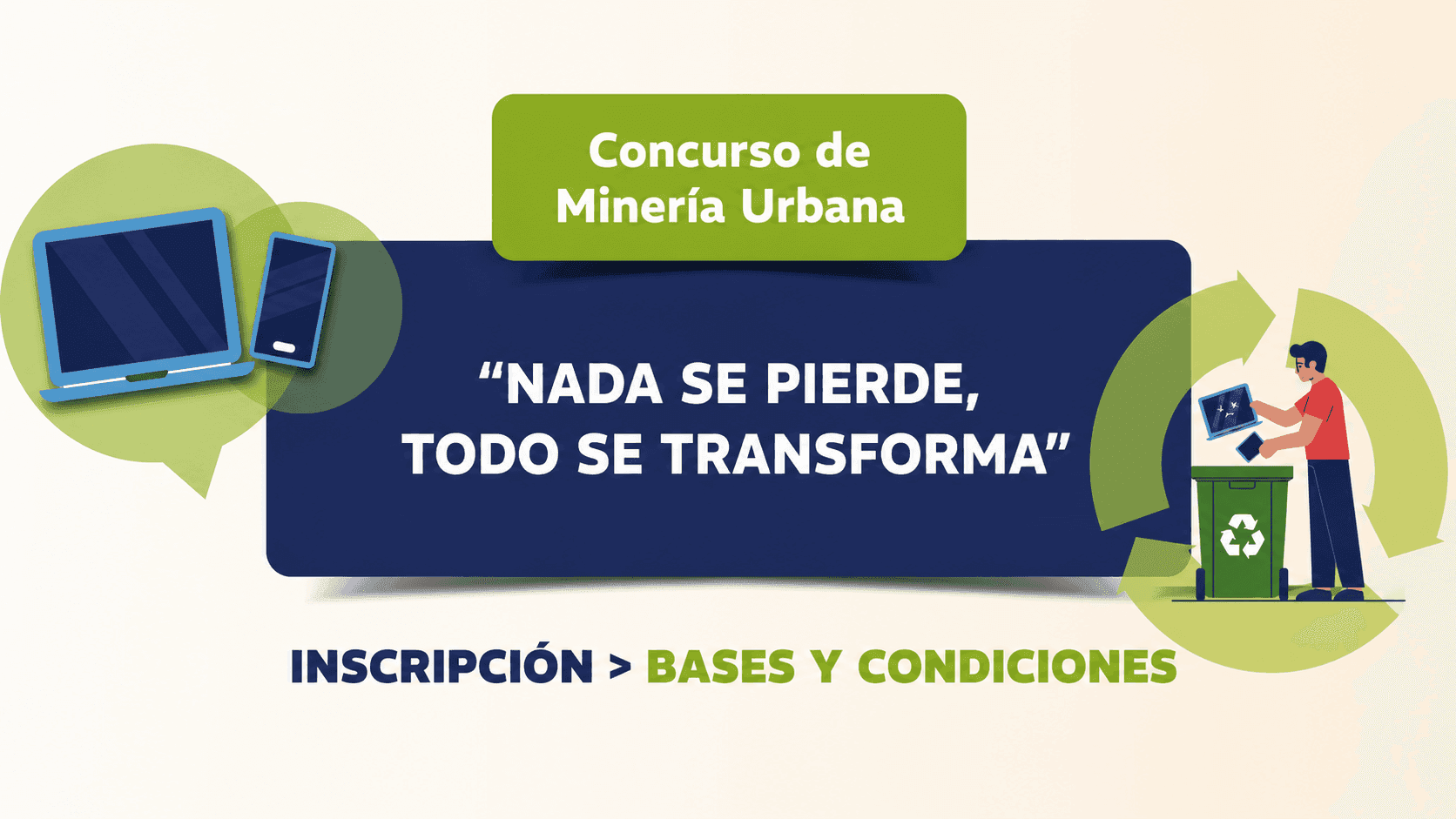
A cell phone, computer or battery contains copper, lithium, nickel, cobalt, gold and other minerals that are essential to its manufacture. Although these materials are present in objects used every day, they are rarely associated with the activity that makes those products possible. This concept forms the basis of the “Urban Mining: Nothing Is Lost, Everything Is Transformed” competition, launched by Mendoza’s Mining Directorate.
By Panorama Minero
The competition invites secondary school, tertiary and university students from across the province to produce audiovisual content on urban mining and waste electrical and electronic equipment (WEEE), with the aim of promoting environmental awareness, responsible waste management and the circular economy. At the same time, it uses these devices as a gateway to understanding that minerals remain part of the production cycle even after equipment is no longer in use.
From Cell Phones to Minerals
Electronic waste contains a wide range of minerals and metals with significant technological value. Copper, gold, silver, lithium, nickel, cobalt and rare earth elements are found in cell phones, computers, tablets, household appliances and numerous other devices used in homes, schools and workplaces.
This is the basis of the concept of urban mining. Unlike traditional mining, which extracts raw materials from natural deposits, urban mining recovers materials contained in waste generated in cities and returns them to the production cycle. The competition rules emphasize that the recovery of WEEE contributes to the circular economy and helps reduce the environmental impacts associated with the improper disposal of electronic waste.
The rules also establish that participants must conduct their own research and produce original content, avoiding the reproduction of existing materials and developing awareness messages aimed at the wider community.
A Resource Gaining Importance
The topic selected by the Mining Directorate reflects a trend that is becoming increasingly relevant worldwide. According to the Global E-waste Monitor 2024, approximately 62 million tonnes of electronic waste were generated in 2022, making it the fastest-growing solid waste stream.
However, only 22.3% of that volume was recycled through formal systems. The remainder represents a significant reserve of raw materials, as this waste contains metals valued at approximately US$91 billion, including copper, iron, gold and other strategic minerals that can be recovered and returned to new industrial processes.
How the Competition Will Work
The competition is open to enrolled students from public and private educational institutions across Mendoza at the secondary, tertiary and university levels. Teams must consist of two to four students from the same educational institution.
Each group must submit a video in vertical format (9:16), with a maximum duration of two minutes, in either MP4 or MOV format. Entries will be submitted through a Google form after completing the corresponding pre-registration process.
Submissions will be evaluated by a panel comprising representatives of the Mining Directorate, sponsoring companies and the WEEE recovery organizations Reciclarg and Traperos de Emaús. Evaluation criteria include relevance to the topic, clarity of the message, creativity, technical quality, and potential impact and reach.
The shortlisted entries will then participate in a public vote through the official Instagram account of the Ministry of Energy and Environment, with the winners determined by the number of “likes” received by each official post.
Timeline
The competition will remain open until August 28. Shortlisted entries will be announced on September 7, when public voting will also begin. Voting will close on September 13, and the winners will be announced on September 15. The awards ceremony is scheduled for September 25.
From Waste to Resource
The competition encourages students to explore what happens to an electronic device once it reaches the end of its useful life. Through their research, participants will identify the minerals contained in these devices, explain why they are important for manufacturing new technologies, and show how some of these materials can be recovered through urban mining.
More than simply producing a video, the initiative encourages students to investigate the origin, use and recovery of minerals found in everyday objects. A cell phone or computer thus becomes more than just a technological product: it serves as a starting point for understanding the relationship between mineral resources, the circular economy and electronic waste management.