The early commissioning of the San Rafael Solar Park, progress on the El Quemado project, and the start of electrical studies for PSJ marks a turning point in energy infrastructure.
By Panorama Minero
Mendoza is ending the year with concrete signals in a historically sensitive area for its productive development: energy infrastructure. The commissioning of new solar parks—one of them under the Large Investment Incentive Regime (RIGI)—and the recent announcement by PSJ Cobre Mendocino about the start of high-altitude electrical studies are beginning to outline a shift in logic: first energy and infrastructure, then large-scale projects.
These are tangible milestones that, taken together, reveal an unusual sequence in the province. Mendoza is not discussing production without first, at least partially, addressing the structural conditions required.
Solar parks in operation: moving from paper to reality
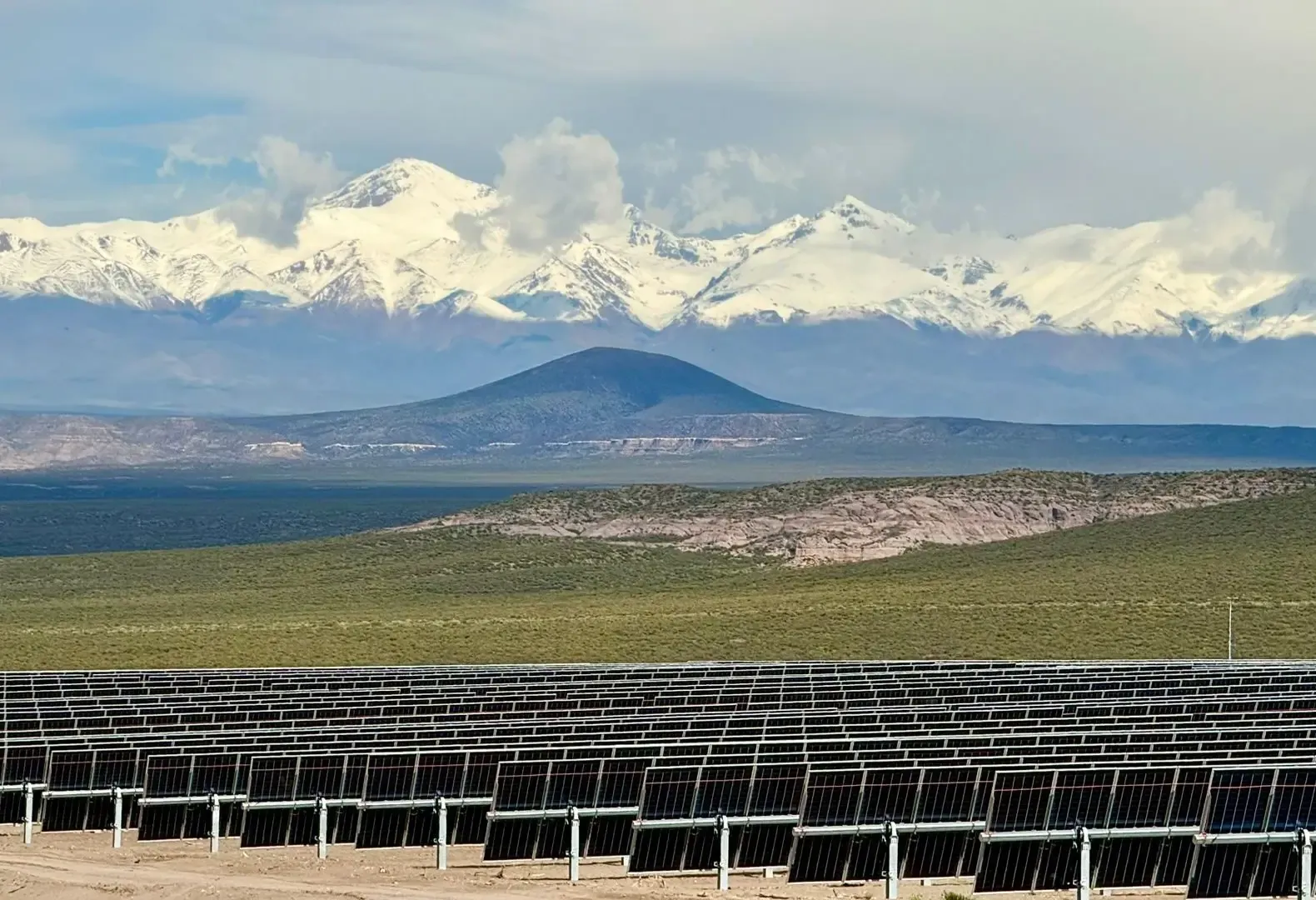
In recent weeks, the provincial government confirmed the early commissioning of the San Rafael Solar Park and the start of generation at El Quemado, the solar mega-project promoted by YPF in southern Mendoza. Both projects add real capacity to the provincial electricity system and consolidate the expansion of the energy matrix based on renewable sources.
The San Rafael Solar Park began operations ahead of schedule with 140 MW online out of a total installed capacity of 180 MW, becoming one of Mendoza’s most significant photovoltaic developments. Developed by Genneia, the project represents a US$180 million investment and strengthens Mendoza’s positioning as a key hub for deploying efficient, large-scale energy infrastructure aligned with energy transition objectives.
The park has approximately 400,000 solar panels and is connected to the grid through the Renewable Energy Forward Market (MATER), supplying renewable energy to private customers.
Meanwhile, El Quemado Solar Park began injecting energy into the national grid with an initial block of around 100 MW as part of its progressive commissioning process. The project has a total installed capacity of 305 MW, which will be added to the Argentine Interconnection System (SADI) in stages, as technical testing, infrastructure energization, and commercial authorization of the remaining photovoltaic modules advance.
Beyond installed capacity or megawatts added, the political–productive message is clear: the first Mendoza project approved under RIGI is not mining or industrial—it is energy. This order is significant. It signals a priority and sends a clear message to investors: before focusing on capital-intensive and electricity-demanding activities, the province aims to strengthen its energy base.
Energy as an enabling condition
In parallel, PSJ Cobre Mendocino announced the start of preliminary studies for the construction of its own transformer station and a high-voltage line to connect the project to the provincial electricity system in the high-altitude Uspallata area. These are engineering studies analyzing routes, voltage levels, connection points, and operational requirements for a future development stage.
Technically, the PSJ project is conceived as an open-pit copper operation with a concentrator plant designed to process around 10 million tonnes per year. The energy demand associated with this productive scheme is significant, in crushing, grinding, flotation, and filtration circuits, requiring advanced planning for electricity supply.
The announcements does not yet imply construction or execution schedules but confirms that energy access is part of the core of the project, even before feasibility studies. Technically, it is a significant signal: energy is not a secondary variable but a structural component of the mining design.
RIGI: energy first, mining later
The official expectation, now taking root in technical and business circles, is that the second Mendoza project to qualify under RIGI will be mining, with PSJ as the main candidate. The sequence—energy first, mining later—contrasts with past experiences, where large projects were discussed without resolving basic infrastructure issues first.
In this sense, the year-end provides a different reading: Mendoza is not accelerating mining but organizing conditions. The operational solar parks and high-altitude electrical studies serve as signals of predictability in a province where, for years, lack of infrastructure was a recurrent argument to halt projects even before technical evaluation.
Energy transition and mining: an inevitable but pragmatic intersection
The link between renewable energy and mining is often presented with slogans. In this case, the intersection is more prosaic and therefore more solid. Modern mining requires stable, traceable, and competitive energy. The energy transition, in turn, demands investment, scale, and territorial planning.
That the first RIGI project in Mendoza is energy-related and the next in line is mining is not about narrative—it responds to a structural need. Without energy, there is no mining; without large-scale productive projects, there is no energy system that justifies certain investments.
A year-end that organizes expectations
Amid national regulatory redefinitions and investment-seeking efforts, Mendoza ends the year showing concrete advances where decades of debate yielded few works. Solar parks are already generating energy, with verifiable technical data and growing installed capacity. PSJ is beginning to address electrical access from early-stage engineering and planning perspective. RIGI is starting to materialize in real projects.
It is not yet a shift in the productive matrix but an ordering of priorities. In a province where mining discussion often precedes material conditions, starting with energy is not a technical detail: it is a long-term political and economic signal.