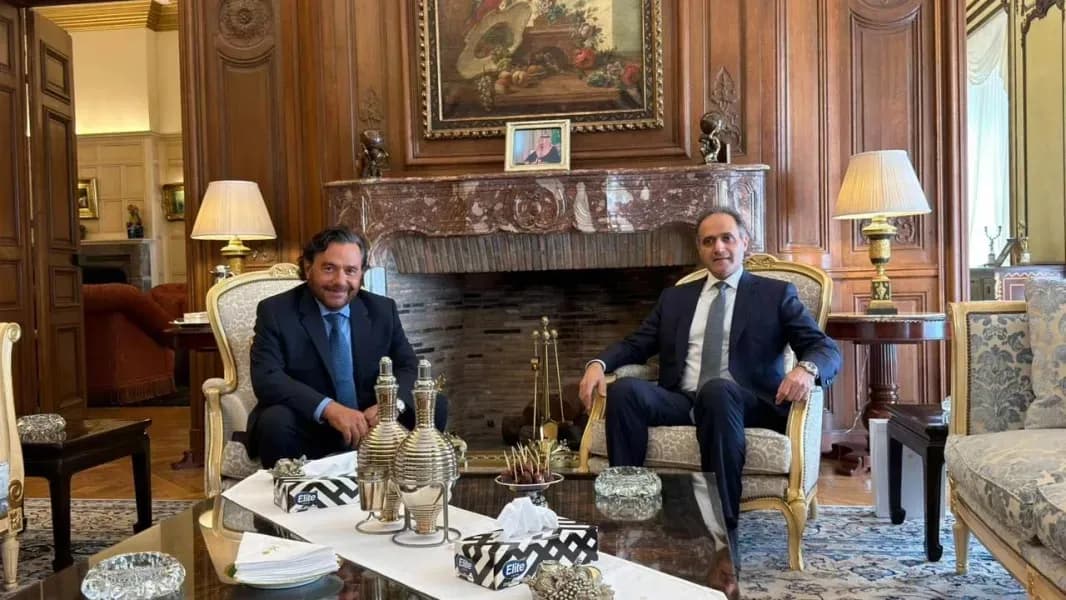
The governor of Salta, Gustavo Sáenz, held a meeting with the ambassador of the Kingdom of Saudi Arabia in Argentina, Hatem Ghormulla G. Alghamdi, with the aim of deepening a bilateral agenda focused on economic cooperation and attracting investment.
By Panorama Minero
The diplomatic meeting took place in an international context marked by the growing centrality of critical minerals. Weeks earlier, Riyadh hosted the fifth edition of the Future Minerals Forum (FMF 2026), under the slogan “The dawn of a global cause,” consolidating itself as a key space for decision-making regarding lithium, copper, and other strategic minerals.
At that forum, the National Secretary of Mining, Luis Lucero, presented Argentina’s strategy to consolidate itself as a reliable partner in the global critical minerals market. According to official data, Argentina’s mining sector closed 2025 with a historic record of exports exceeding US$6 billion, of which metallic minerals accounted for 82% (US$4.948 billion). Lithium reached exports of US$905 million, equivalent to 15% of the total.
This is the backdrop to the rapprochement between Salta and Saudi Arabia. During the meeting, Sáenz presented the province’s productive profile and underlined the guidelines of his state policy, centered on legal certainty, institutional stability, and the promotion of industrial development.
One of the central topics of the dialogue was the mining of critical minerals. The governor detailed the progress of lithium and copper projects in the province, strategic sectors for the global energy transition. Argentina projects that by 2035 it could reach production of 650,000 annual tonnes of Lithium Carbonate Equivalent (LCE), while in copper, official estimates indicate that within a period of five to eight years the country could produce between 1.3 and 1.5 million tonnes annually, based on the entry into construction and production of world-class projects.
In this context, Salta — as a central actor of the NOA and part of the “Lithium Triangle” — is positioned as a key district to attract investments linked to electromobility, energy storage, and electrical infrastructure. In addition, the province has copper projects at different stages of development, aligned with expectations of export expansion.
The bilateral agenda also addressed the export potential of Salta’s food products and technological cooperation in renewable energy.
“Salta has resources, predictability, and a clear development vision. We continue strengthening and expanding ties with the world to promote investment, growth, and more employment for the people of Salta,” Sáenz stated after the meeting.
The governor also highlighted the harmonious coexistence of diverse traditions in the province and the coordinated relationship with communities, in line with a model that seeks to reconcile productive development, formal employment, and international projection. In a global scenario where critical minerals redefine strategic alliances, the rapprochement with Saudi Arabia is part of a broader strategy of active integration of Salta and Argentina into the value chains of the energy transition.