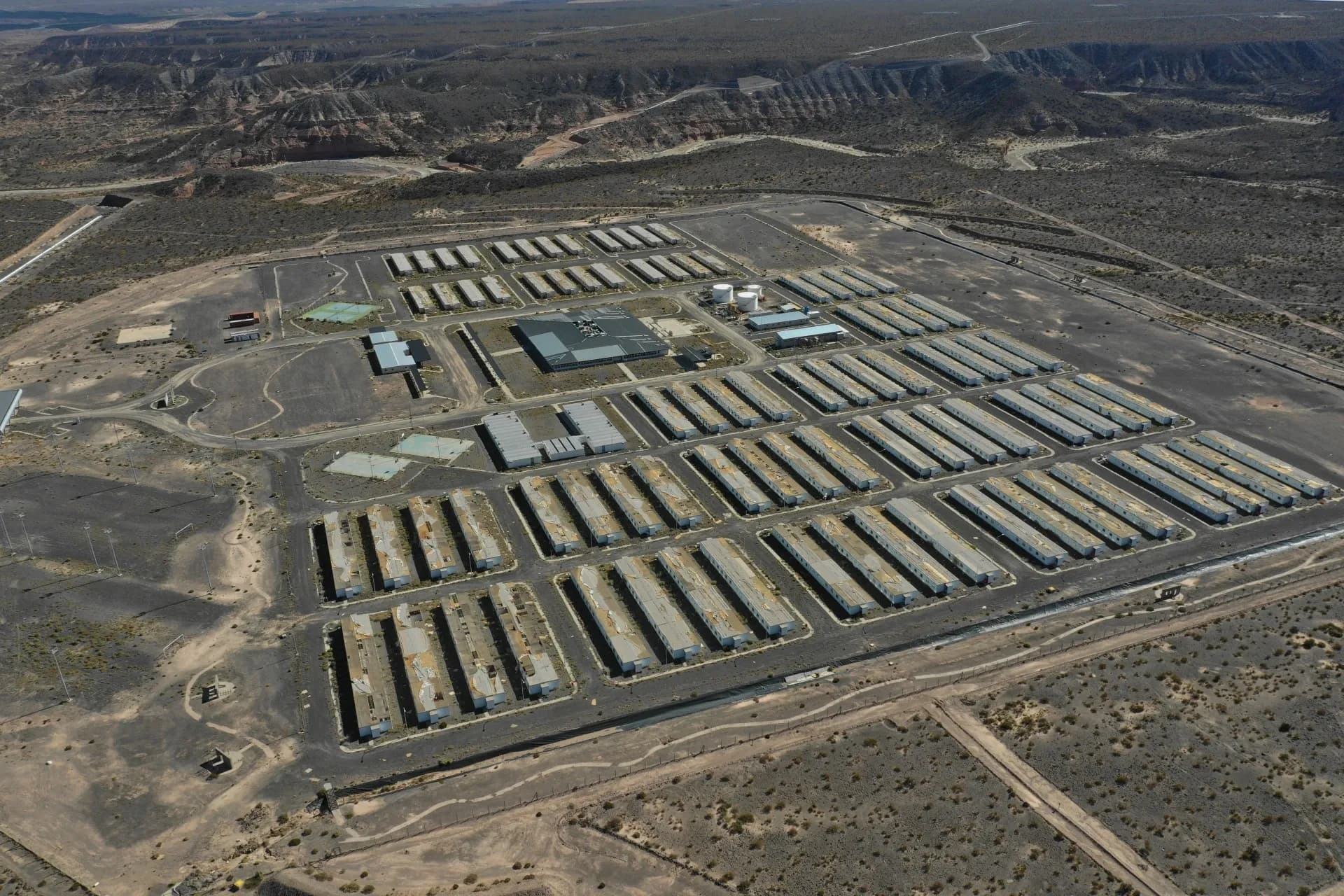
The failed attempt to restart Potasio Río Colorado (PRC) marked a turning point in Mendoza’s mining policy. The process, which did not achieve the committed milestones, led to the departure of Emilio Guiñazú from the leadership of Impulsa Mendoza and opened a new phase in which the provincial government is analyzing what to do with the project, how to adjust the existing contract, and under what conditions PRC could be considered viable again.
By Panorama Minero
From a technical standpoint, the diagnosis is clear. The reactivation contract signed with Minera Aguilar contemplated a staged scheme, with the first key milestone being the development of a pilot potash chloride (KCl) plant. This stage was intended to validate processes, engineering, and costs before progressing to a potential industrial phase.
That milestone was not achieved within the committed timeframe. As a result, the project did not generate the technical information or execution signals necessary to advance to a financing stage or strategic partnership. In practical terms, Potasio Río Colorado remained at a preliminary stage, without the capacity to evolve within the existing contractual framework.
Based on this, the Mendoza Government began an analysis of the agreement’s future, which includes the possibility of adjusting, renegotiating, or redefining the conditions under which the project could continue.
A change of phase at Impulsa Mendoza
The departure of Emilio Guiñazú and the appointment of Sebastián Piña as head of Impulsa Mendoza are part of this process. The leadership change reflects a transition toward a profile more focused on financial structure, risk assessment, and investment attraction, in a context where strategic projects like PRC require stricter decision-making.
Although PRC is not the sole factor behind the organization’s reorganization, its operational failure appears as the most visible precedent that triggered the need to review execution criteria and oversight of large-scale projects.
The global framework: signals from the potash market
The local review occurs in parallel with a reorganization of the global potash market. The clearest reference is the progress of the Jansen project, developed by BHP in Canada. The company confirmed that its first stage is in an advanced construction phase and maintains the goal of starting production by mid-2027, with a capacity of approximately 4 million tons per year.
Beyond volume, the published economic estimates show moderate returns and long timelines, even for a large-scale, integrated infrastructure project. This information reinforces an interpretation gaining consensus in the industry: potash remains strategic, but under stricter supply discipline and with greater price sensitivity.
Implications of this scenario for PRC
This international context does not determine PRC’s fate by itself, but it does tighten the conditions for analysis. In markets with more orderly prices, viability depends more on cost structure and logistical efficiency. In the case of PRC, discussion repeatedly returns to a structural issue: transport infrastructure.
The project’s future appears linked to the comprehensive resolution of logistical issues, which include both the energy supply necessary for sustained industrial operation and, primarily, the feasibility of a rail solution connecting the deposit with exit nodes. Without large-scale, low-unit-cost transportation, PRC’s potash is exposed to pricing scenarios that are not always favorable.
A second project progresses along a different track
While PRC is under review, Mendoza continues the environmental analysis of Potasio CanCambria, driven by Argentina Potash. This is an early-stage project focused on exploration and generation of geological information, following an incremental logic without immediate industrial development requirements.
This progress does not replace the discussion on PRC, but it allows the province to maintain active interest in potash while defining the future of its main inherited asset.
With the failure of the reactivation scheme, the leadership change at Impulsa Mendoza, and a more demanding international market, PRC enters a stage where decisions can no longer be postponed. Potash remains relevant for Mendoza, but the focus shifts from expectation to concrete execution: enforceable contracts, verifiable milestones, logistical structure, and economic realism. Without a rail solution, the margin of viability is reduced; with it, the project enters another category of analysis.