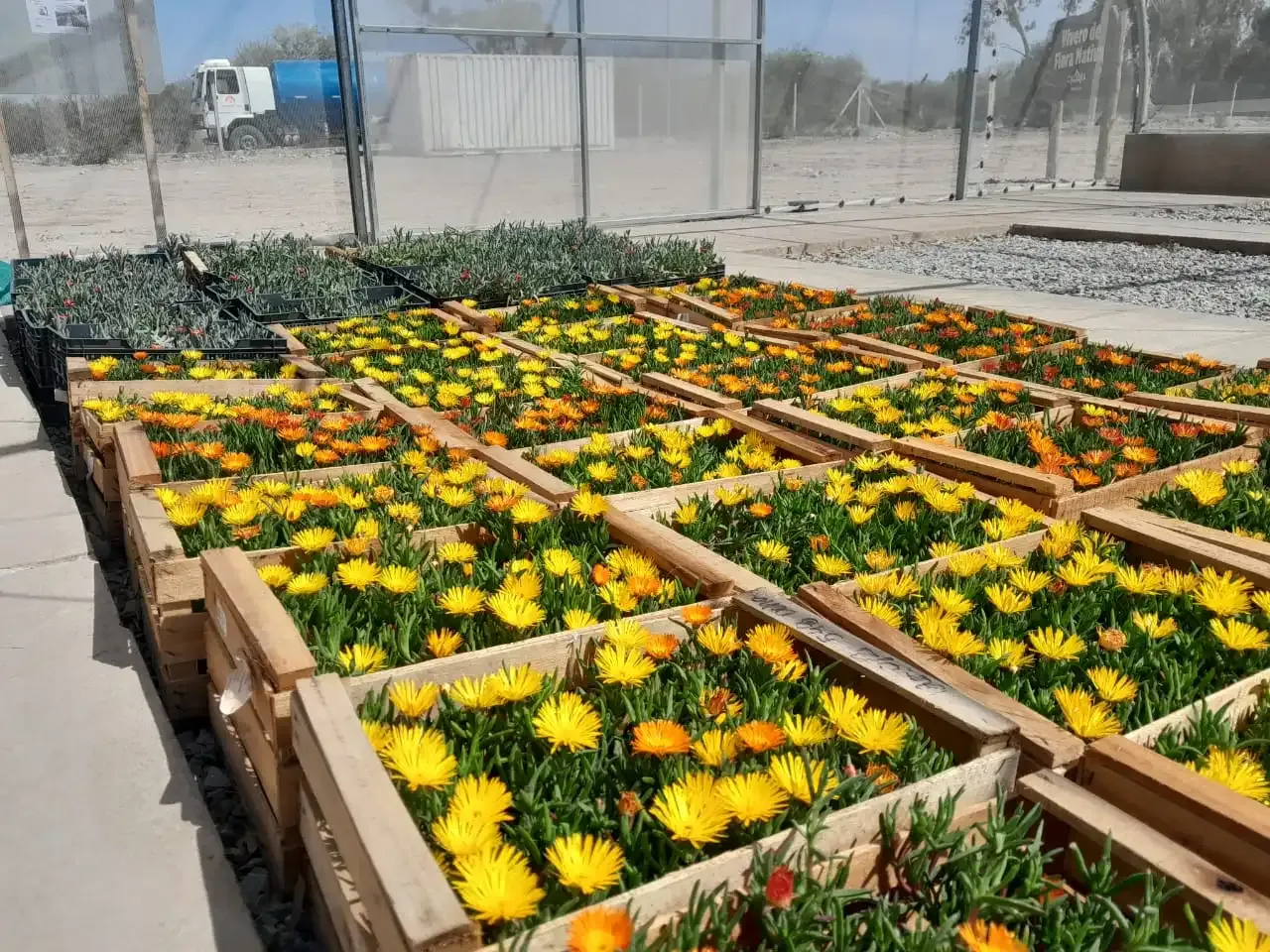
Calidra commissioned a native flora nursery in 2025 in La Laja, Albardón, covering 2,000 m² with a production capacity of up to 18,000 plants. The nursery cultivates native species adapted to the local climate of San Juan for environmental restoration of areas linked to its industrial plant. One year after start-up, more than 3,000 specimens are currently in growth, and the initiative has already enabled reforestation of internal sectors of the site. The project is aligned with Grupo Calidra’s long-term environmental objectives.
By Panorama Minero
In the Albardón department, the company is developing this nursery in connection with its industrial plant in the La Laja district as part of its sustainability strategy. The project focuses on producing native species for ecological restoration of areas affected by industrial operations.
The nursery began operations in early 2025 and is located approximately 7 km from the plant. Site selection was based on logistical and environmental criteria, enabling production of specimens adapted to the climatic and edaphic conditions of the areas where they will be planted. It was conceived as a permanent unit with continuous production cycles, including seed collection, germination, and plant development.
The facilities cover 2,000 m², of which 400 m² belong to the main production greenhouse. The remaining area is allocated to acclimatization, storage, and internal circulation. Technical oversight is led by forester Emiliano Ariel Castro, and the project is integrated into the Sustainable Development area headed by Renzo Emanuel Muñoz.
The nursery currently maintains more than 3,000 plants in growth, along with additional specimens in the germination phase, ensuring biological continuity and availability for future reforestation programs. More than 200 specimens have already been planted in sectors of the La Laja Plant.
Species Selection
Species selection was based on floristic surveys and field studies to ensure compatibility with the local ecosystem. Cultivated varieties include algarrobo species (Neltuma alba, N. chilensis, and N. flexuosa), jarilla (Larrea divaricata and L. cuneifolia), retamo (Bulnesia retama), and cacti such as Tephrocactus sp. and Opuntia sulphurea. The nursery also produces shrubs and ground cover species such as piquillín, olivillo, sampa, and jume, as well as native grasses including Trichloris crinita, used for soil stabilization and rehabilitation of degraded areas.
The nursery design incorporates efficient water resource management. Native species require lower water volumes compared to non-native ornamental species. Irrigation is carried out through a micro-sprinkler system that regulates both application time and water volume. Water supply is sourced from an on-site groundwater well, ensuring operational autonomy and consumption control.
Reforested areas with native flora contribute to carbon storage in biomass and soil, enhance soil stability, and reduce erosion. They also provide habitat for local fauna, improve air quality through particulate retention, and facilitate rainwater infiltration.
The Nursery and the Community
The nursery also serves an educational and community engagement function. Six school visits have been conducted to date, allowing students and teachers to tour the facilities and learn about the production process. Specific educational materials on the life cycle of native plants were developed for primary-level students.
In line with circular economy principles, the company incorporated a wood chipper to process pruning residues into chips used for composting or ground cover. In addition, by-products from the lime production process are reused as components of the growing substrates.
The La Laja nursery project forms part of Grupo Calidra’s environmental strategy. Under the coordination of Regional Manager Andrés Nielson, ecosystem restoration is identified as a tool to advance toward the company’s 2050 carbon neutrality target. The San Juan initiative is projected as a model for replication at other company operations in Argentina and Chile.